
Relics from the Responsa Literature
The Heavens Belong to God: May a Jew Leave Earth?
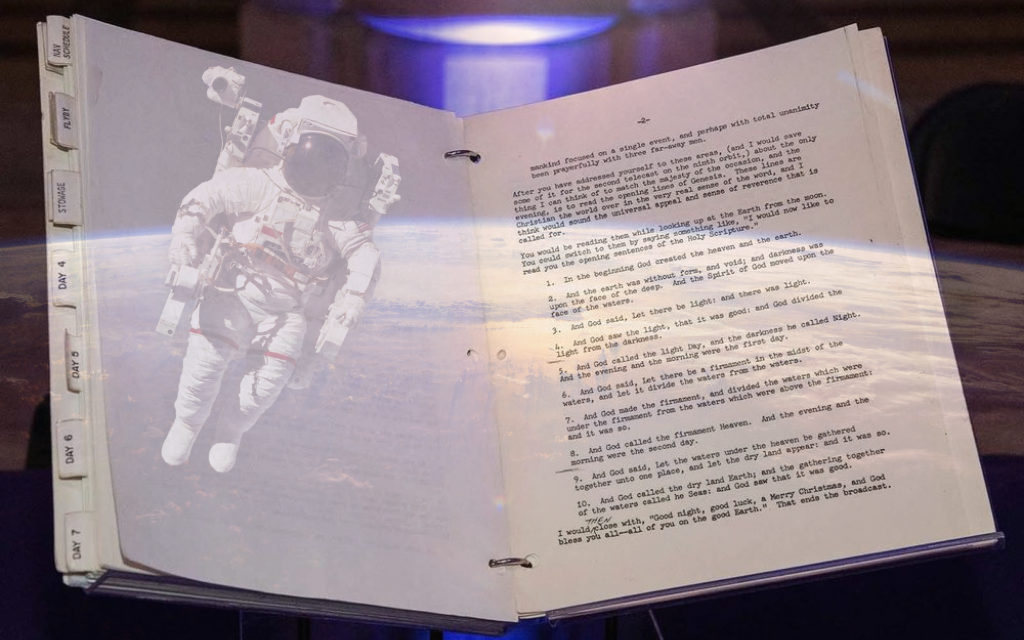
Apollo 8 Flight Plan, Smithsonian’s National Air and Space Museum, Adler Planetarium and Astronomy Museum. Astronaut in Space. Composite image.
Early Space exploration precipitated an interest in how Jewish law might be kept beyond the confines of planet Earth. Before asking how Halakha could be observed in Space, we need to return to an earlier question: whether humans may venture there at all.
Soviet cosmonaut Yuri Gagarin (1934-1968) was the first person to reach outer Space when he completed one orbit of Earth on 12 April 1961. Less than two weeks later, on 24 April, a correspondent wrote to the leader of Lubavitch Hasidism, Rabbi Menachem Mendel Schneerson (1902-1994; known by the acronym Ramash before he became rebbe), about the permissibility of Space exploration according to Jewish law. Then, on 5 May, Alan Shepard (1923-1998) became the first American astronaut to reach Space. Three days later, on 8 May, the Lubavitcher Rebbe wrote his responsum in English.
****
The Human Realm
As per standard practice in the responsa literature, the Lubavitcher Rebbe opened his letter regarding Jewish law and Space travel by restating the question:
I received your letter of April 24th, in which you write about the apparent contradiction between the latest scientific attempts to penetrate outer space, especially reaching the moon, which seems to you to contradict the statement in the Torah, ‘The Heavens belong to G‑d, and the earth He gave to the children of man’ (Psalms 115:16).
The transcription of the letter does not identify the recipient; an authenticated original document is not publicly available. An annotated series of the Lubavitcher Rebbe’s English correspondence is being prepared (though its announced inaugural volume covers 1950-1951). While at this stage the correspondent’s identity remains unknown, that information may yet come to light.
The questioner doubted whether Jewish law permitted Space travel, as the biblical verse seemed to limit the human realm to Earth. Rabbinic authorities would soon ponder whether Jewish law applied in Space, on the Moon, and beyond, as well as how it should be observed. The Lubavitcher Rebbe, however, was tasked with a preliminary question: Does Halakha permit humans to try to get to the heavens?
Unsurprisingly, this question had not been raised in classic halakhic literature. Leaving Earth had just become a real possibility, and with Space travel making headlines, this question was now relevant. It should be noted, however, that it was a theoretical question: Jews were yet to take to the heavens, and Space agencies were not publicly consulting rabbinic authorities. For this correspondent, the question concerned the permissibility of exploration rather than instructions for an impending Jewish Space flight.
****
Heaven or the Heavens?
In his response, the Lubavitcher Rebbe employed a classic interpretive technique from the legal process – distinction:
Actually there is no contradiction at all, if you consider the term ‘earth’ not in the narrow sense referring only to our globe, but in its proper sense, as meant in this verse, which includes also the atmosphere and the whole physical universe, with which mankind is concerned and directly affected by. We must not confuse the terms Heaven and the planets. The stars, planets, moon, etc. are not called Heaven, since Heaven is something spiritual, whereas those planets are physical and belong in the physical universe.
For the Lubavitcher Rebbe, this biblical verse presented no halakhic obstacle to Space exploration. Although the verse seemed to suggest otherwise, he distinguished between the physical universe – “earth” in his reading of the psalm – which is the territory of humans, and the divine spiritual realm of “Heaven” that is beyond human dominion. He then continued, justifying human attempts to learn about celestial bodies and framing the quest to reach the Moon as a legitimate scientific pursuit.
The Lubavitcher Rebbe’s assertion that “We must not confuse the terms Heaven and the planets” may not be as clear-cut as it sounds. The Bible uses the same Hebrew term, shamayim, to refer to the spiritual realm and to the physical sky. Thus, for example, during the dedication of the Temple in Jerusalem, King Solomon asked God to heed the prayers of the people when they are faced with drought:
Should the heavens be shut up and there be no rain, because they have sinned against You, and then they pray toward this place and acknowledge Your name and repent of their sins, when You answer them, oh, hear in heaven and pardon the sin of Your servants, Your people Israel, after You have shown them the proper way in which they are to walk; and send down rain upon the land that You gave to Your people as their heritage (I Kings 8:35-36, Revised JPS 2023).
The same Hebrew word, shamayim, is used in these adjacent verses for the shuttered sky that does not provide rain and for God’s abode where prayers are received. In English, capitalisation can help signal this distinction, differentiating between God’s domain in the spiritual “Heaven” and the physical “heaven”. Usage varies, however: the translation quoted here uses lowercase throughout, distinguishing instead between the plural “heavens” for the sky and the singular “heaven” for God’s abode. Hebrew has no distinction between upper and lower case, and the word shamayim has no separate singular form, so readers must rely on context. Hence the force of the original question: If the term shamayim can refer to the physical realm, then perhaps the biblical declaration that the shamayim belong to God suggests that Space travel is prohibited?
By clarifying the original question, we can appreciate the Lubavitcher Rebbe’s interpretive move to distinguish between Heaven and heaven. It may seem like an obvious distinction, but it needed to be laid out.
****
Truth and Torah
The Lubavitcher Rebbe concluded his brief discussion with a theological axiom:
There is nothing in actual scientific experiments and accomplishments that contradict the Torah, nor is there such a possibility since the Torah is Truth.
Like other rabbinic respondents who would follow, the Lubavitcher Rebbe was well aware that Space travel did not just pose questions of Jewish law; the new frontier raised existential issues that cut to the roots of Jewish theology.
The letter closed with a personal exhortation, encouraging the correspondent to observe Jewish law and continue advancing in religious practice:
Judging by your writing and background, I firmly hope that you are conducting your daily life in strict accordance with the Torah, which is called Toras Chaim, the Law of Life, and the Mitzvahs whereby Jews live, and that you attempt to make steady advancement along this road, in compliance with the principle that ‘all things of holiness should be on the upgrade.’
****
Moonward Bound
A few weeks after the Lubavitcher Rebbe’s letter, the Space Race moved up a gear. On 25 May 1961, US President John F. Kennedy (1917-1963) addressed the US Congress on “Urgent National Needs”. He declared:
I believe that this nation should commit itself to achieving the goal, before this decade is out, of landing a man on the moon and returning him safely to the earth.
The mission was no longer just crossing the Kármán line – a conventional boundary of outer Space, 100 km above mean sea level. The edge of Space had already been reached; the objective now was a lunar landing.
Apollo 8, launched from Florida on 21 December 1968, was the first crewed mission to leave Earth orbit. The spacecraft orbited the Moon ten times over some twenty hours. On Christmas Eve, during a television broadcast from lunar orbit, astronaut Bill Anders (1933-2024) opened with these words:
We are now approaching lunar sunrise, and for all the people back on Earth, the crew of Apollo 8 has a message that we would like to send to you.
The message was simple yet profound: the crew read the first ten verses of Genesis from the King James Bible, ending with the words “and God saw that it was good”. They then signed off wishing everyone a Merry Christmas, adding, “and God bless all of you – all of you on the good Earth.”
****
Spiritual Mission Accomplished
The Lubavitcher Rebbe discussed the Apollo 8 mission at a public Shabbat farbrengen (Hasidic gathering) on 28 December 1968 – a day after the spacecraft returned to Earth. He reflected on lessons that could be drawn from this momentous occasion. In the Lubavitcher Rebbe’s eyes, this was an opportunity to strengthen faith.
The Lubavitcher Rebbe noted that Apollo 8 had splashed down on Friday, an event that captured global radio and television coverage just as Jews were preparing for Shabbat. Rather than dismiss the spectacle as something that disrupted Shabbat preparations and interrupted the sacred rhythm of Jewish life, he advocated considering what had transpired and drawing spiritual and religious lessons.
According to the Lubavitcher Rebbe, Space exploration was an opportunity to grasp the vastness of creation, which in turn should lead to a sharper realisation of the Almighty’s infinitude. Moreover, thanks to the Space perspective, people could gain a deeper appreciation of God’s rule over the universe. The Lubavitcher Rebbe explained the point with a parable: A king who reigns over a small country cannot be compared to a king who reigns over a great country, and the King who reigns over Space is on a different level altogether. Contemplating God’s dominion over the universe should inspire awe.
The Lubavitcher Rebbe further observed that not too long ago, Space travel had been considered impossible. It had been thought that a spacecraft could not travel at such speeds without breaking apart or burning up. This – he opined – should trigger a sense of humility: what we think we know may soon prove to be otherwise, as human intellect continues to grow and arrive at new understandings.
****
In the following years, the Lubavitcher Rebbe would revisit the issues of Space and Judaism in private communications, in talks to his faithful following, and in public interviews. The foundations for his approach were laid in real time, as the world experienced the nervous excitement of the Space Race.
According to the Lubavitcher Rebbe, Space exploration was permitted according to Jewish law. More importantly, this new scientific frontier was an opportunity to deepen appreciation of the Divine, cultivate intellectual humility, nurture spiritual growth, and strengthen fidelity to Jewish tradition among those entrusted with the Earth.
Related Topics
Related Posts