Choosing life is the only way forward
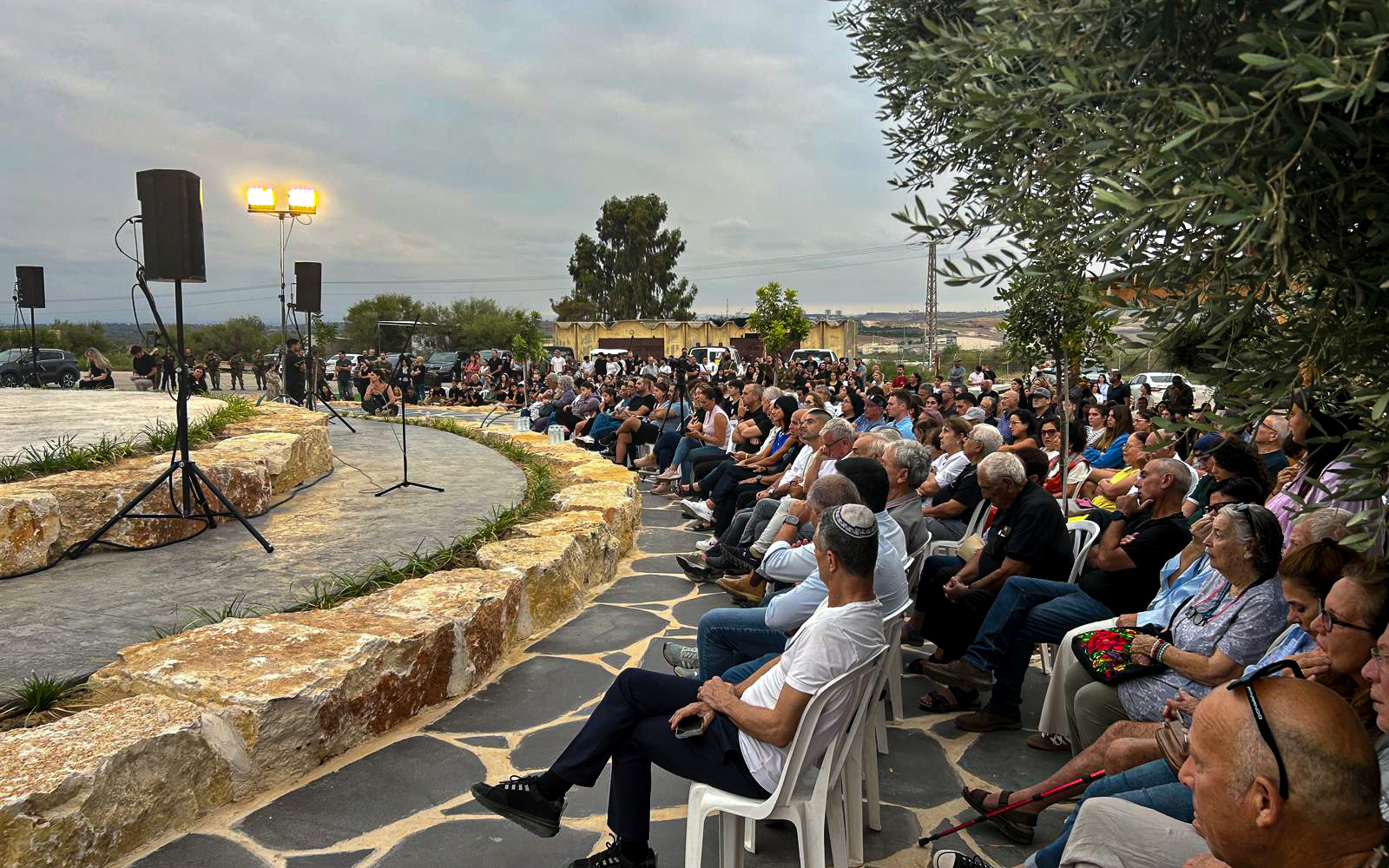
The “Garden of the Twenty” in Netiv HaAsara, nestles “peacefully” between two 10-meter high concrete walls, features 20 olive trees and a massive Israeli flag, purportedly the biggest in the country. Each tree memorializes one of the 20 community members murdered on October 7, 2023 when Hamas terrorists paraglided into the moshav.
It was here that I, along with 40 students and faculty members from across the political and religious spectrum at the Pardes Institute of Jewish Studies, met with longtime peace activist Roni Keidar, who lives in Netiv HaAsara with her husband and three of her five adult children and their children. We were here as part of a trip to the south on the 24th of Tishrei, Israel’s official day commemorating the October 7th attack.
When asked directly about her experiences on the morning of October 7th, Keidar details how they sat locked in their safe room and got WhatsApp messages from her grandchild not to call so as not to expose their hiding place as terrorists roamed their house. But what she really wants to talk about is her journey as a peace activist, slowly building relationships over the course of decades with Egyptians and Palestinians after Israel’s withdrawal from Sinai in 1982 forced her and her community from their homes in the original Netiv HaAsara. Before the Intifada, she developed close connections with her Gazan neighbors. And in later years, she drove Gazans to the hospital and continued to foster connections by way of WhatsApp and social media despite the border fence. Remarkably, she says many of those personal connections remain even after October 7. Palestinians are themselves victims of Hamas, she insists.
In addition to meeting with Keidar, our trip included some of the “standard” destinations in the Gaza envelope area —a look out at Gaza, a visit to Sderot, with a stop at the police station memorial, the car memorial at Tekuma, the site of the Nova festival. Students and faculty shared their own personal stories from October 7—wherever they were in the world, everyone was impacted profoundly. For many, these experiences motivated them to explore Israel and Jewish tradition on their own terms.
Perhaps not surprisingly, our armed medic had also spent the last two years fighting in the war, but he insisted that he is “not a hero.” Reluctantly, he agreed to share a bit of his experiences. An off-duty soldier at the time of the attack, he nevertheless rushed south with his weapon on October 7, attempting to help his friends who were trapped at Nova. Later, while fighting in Gaza, he was badly injured when his armored vehicle was hit by RPG fire. With barely a pause, he rattled off the names of each of his fellow soldiers who had died that day. We were without words.
We closed the day with the privilege of paying a shiva call to the Perez family in Yad Binyamin, a small town known as a place of refuge for evacuees of Gush Katif. Their son Daniel had been killed in battle on October 7, and his body was taken from his tank to Gaza. His was one of the first four bodies returned in the exchange just two days before our visit. We had prepared a card, imagining that we would spend a few anonymous minutes in the back of a large hall along with more than a hundred others. To our surprise, Rav Doron Perez cut short conversations with friends to address us directly in English. He spoke briefly about Daniel and his brother Yonatan who was also injured in battle on October 7. Having one son missing and the other injured at the same time is uniquely harrowing. But what Rav Perez really wanted to talk about is what makes us special as Jews. While Hamas’s theoretical concern for the “entire” Palestinian people results in their caring for no one, what makes the Jewish people “chosen” in his words, is our steadfast commitment to every one — each individual. What matters to Rav Perez is the unity of the Jewish people going forward in their fight against evil.
Both Keidar and Perez would have been justified in crying and screaming as victims, but instead they preferred to focus on their blessings and work to build a better future. As Holocaust survivor Victor Frankel wrote: “Between stimulus and response lies a space. In that space lie our freedom and power to choose a response. In our response lies our growth and our happiness.” Keidar and Perez demonstrate their freedom by responding to evil with hope and determination. Their approaches may differ from one another, but they share a fundamental commitment to building a better world and Israeli society.
Thirty years after the assassination of Yitzhak Rabin, our society is more torn than ever by polarization and distrust of the “other.” Yet it is the brave resilience of people such as Perez and Keidar that points the way forward. May we have the courage as a people to join them and commit ourselves to setting aside hatred and victimhood so that we may build a better future together.