Life Member, Hadassah Westchester, Hadassah Writers' Circle
For Father’s Day: My Dad’s Life of Curiosity and Hospitality
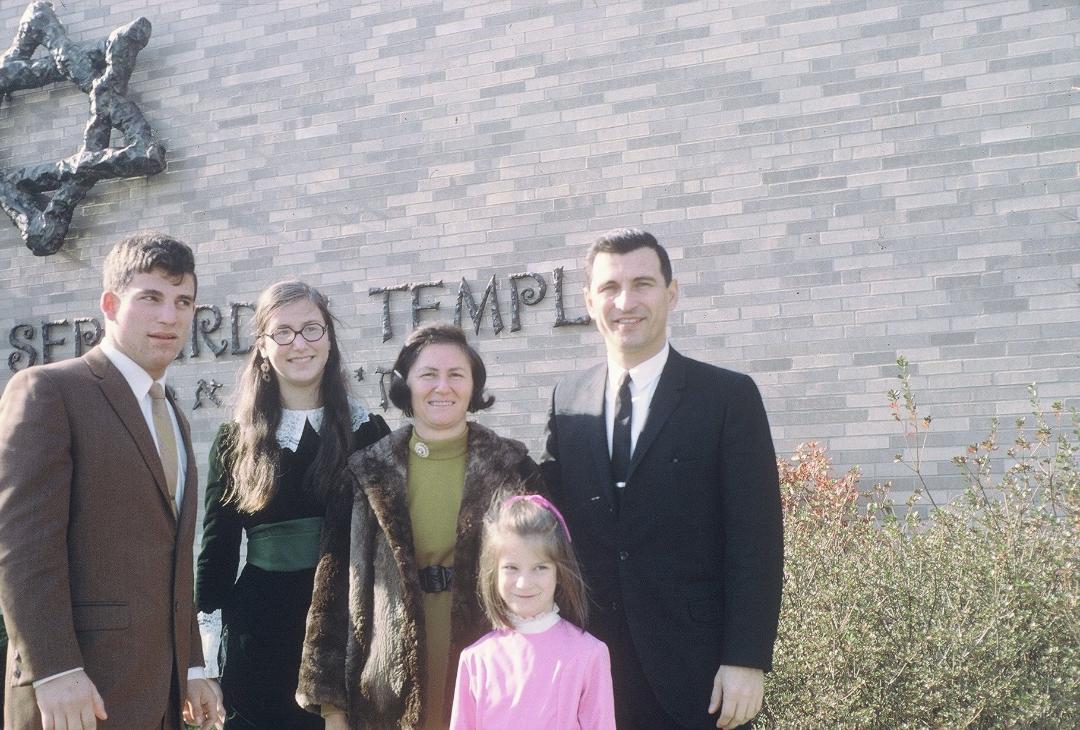
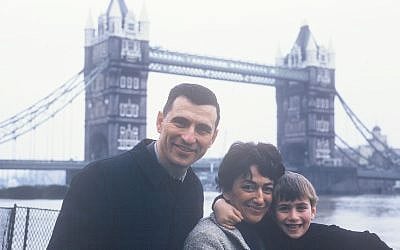
The author's family photographed in 1968: Steven, Michele, Dorothy, Janet, Howard Braun. Photo courtesy of the author.
My father really enjoyed Hadassah Magazine. As a dyslexic, he read slowly and also very carefully. As an intelligent individual, he had a significant vocabulary and particularly appreciated well-written and well-thought-out articles. I suspect he read each issue more closely than did my lifetime Hadassah member mother. My parents also enjoyed traveling — to see new places and to visit old friends. Not surprisingly, the Hadassah Magazine articles that highlight Jewish communities around the world were a favorite feature of theirs.
A number of years ago, my husband, daughter and I traveled to Spain on a trip that included a number of historic Jewish cities and sites, including Maimonides’s Cordoba, Nachmanides’s Girona and stunningly beautiful synagogue buildings that had been converted to other uses after the 1492 expulsion of Jews from Spain.
In one small town, we unexpectedly came across an excavation, la Sinagoga del Agua (the Synagogue of Water), where a subterranean mikvah (ritual bath) and other indications of hidden Jewishness had been found. So, as delighted Jewish travelers, we took the tour.
My father, rarely a cynic, later observed that Spain seemed happy to market its antisemitic past to attract Jewish tourist dollars. This put a whole new spin on my travel thinking. Rarely, almost never, had we visited Jewish sites when we traveled domestically or internationally. Except, of course, in Israel or when traveling for b’nai mitzvah and weddings.
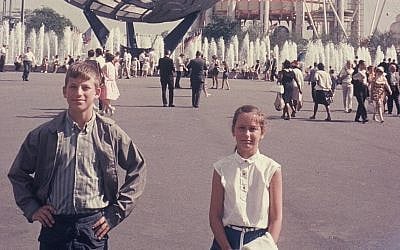
When I was 11 or 12, we drove cross country and stopped at the US Air Force Academy campus in Colorado. For the next 40 years, my father extolled the design of its Jewish chapel. But that’s the only example I can think of.
Then, one summer, my spouse and I flew to Barbados. There we learned of the 16th century Jews who fled the Inquisition from the Iberian Peninsula to the Netherlands to Brazil, finally settling in Barbados, New York and Newport, R.I.
The Barbados contingent had established a graveyard and built a mikvah and synagogue. Eventually, the Sephardic congregation dwindled, but the community was revived by Ashkenazi Jews escaping Nazi persecution.
Over the years, the original building was damaged by a hurricane, rebuilt, sold and then recovered. A few years later, we traveled to Newport, R.I., where another contingent of Spanish and Portuguese Jewish refugees had settled. Their experiences in colonial America and with the first president of the United States was markedly different than in the countries from which they’d fled. I tell that community’s story in a 2024 Times of Israel blog, Today’s Challenge: Living Up to George Washington’s Promise.
On a recent trip to Avignon, France, we noticed a marker for a synagogue on a town map and had a taxi take us there. Unannounced, we knocked on the door. Relying on my never-fluent and now decades-old high school French, I explained that we were Jews visiting from the US. The woman who opened the door kindly showed us around the elegant historic building, including the on-site matzah oven. She told us that her family was from North Africa and that this historically Sephardic congregation was adjusting to its new Chabad rabbi. I felt a bit of extra connection to the broader Jewish world.
My father had the talent (which I do not share) of striking up conversations with almost anyone. A few people found his overtures annoying but far more responded well.
Most evenings on that cross-country trip I mentioned earlier, we’d pull off the highway and find a local motel for the night. One such evening, I recall my father leaving us in the car while he went to inquire about a room. Just a few minutes later, he returned with the proprietor, the two of them jabbering away in Hungarian. Later, I asked my dad how he knew to try speaking in Hungarian; after all, it is not widely spoken outside of its home country and, linguistically, it’s quite different from the languages of the surrounding eastern and western European countries. “Well,” my dad said, “there was a hint of something in her voice that sounded Hungarian to me.”
[Side note: my father was a native-born Hungarian speaker, born in the Romanian-controlled Transylvanian region. The only Hungarian I know is “Nem beszélek magyarul – I don’t speak Hungarian.”]
Years later, at a national park in Turkey, my parents would befriend a young Turkish family. Neither spoke Turkish and the couple spoke no English, but somehow the husband’s German and the Yiddish my father gleaned growing up in Brooklyn’s Brownsville neighborhood were sufficient. My folks visited this family again on a subsequent trip to the area and were invited to its family celebrations.
For many years, while I was growing up, my parents were active hosts with the Pittsburgh Council for International Visitors (now called Global Pittsburgh). Through this group, they provided at-home hospitality to students and travelers, which included meals and lodging for weekends or longer.
One week-long visitor was Mr. Potter, a Scottish sculptor who, in appreciation for our hospitality, sculpted heads of me and my sister. Catherine, from Kenya, was a summer university student, who became a life-long friend to my parents. When the tablecloth Catherine embroidered as a gift wore out, I turned it into a pillow cover for my daughter. It’s now in shreds but still treasured.
One Yom Kippur holiday, as our congregation started the נְעִילָה (ne’ilah) closing service, several young men quietly entered the back of the room. When my father asked, he learned that they were in the Air Force Reserve, stationed just outside of town. They had come looking for a service.
I have no idea how they possibly arrived at our small congregation. We met in the smaller of the two auditoriums of the Hebrew Institute, a community supplemental school facility. The building was Jewishly identifiable, but not as home to two congregations and it was located in a neighborhood with many more noticeable synagogues. What I do know is that these individuals came home with us that evening to break the fast with our family.
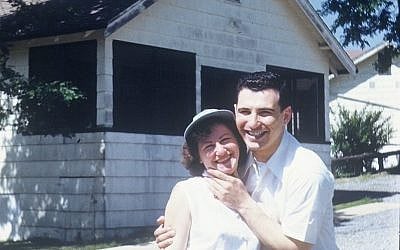
Because I enjoy studying Torah and increasingly appreciate the nuance and interpretation demanded by the ancient Hebrew, I am tempted to offer these recollections as a contemporary parallel to our Biblical forebearers, Abraham and Sarah. Indeed, Abraham and Sarah ventured away from the places of their births (see Genesis 12) and offered audacious hospitality to passing strangers (described in Genesis 18). But I don’t want to overplay the analogy — my parents did not break new ground the way Abraham and Sarah did. Rather, my parents, Howard and Dotty Braun, inherited the tradition, embodied the spirit and passed it along to their children and grandchildren. Also, unlike Abraham and Sarah, they booked return flights before leaving to explore the world.
Related Topics