
Christian Antisemitism in the Guise of Collective Jewish Introspection
The prominent Jewish historian, David N. Myers has added his voice to the growing chorus of Jewish public intellectuals and Jewish Studies scholars accusing Israel of crimes against humanity in Gaza. Full disclosure: when I was a newly minted assistant professor, Myers befriended me and graciously mentored me in the field of Modern Jewish History. In fact, Myers’ blurb graces the jacket of my first book. I have chosen to publicly refute his views because my pain at his libelous attack on Israel outweighs my sorrow at having to openly part ways with a friend. Even more disturbingly, his portrayal of a vengeful Israel enacting a tradition of Jewish vengeance with biblical roots echoes the Christian antisemitism that undergirds both the far-left and far-right’s demonization of the IDF as sadistic baby killers.
In his July 31st Forward op-ed, “The Horror in Gaza is a Catastrophe for Jews—this Tisha B’av Must be a Reckoning” https://forward.com/opinion/759751/gaza-israel-tisha-bav-judaism/ , Myers declares the IDF’s actions in Gaza as nothing less than “one of the gravest moral crisis [sic!] in the history of the Jews.” Although Myers stops short of declaring Israel’s actions genocide, he labels it “daily slaughter”, “ongoing starvation—of children…” and the greatest “wanton disregard for human life perpetrated by Jews against others” perhaps in all of history. In fact, as early as December 2024 https://forward.com/opinion/680494/amnesty-international-israel-genocide/ , Myers argued that the growing world consensus that Israel was committing genocide in Gaza was proof not of anti-Israel bias and antisemitism, but rather of Israel’s “profound moral and political blindness”. In December, Myers at least acknowledged Israel’s right to militarily respond to Hamas’ October 7th massacre, critiquing the IDF for waging a just war unjustly. At the time, he attributed this alleged Israeli moral blindness to “the immense trauma triggered by October 7th.”
Now, Myers has dispensed even with this small modicum of nuance and empathy for Israel’s war goals, which he now has flattened into “a state-sponsored campaign of mass Jewish violence”. He finds the motive for this alleged Jewish murder spree in the call for “mighty vengeance”, issued by Prime Minister Benjamin Netanyahu on October 7th, in the immediate aftermath of Hamas’ massacre and abduction of Israelis. As a fellow historian, I would expect Myers to place that call for vengeance in context. In fact, Netanyahu’s words https://www.youtube.com/watch?v=wquCRPxaHdU focused on the war goal of preventing Hamas from ever repeating its unprecedented mass slaughter of Israeli citizens on sovereign Israeli soil. Netanyahu’s call for “mighty vengeance”, a biproduct rather than the driving force of the war, was clearly directed at Hamas, not at all Gazans. As historian Jeffrey Herf recently wrote https://blogs.timesofisrael.com/hamas-disappearing-responsibilitiy-in-the-genocide-accusations , Israel’s war aims refute the charge of genocidal intent just as clearly as its actions refute the charge of genocidal deeds. Both historical and contemporary context, moreover, point toward Hamas’ genocidal intent and actions against Israelis and indeed all Jews. From its cynical sacrifice of the people of Gaza on the altar of its genocidal war against Israel to its simple refusal to surrender despite its military defeat, Hamas bears the responsibility for the fate of Gaza’s inhabitants.
It is ironic that Myers, the historian, accuses Israelis and diaspora Jews of blindness even as he is blind to his historically decontextualized portrayal of the Gazans as blameless victims and of Israelis as murderous perpetrators of revenge. But he does not stop there. In his words: “The shame of inaction will not be ours alone. It will pass on to our children and to their children. What has unfolded is obviously a catastrophe for the Palestinian people. But it is also a catastrophe for the Jewish people. We must mourn our own violence as honestly as we mourn the violence done to us.” He then calls upon Jews everywhere to pray for Gaza’s Palestinians this Tisha B’av, even going so far as to demand liturgical commemoration of the Jews’ alleged vengeful destruction of Gaza and its inhabitants.
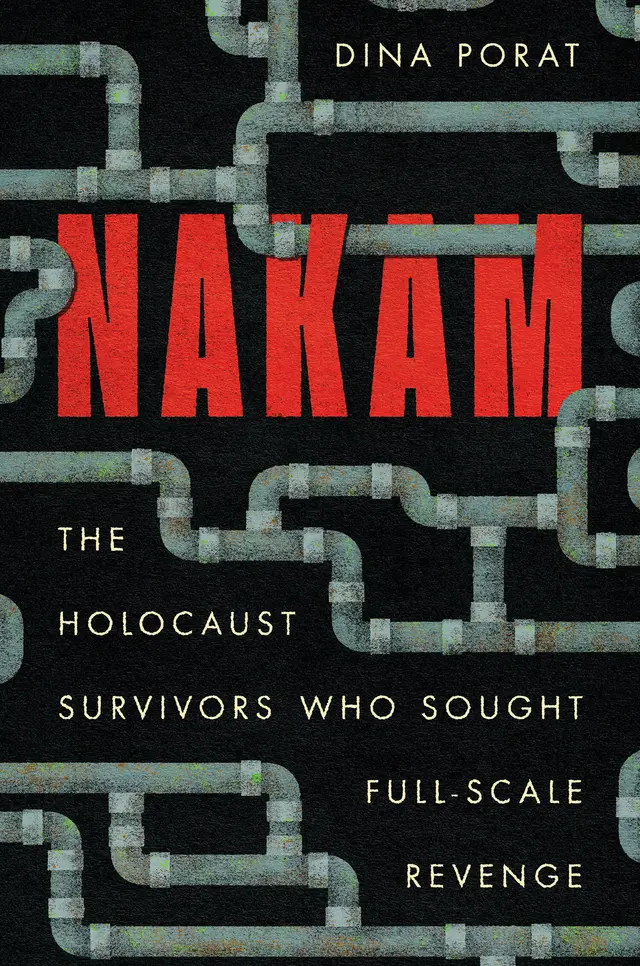
When Myers finally turns to historical precedent, it is to a deeply distorted genealogy of a tradition of Jewish revenge, drawn from the wellsprings of Christian antisemitism: the Book of Esther’s account of the Jews’ slaughter of 75,000 enemies who fought to annihilate them; the Hasmonean king, John Hyrcanus’ forcible conversion of the non-Jewish inhabitants of adjacent kingdoms (analogous to the IDF’s current actions in Gaza only if one wholly ignores the history of the Gaza Withdrawal of 2005 and the de-facto ceasefire between Israel and Hamas before October 7th); and the hero of the Vilna Ghetto’s partisan resistance and poet Abba Kovner’s short-lived and aborted plan of revenge against the German people for the Holocaust.
If Myers’ conviction of generational Jewish vengeance and guilt sound familiar, it is because it is rooted in the New Testament’s crucifixion narratives that depict the Roman procurator, Pontius Pilate, offering the Jews at the Temple the opportunity to pardon Jesus. In response, the Jews cried out in unison: “Crucify him! Let his blood be on us and our children.” At that moment, according to classic church doctrine, God spurned the Jews as his chosen people, bestowing the status of the “new Israel” upon the Christians. In Christian fantasy, the Jews, depicted in medieval art as a blindfolded “Synagoga” remained blind to spiritual truth. Rather than seeing the error of their ways, they took revenge for their divine rejection by reenacting the crucifixion upon future generations of Christians, especially children.
One of the most disturbing results of the Israel-Hamas war is the rejuvenation of Christian supersessionist antisemitism, in which the IDF plays the role of the crucifiers and Palestinian civilians play the role of Jesus. The image of the Jews as perpetrators of deicide and Gazan civilians as the analogue of Jesus and later Christian martyrs hover behind statements uttered by such varied sources as the late Pope Francis to right-wing Christian podcasters such as Tucker Carleson and Candice Owens. Slightly more hidden, this narrative also propels the progressive left’s dream to redeem humanity through the elimination of Israel, the source of all its ills.
That both the far right and the far left view the Israel-Hamas war through this lens shakes to its core our sense of Jewish security here in the United States. That an eminent American-Jewish historian has adopted this paradigm, though, is a terrifying embodiment of what I have elsewhere described as “The Demise of Jewish Studies in America” https://www.commentary.org/articles/joshua-karlip/jewish-studies-america-israel/. The discipline of modern Jewish historiography was created in nineteenth-century Germany largely to reclaim Jewish history for the Jews, free from a distorting antisemitic Christian supersessionist lens. How tragic that in twenty-first century America, a leading Jewish historian has succumbed to the same supersessionist myths that the discipline originally came to combat.