
Political Consultant
Collapsed Currencies in a Fractured Axis
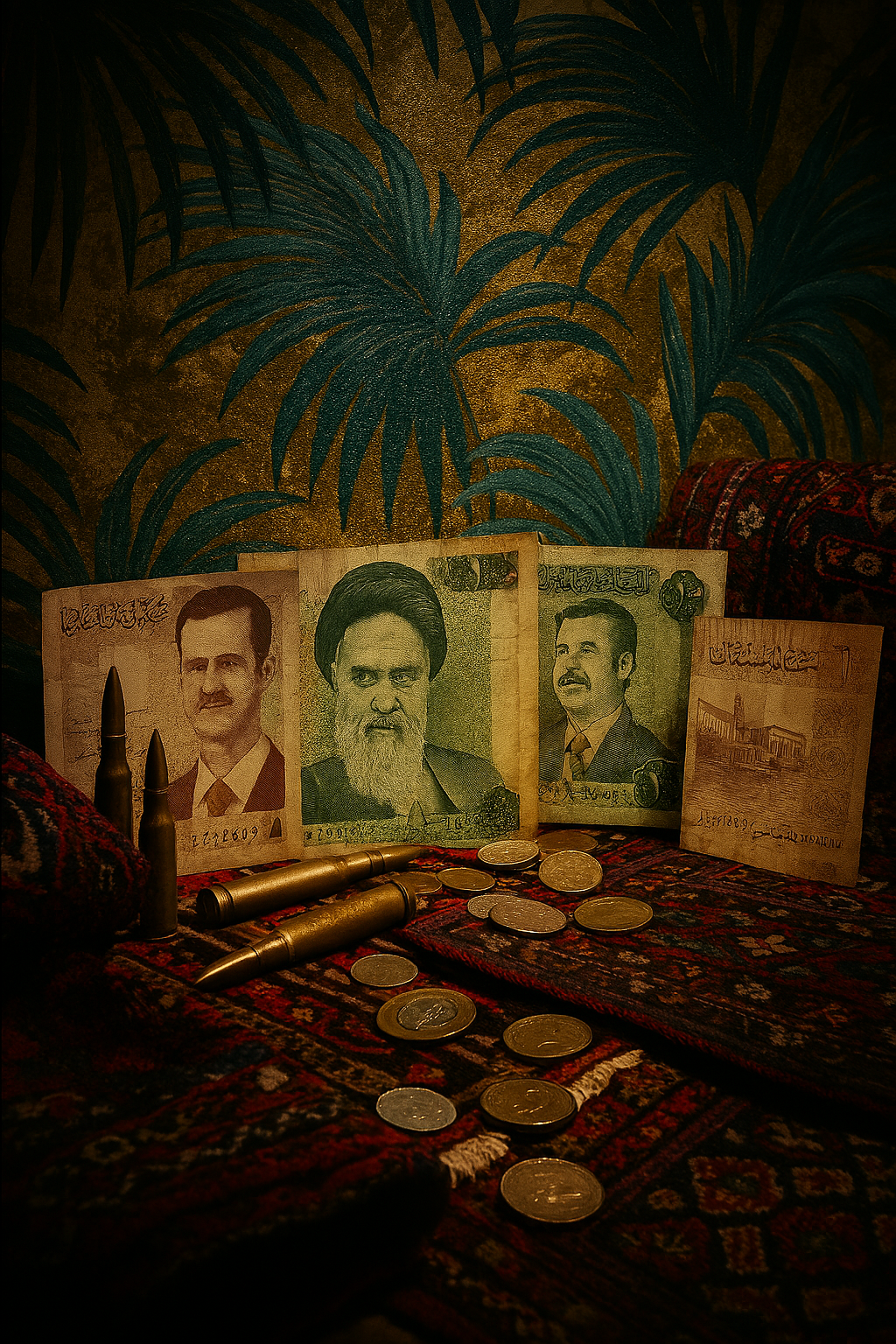
Collapsed Currencies in a Fractured Axis - AI generated
The currencies of five countries in the Middle East—Iran, Syria, Yemen, Lebanon, and Iraq—are collapsing in striking manner. This monetary breakdown cannot be separated from the political contexts governing these nations. They are bound by a common thread: varying degrees of alignment with the Iranian axis, whether through direct alliances or indirect influence that has penetrated their financial and economic institutions. What may initially appear as a currency crisis is, at its core, a reflection of the collapse of the political model adopted by these states—where regional agendas have consistently overshadowed national development priorities.
The Iranian Rial is buckling under suffocating economic sanctions imposed by the United States and Europe, particularly after Washington’s withdrawal from the nuclear agreement. Yet the crisis runs deeper than sanctions alone. A significant portion of Iran’s budget is allocated to funding military activities beyond its borders—from Lebanon to Yemen, through Syria and Iraq, and even reaching Sudan and Nigeria. This external spending, coupled with a lack of transparency and central bank independence, has turned the Rial into a casualty of expansionist policies that neglect domestic needs. Genuine reform cannot begin without redefining the state’s priorities—starting with curbing foreign military expenditures, liberalizing the market, and opening serious negotiation channels with the West.
For years, the Iranian regime has sought to project the image of a state capable of overcoming its economic woes. However, reality points to structural complexities that cannot be resolved without a fundamental reassessment of regional policies. While Iranian officials announce reform plans—such as reducing oil dependency, expanding local production, and developing industRial infrastructure—these efforts collide with a wall of political isolation, largely self-inflicted through antagonism toward its Arab and Gulf neighbors. Military interventions in Syria and Yemen, and support for armed networks in Iraq and Lebanon, have not only drained financial resources but also eroded regional and international trust in Iran’s economy. This has led to capital flight, frozen cooperation, and expanded sanctions.
Domestically, the regime promotes a “resistance economy” model based on self-sufficiency. In practice, however, this translates into deeper isolation and depriving the market of technology and foreign investment. Attempts to stabilize the Rial through central bank interventions have failed to halt its decline, with the exchange rate hitting record lows due to ongoing dollar smuggling, a thriving black market, and lack of transparency. True reform in Iran requires redefining its relationship with neighboring countries, halting the export of crises, and acknowledging that development cannot flourish under militarization and sanctions—but rather through trust and openness.
In Syria, the lira has become a symbol of the state’s own disintegration. The war, ongoing in various forms since 2011, has devastated the economic infrastructure and plunged the country into a spiral of sanctions—most notably the U.S. Caesar Act, recently lifted. The Syrian regime, reliant on financial support from Iran and Hezbollah, has failed to build a productive economy. Instead, it has entrenched a rentier system based on smuggling and patronage. Reform here cannot begin without a comprehensive political settlement that opens the door to reconstruction, restores investor confidence, and dismantles the organic link between the economy and the security apparatus.
Since assuming the presidency in Syria, President Ahmad Al-Shara has launched a series of economic initiatives aimed at rescuing the country from a deepening financial collapse that has worsened over more than a decade of war and sanctions. Al-Shara, who entered office with a reformist discourse distinct from the previous regime’s approach, prioritized restructuring Syria’s economy away from rentierism and smuggling, and toward production and investment. In his public speeches, he emphasized the need to separate the economy from security apparatuses and to restore the role of civilian institutions—chief among them the Central Bank, which under his supervision began regaining some independence in managing monetary policy.
One of his most notable moves was opening communication channels with Gulf states in an effort to rebuild regional trust lost during the war years. He dispatched economic delegations to Riyadh and Abu Dhabi and presented a reconstruction roadmap based on partnership rather than quota-sharing. He pledged legal guarantees for Gulf investors and committed to insulating development projects from political polarization. Al-Shara also launched a program to rehabilitate infrastructure in major cities, partially funded by Syrian expatriates and overseen by a newly formed independent economic committee.
Al-Shara did not overlook the social dimension of the crisis. He announced a plan to support the most affected families through digital ration cards linked to an electronic platform designed to reduce corruption in aid distribution. He also began reforming the tax system, expanding the revenue base to include informal sectors in an effort to increase state income without overburdening the middle class.
Although these steps still face major challenges—including remnants of entrenched influence and the lingering effects of Western sanctions—al-Shara’s economic agenda is viewed as the beginning of a gradual transformation in Syria’s state structure, shifting from a war economy to one of recovery. His success will depend on his ability to build internal consensus, restore external confidence, and offer a model of governance distinct from what Syria has known in past decades.
In Yemen, the Rial faces a state of fragmentation that mirrors the division of the country itself. Financial institutions are split between Sana’a and Aden, and the monetary reserves have been alarmingly depleted over the past decade. Civil war, foreign interventions, and militia financing have all contributed to the currency’s collapse. The solution begins with unifying financial institutions under an independent national authority, ending the war, and redirecting resources toward development rather than conflict.
Overcoming the collapse of Yemen’s currency requires more than financial measures—it demands rebuilding the state from the ground up: politically, economically, and institutionally. The Yemeni Rial is not merely falling due to war, but due to a lack of trust, institutional fragmentation, and the absence of an independent economic vision. Still, there are realistic pathways to recovery if national will and regional and international support are present.
First, financial institutions must be unified, starting with the Central Bank, which remains divided between Sana’a and Aden. This split creates parallel currency markets and prevents any unified monetary policy from being effective. Reuniting the Central Bank under an independent national authority, free from political interference, is the first step toward stabilizing the Rial.
Second, the financial hemorrhage caused by war and corruption must be stopped. Spending on militias, smuggling through unofficial channels, and depletion of monetary reserves all weaken the state’s ability to regulate the market. Any reform plan must include strict oversight of financial transfers, closure of smuggling routes, and restructuring of public spending to prioritize essential services and development.
Third, Yemen can benefit from conditional Gulf support—particularly from Saudi Arabia and the United Arab Emirates—through development programs and financial aid tied to transparency and accountability benchmarks. This support must be managed through international mechanisms that ensure it reaches legitimate institutions rather than patronage networks, with projects built and administered directly by the funders.
Fourth, it is essential to revitalize productive sectors such as agriculture, fishing, and small-scale industries, which can generate employment and reduce reliance on imports. Supporting these sectors through micro-financing, vocational training, and integration with Gulf markets could serve as a genuine lever for strengthening the Yemeni Rial.
Finally, restoring trust is the decisive factor. No currency can stabilize in the absence of institutional credibility or amid ongoing conflict. A comprehensive political solution that guarantees inclusive governance is the framework upon which any economic reform must be built. The Yemeni Rial does not merely require monetary policies—it needs a state worthy of public trust.
Lebanon presents a unique case of currency collapse driven by a breakdown in trust. Since 2019, the banking system has been paralyzed, and the Lebanese lira has plummeted to unprecedented levels. More critically, the smuggling of U.S. dollars to Syria and Iraq—and from there to Iran—via networks linked to Hezbollah has exacerbated the crisis and drained liquidity from the market. The absence of regulatory oversight, soaring public debt, and dwindling monetary reserves have made the lira a casualty of systemic corruption.
Additionally, the Lebanese government’s positions have deepened economic isolation, particularly following a series of statements deemed provocative toward Saudi Arabia—Lebanon’s largest financial backer. Notably, remarks by ministers affiliated with Hezbollah regarding Saudi involvement in Yemen sparked widespread Gulf anger. This political tension led Riyadh to withdraw its investments from Lebanon and halt direct financial support, delivering a severe blow to an economy partially reliant on Gulf remittances and Saudi investments in the banking and tourism sectors. This withdrawal was not merely a diplomatic reaction—it was a direct catalyst in accelerating the lira’s collapse and worsening the monetary crisis.
Reform in Lebanon must begin with restructuring the banking sector, securing the borders, insulating the economy from regional conflicts, and reaching an agreement with the International Monetary Fund that includes deep structural reforms. Most importantly, Lebanon must restore its Gulf relations—not just as a source of financial aid, but as a strategic pillar for reintegrating the country into the map of regional stability.
Despite its vast oil wealth, Iraq’s dinar continues to deteriorate due to rampant corruption and political and economic dependency on Iran. Dollar smuggling and the lack of economic diversification have eroded the currency’s value. Reform requires strengthening the independence of the Central Bank, enforcing oversight on financial transfers, and developing non-oil sectors that can offer genuine alternatives to the beleaguered dinar.
Despite possessing one of the largest oil reserves in the world, Iraq is grappling with a deepening monetary crisis that is weakening the dinar and destabilizing the market. This paradox—between vast natural wealth and financial collapse—reflects a profound structural dysfunction within the Iraqi state, where corruption, political dependency, and the absence of economic planning converge to produce a fragile reality unable to withstand internal or external pressures.
One of the most prominent causes of the dinar’s deterioration is the continued smuggling of U.S. dollars to Iran through falsified commercial invoices—a systematic operation that drains the Central Bank’s reserves and undermines the state’s ability to control the exchange rate. This smuggling is not limited to informal networks; at times, it involves collusion from within state institutions, making financial reform inseparable from political reform and anti-corruption efforts.
In addition, Iraq suffers from a lack of economic diversification, relying almost entirely on oil revenues to cover salaries and operational expenses without investing in productive sectors. This excessive dependence leaves the Iraqi economy vulnerable to global oil price fluctuations and weakens the dinar’s resilience in times of crisis.
Initial reform efforts have emerged through Central Bank measures such as regulating transfers, modernizing the electronic payment system, and restricting daily dollar auctions. However, these steps remain limited in impact unless accompanied by bolder actions—such as reinforcing the Central Bank’s independence, activating oversight of financial transfers, and restructuring the public sector, which consumes the bulk of the national budget.
True hope lies in developing non-oil sectors like agriculture, tourism, and manufacturing, which can generate employment and restore economic balance. Building economic partnerships with Gulf countries—free from political entanglements—could serve as a genuine lever for the Iraqi dinar, especially if framed within transparent mechanisms that protect investments and rebuild confidence in Iraq’s economic environment.
It must be acknowledged that the Iraqi dinar will not recover through monetary measures alone. It requires a strong, independent state with institutions capable of enforcing the rule of law, safeguarding public funds, and channeling wealth toward development rather than power-sharing arrangements. Iraq has the potential—but it must summon the will.
Ultimately, the common thread linking Iran, Syria, Yemen, Lebanon, and Iraq is not merely the collapse of their national currencies, but their adoption of a troubled political and economic model—one rooted in external dependency, excessive militarization, and entrenched corruption within state institutions. These currencies did not fall due to technical or circumstantial factors alone, but as a result of deep-seated dysfunction in state governance, where power shifted from serving citizens to executing regional agendas often disconnected from the interests of their people.
Reform in this context cannot be reduced to financial procedures or monetary policies, no matter how precise. It requires a comprehensive reassessment of the relationship between the state and its citizens, and between domestic priorities and foreign alliances. When a state becomes hostage to external coalitions and channels its resources into militias or regional influence projects, internal trust erodes, and citizens grow alienated from their governing institutions.
However, when the state returns to its people—reordering its priorities to place development, justice, and transparency at the forefront—recovery becomes possible, even if the currency has hit rock bottom. The true value of a currency is not measured solely by its exchange rate, but by the public’s confidence in their future and in their state’s ability to protect their interests. When that trust is restored, even the most collapsed currency can be revived—not just as a financial symbol, but as a sign of the state reclaiming its fundamental role: serving its people, not the ambitions of others.
Related Posts