Connecting to the land: Israeli agriculture for growth and healing
Many Israelis have a growing sense that we are in a time warp, resonant of other dark periods; that the “vacation from Jewish history” is over. With that — a hopeful sense that while our leadership is beyond disappointing, our nation is resourceful and brave. While those in charge look for ways to blame others and pass the buck, a surprising new generation looks for ways to take responsibility and initiative, drawing inspiration… from history.
An eager return to the earth is one such example — seen as both a national duty, and a tool for facing our many challenges. The resurgent dominance of Israeli agriculture — particularly in education and in healing the trauma wrought by war — is a window into the DNA of the Israeli national ethos: resilience, innovation, and community.
I hit the road and went looking for hope… and I found it. Lots of it. Where I usually find it: with young people, under an open sky, a hundred kilometers away from any city street named after a Zionist founder, but much closer to what those founders believed.
This post started as a reported article, but it became long, and a bit philosophical. I have turned it into a blog post to have the freedom to muse a bit, taking solace in our nation’s primordial agricultural story, as we approach the Shavuot harvest festival.
Join me.
* * *
Now I see the secret of making the best person: it is to grow in the open air and to eat and sleep with the earth.” –– Walt Whitman, “Song of the Open Road,” 1856
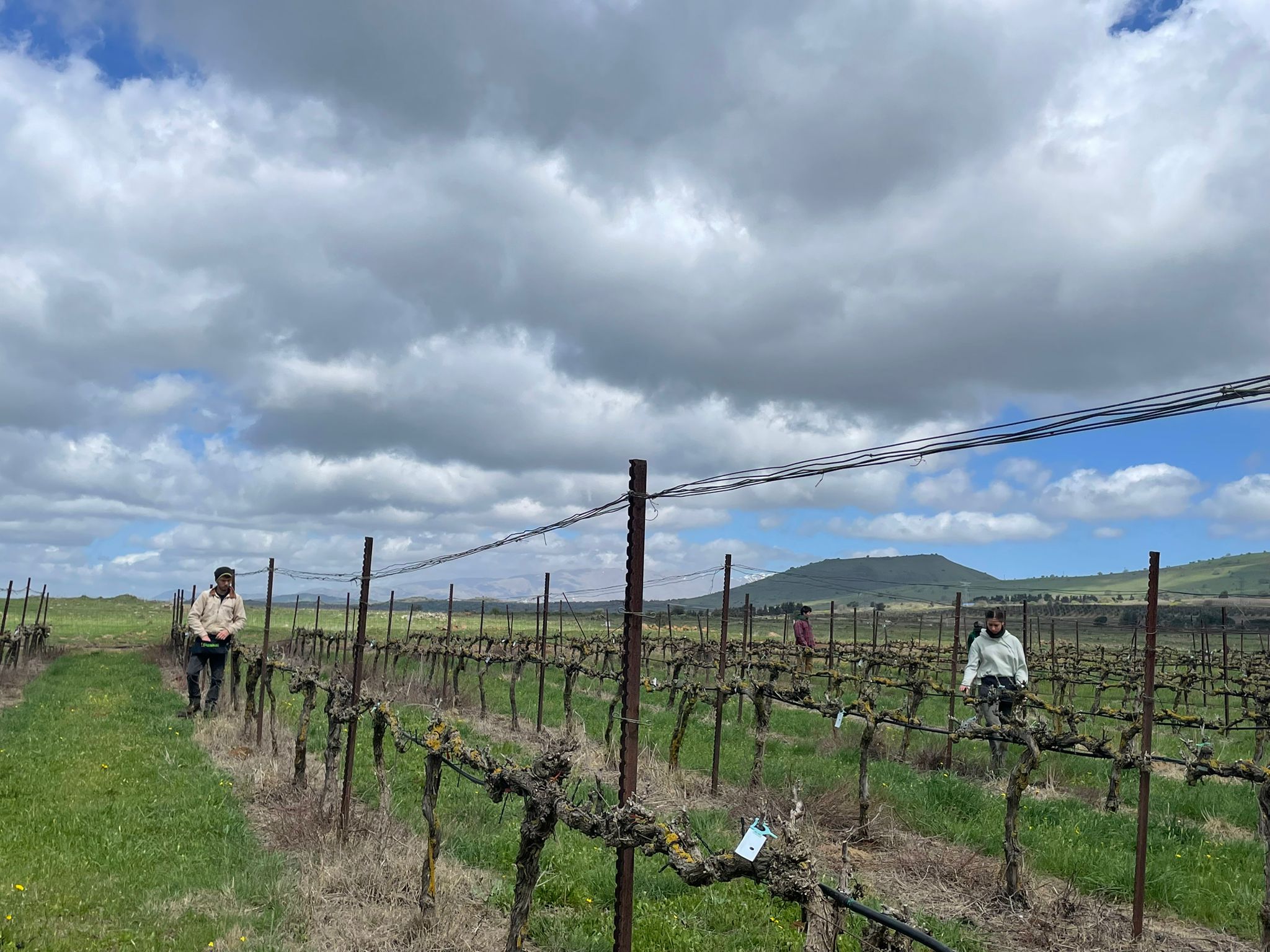
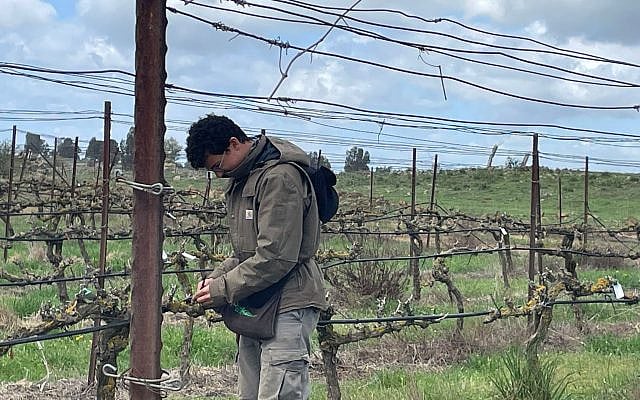
A dozen teenagers in workboots sit eating breakfast at the far end of a vineyard, four hours into their school day. It is barely 9 a.m. Against the charcoal skies and deep mountain shadows of the Golan Heights, near Kibbutz Ortal, they could be a sportswear ad, but they soon pack up the picnic with zero selfies taken (no phones allowed!) and resume the day’s task of attaching irrigation pipes to a trellis. Purposeful, efficient, and completely relaxed with each other, the performative nihilism we’ve come to expect in this demographic is noticeably absent. Instead, there is easy competence and ambient optimism.
Later, they will attend required classes on the way to achieving full matriculation, like their peers in more conventional schools back home, who, as one of them puts it, “are in a constant loop of boredom.” These kids will participate in enrichment activities, such as guest lectures on a topic of interest, which they have organized themselves. They will prepare food and do laundry and tend to a communal garden that the previous graduating class planted for them as a going-away gift. (They will not use their phones at lunch, even when allowed to.)
One of the kids will take inventory of the laptops the students use; one will work on the menu, shopping list, and food budget; and another will coordinate tomorrow’s shift work with the farmer.
“If we don’t do it, it won’t happen,” shrugs Telem, a senior from Malkia, a kibbutz not far from Kiryat Shmona, who will be drafted to an elite infantry unit at the end of the summer. With this offhand comment, he sums up not only an educational philosophy at the junction of Montessori and Transformative Leadership theory — building excellence and agency as internal processes, in the context of communal goals — but the century-old ethos of the halutzim (pioneers) who built Israel.
The same gritty frontier that was tasked by Zionist farmer-philosophers a century ago with growing a people is now doing another shift… growing people.
New Old Things
The young generation in the Land of Israel has a great role to play, and an unparalleled amount of work lies before it, especially at this time of great difficulty, the difficulty of the human world in general and our Jewish world in particular; a work of preparing the ground, of adapting life; a work of complete revolution in spirit and life. Strength is needed, supreme heroism and a dedication of soul to an extent that is unparalleled.” –AD Gordon, Letter to Shalom Streit, 1917
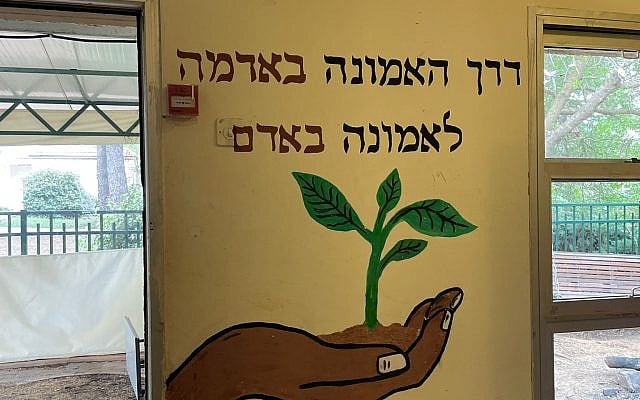
The Adam V’Adama high schools — founded a decade ago in Hatzeva in the Arava region, and now operating in six locations throughout Israel’s North and South — were established by the HaShomer HaChadash organization to address two major challenges simultaneously. One, a long-faltering and uninspiring national education system, alongside a serious shortage in agricultural human resources. The average age of the Israeli farmer now approaches 65, the sector’s workforce is mostly transient, and the industry needs some 700 new farmers annually, according to HaShomer HaChadash co-founder On Rifman, who sees part of his ambitious mission as providing them.
This agricultural crisis was already years in the making due to Israel’s land shortage and arid climate, before being exponentially magnified by the ongoing October 7th war — a war that points to the central, overarching challenge addressed by the parent organization HaShomer HaChadash: the importance of agricultural communities in securing Israel’s geographic periphery, and the crucial role of empowering those communities with volunteers doing security and agricultural work.
Ran Kaminsky founded the Golan branch of that organization’s Adam V’Adama school just over six years ago, in honor of his native Kibbutz Ortal’s 40th anniversary, and he serves as its principal. With over 60 students on that campus alone from religious, traditional, and secular homes, the student body is the same kind of self-selecting national microcosm that one finds in elite army units: a melting pot that is more of a refinery.
“These kids bring a youthful spirit that revives everything,” he says, “which is required for agriculture’s future.” The seasoned manager and educator observes — only days after the record-breaking Wiz acquisition — that young high-achievers have, for decades, been aiming their excellence and idealism at “the next big hi-tech exit,” but that he is seeing an ideological shift, particularly in light of Israel’s current state of emergency.
Co-founder Rifman, an ex-special forces officer and legacy farmer (his grandparents helped establish Kibbutz Revivim in the pre-state era Negev), post-high school educator, and rancher’s rights activist, agrees. He notes that the kibbutz-driven practical Zionism that founded the country, for a host of reasons, failed to pass its ideological DNA to secular Gen Xers and millennials; the vacuum created by a lack of spiritual confidence left the kibbutz movement in crisis. But an increasing number of kids with an entrepreneurial spirit are turning their passion for fixing the world back toward the national interest of agriculture.
Kaminsky adds that “these kids have the courage to go where their educational needs are met.” This increased demand for a different, deeper learning experience, along with the national prioritization of rehabilitating the Galilee, is bringing about the opening of Adam V’Adama’s seventh campus at Kibbutz Yir’on in the coming school year, with a founding cohort of some 20 students.
While agricultural educational boarding schools have been available in Israel since its inception, more recent iterations of the model have had different missions, such as addressing kids with attentional, emotional, or behavioral challenges; or a national-religious ideal in which working the land has a redemptive component, and in which the entire land of Israel is considered holy.
This is different. Binyamina-born Freshman Dar patiently shows me how to help her perform the morning’s irrigation task, while reflecting on why she is here. Dar says that, as of seventh grade, she knew she had to be involved in something “more serious” than obsessing with her friends about “shtuyot” (trivial nonsense), and sought out a place where she could do something meaningful, challenging, and excellence-driven, with like-minded peers.
Peers like 12th grader Shira, who walks to the lunchroom later in the day sporting a pretty belt holster, containing pruning shears. She explains how she earned the tool, awarded in a special ceremony, by mastering a series of tasks and skills. Wearing them around school is the agricultural version of a shoulder rank insignia.
Apparently, like a long forgotten bulb yielding a surprise plant a few seasons down the line, the love of land and labor as a foundational, mainstream Israeli value – and as a “way to become” – is back.
Doing the Work
When despair for the world grows in me, and I wake in the night at the least sound, in fear of what my life and my children’s lives may be…For a time, I rest in the grace of the world, and am free.” — Wendell Berry, The Peace in Wild Things, 2018
Tzuriel Assaf is a poet and eco-philosopher behind the content-rich program curriculum at HaShomer HaChadash. When asked what it is about agricultural work in particular that provides their volunteers and students with a sense of purpose, agency, and mental clarity, he cites agricultural Zionism’s high priest, AD Gordon: human development — and by extension, Jewish national rehabilitation — is contingent on physical work and nature. He adds Scottish-American wilderness advocate John Muir’s assertion that “going in” to enact personal processes requires “going out,” and observing nature’s own way of moving forward.
Assaf further contemplates, in a post-October 7th Israel, the role of a physical place in providing comfort — evoking the mourner’s greeting of “HaMakom yenachem etchem” — May the place (God) comfort you.
As it turns out, agricultural work and nature are being widely employed not just for a better educational process, but also to help heal the trauma wrought by war.
…Because you connect most intensely to a land that is home.
Yair W. is a Battalion Medical Officer (Ta’agad) in the Givati Brigade who has spent much of the last year in Gaza. He recently participated, with other members of medical combat teams, in a healing retreat at Lahav Farm, part of the Rimon Farm network, “for people who saw things. To do a special process.” “Saw things” — like “friends dying in your arms.”
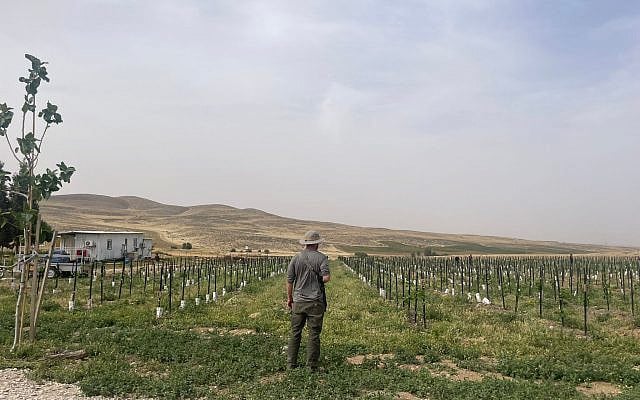
The farm is located at the edge of the Lahav Forest south of Lachish, overlooking the arid landscape en route to Be’er Sheva — a visual metaphor for the work done in this place, to reconcile growth with loss. To wit: it is named for shepherd and counterterrorism (reserves) officer Liran Almosnino, who was killed in action on October 7th at Holit, just as he had taken the helm managing Havat Lahav.
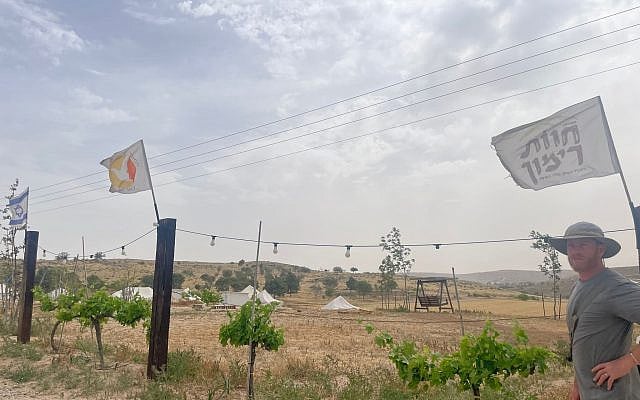
Yair, who sounds both 22 and much, much older, describes a few days of contemplative planting, working with animals, hikes, group processing sessions, yoga and sound healing workshops — and a professional, deeply invested staff. “There’s a freedom there that opens you up. Most of the time, this kind of outdoor experience comes at the expense of quality and cleanliness, but here that wasn’t the case. It was clean and organized — which made it possible for even the people from the mercaz (i.e., city people) to give themselves over to the process.”
This market-awareness and attention to detail is not an accident: it is perhaps the embodiment of a classic Don Draper wisdom about creating a product experience that you yourself would want. Which is how the Rimon Farm Network came to be. Founder Nir Amitay (another former-special forces officer / kibbutznik) survived a 2016 terrorist shooting at a Tel Aviv pub – but his best friend did not; the event tragically unfolded like the scene Yair described.
Haunted for years by the event, particularly the helplessness of not having been able to save his friend, Amitay concluded that he had been “skipped over” by the terrorist’s bullets for a reason — and pivoted from his military career and environmental activism to a life-mission of healing trauma.
Developing a treatment model — with the help of relevant mental health professionals — which fuses sustainability (“healing the earth”); community; personal empowerment and self-regulation (“healing the person”); and creating a positive enterprise across Israel’s often lawless South, Amitay’s farm network has at its core that most Israeli quality of all: traumatic growth, his own included. In 2021, the organization was born, with its flagship campus, Havat Rimon, serving youth at risk not far from Amitay’s home in Kibbutz Lahav.
What Grows Here
Rimon Farm, a quiet, well-kept homestead down a dusty country road through the woods, runs on a day model, where students who have fallen between the cracks of other frameworks come to work, learn, and heal. They are referred, usually by the Department of Welfare, for another chance at turning themselves around.
“They come to return to the basics, to themselves,” says Rimon’s Director of Youth Programming, Gidi Wolfson, a criminologist who spent nearly 20 years in youth crisis and welfare educational frameworks before joining the farm. His first day on the job was, incredibly, October 8, 2023. “Screens and other addictions take them away from themselves. Farming brings them back.”
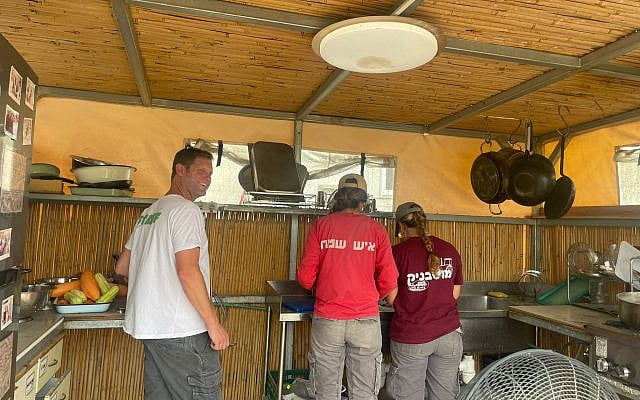
He adds another important feature of farm work that has specific relevance for kids having trouble at home, or in trouble with the law: “Working with nature, slow processes, raise frustration and allow people to learn distress tolerance and patience — so they can grow into adults motivated and capable of benefitting society.”
On weekends, in a scene straight out of a Morgan Wallen song, the farm opens its doors to young families from neighboring southern communities for a country fair — where the Rimon youth are in charge of food, activities, and selling the produce they grew. These events are part of Amitay’s vision to have every central growth process be mutual for those treated on the farms and those in their communal vicinity. Symbiosis, after all, is one of nature’s greatest techniques.
Wolfson says it is also part of the process. “The kids learn to be in charge, accountable, serving people in a normative situation, with some amount of pressure. They learn to be assertive, but polite and patient. Boundaries, connection, caring for others… Part of a community.” This community model is expanding to two campuses near the Gaza border, with farms recently opened to serve the needs of long-battered communities like Sderot, with an additional focus on secondary trauma.
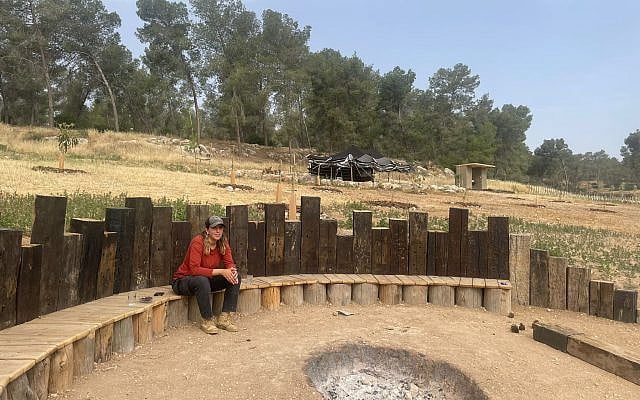
More than 5,000 soldiers and security personnel — including some of the police officers who arrived at the scene of the Nova massacre and have had trouble communicating in its aftermath — have undergone trauma processing workshops at Lahav and a newer campus near Shekef since October 7th, in cooperation with the IDF’s Rehabilitation Division, the GOI’s Defense, Welfare, and Health Ministries, and other governmental organizations.
In some cases, coming to the farm stands in for psychiatric day treatment hospitals. The JNF-KKL and several North American Jewish Federations are major partners as well, and Amitay sees the support of the Jewish community abroad, as more of the aforementioned symbiosis: “We can not live without each other,” he says, and mentions a new project being explored, sharing methodologies with addiction treatment farms in the US.
I wonder aloud to Amitay: Is it simply the agricultural process, or the quiet community, that does the healing — or is there some specific, possibly spiritual, land-of-Israel element in the mix, a sentiment I have heard many times from religious farmers.
“Our healing comes from the land of Israel,” he answers, reconciling multiple streams of Jewish and Zionist thought in his straightforward, but poetic way, “because you connect most intensely to a land that is home.”