Conquer Your Own Rhythm: Art and Epilepsy
It is 7:55 a.m. EST.
“I’m available now,” Pamela Schoenberg, owner of dnj Gallery, texted me from Cincinnati, Ohio, when I reached out to learn more about her upcoming exhibition, “Conquer Your Own Rhythm”, a group show by artists living with epilepsy, opening January 11, 2026.
“Okay, just a moment,” I replied from Le Havre, France. “Give me five minutes. I just need a piece of paper.”
I rushed to the stove, turned off the boiling potatoes and leeks, grabbed a sheet of paper, and returned to my phone. Two minutes later, another message arrived.
“Actually, give me ten. The doctor just came. Sorry. This is serious.”
An hour passed.
“Okay, I can talk now.”
This brief exchange captured, in microcosm, the rhythm of life alongside serious illness. Pamela was in the hospital with her mother, whose condition was uncertain and life-threatening. The clicks, beeps, and footsteps on linoleum floors formed a familiar hospital soundscape. I was transported back into my own memories.
My younger brother lived with a severe intellectual disability and a medically uncontrollable form of epilepsy. His seizures were unpredictable, occurring day and night, sometimes escalating into status epilepticus and long hospitalizations. Life unfolded in interruptions: constant medication adjustments, isolation from what others considered normal life, repeated disruptions of conversations, the looming threat of a shortened lifespan, and the weight of difficult treatment decisions. Sometimes survival meant keeping him in a safe place to prevent injuries from falls, especially after he refused to wear his epilepsy helmet. At other times, it meant simply staying in the car with him while my mother went into the supermarket.
He died at home in February 2003, and the trauma of those years has woven itself into my memory, becoming a driving force to find meaning in lived experience and to make the best of a life that did not follow a fixed blueprint.
Moments like these leave lasting marks on a person’s life. People with chronic illnesses and those who care for them live by a different rhythm. Their emotional energy is directed toward survival, their own or that of someone they love. For some, these disruptions are temporary. For others, they define a lifetime. Schools, workplaces, and other institutions offer little tolerance for pauses, delays, or altered productivity. Once someone falls out of the system, it can be difficult to find a way back in.
Moments like the one with Pamela, when time seems to pause, and attention shifts entirely to the ill person, reveal a tempo largely invisible to those who live outside caregiving. This awareness of rhythm and attention is at the heart of her upcoming exhibition, a group show by artists living with epilepsy, which opens today and runs through March 21, 2026. The show brings together works by artists living with epilepsy and those who collaborate closely with them, alongside public programs that include conversations between artists and medical professionals, HG Open Mic, and performances by the Webern Quartet.
Before turning to the exhibit itself, which I will not be able to visit from France, it is worth reflecting on how I came to know the exhibition’s curators, Pamela Schoenberg and artist Ted Meyer, and the vision that drives their work.
How I Met the Curators
Pamela Mayers Schoenberg
I first met Pamela Mayers Schoenberg in 2010, when I was still living in Los Angeles at her then-relatively young gallery on La Brea Avenue. The neighborhood was culturally rich, with Jack Rutberg Fine Arts Gallery across from a synagogue, The Loft at Liz’s, a New York–style gallery above Liz’s Antique Hardware further south, and KP Projects (Merry Karnowsky Gallery) and Pamela’s space on the opposite side of the street.
I covered numerous exhibitions at her gallery for Artscene and Art Ltd., and even then, it was clear that her program was guided by a purpose beyond commerce. I wrote about exhibits such as “Night Lights”, featuring Helen K. Garber, Ginny Mangrum, and Bill Sosin; Maria Luisa Morando’s “Silver”; and Ellen Cantor’s “Prior Pleasures”. Over the years, I also covered Pamela Mayers Schoenberg’s “The Vermont Project” and “When Did It Stop Being Fun?”, Susan Berger’s “Dr. Martin Luther King Jr.: Honoring an American Hero”, Jennifer Bermon’s “Her I Self: Women in Their Own Words”, and Pat Sandler’s “INSIDE/OUT”.
The exhibit that related most to my experience as the sister of a late younger brother with an intellectual disability and epilepsy was “INSIDE/OUT”, a collaborative art project by art therapist and photographer Pat Sandler, which consisted of portraits, texts, and photographs of 20 young artists with special needs from The Help Group’s Village Glen School. Each student was displayed in a black-and-white portrait shot by Sandler, along with insightful writing about their inner lives—something my brother wasn’t able to do.
For example, there was Ebony, an African-American teenage girl, depicting her palms pointing at the viewer, partially covering her face. She wrote, “When I look at this picture, I see beautiful hands hiding an emptiness underneath a tender face. Yet she smiles when the world turns away. Who is she? Who does she wish to be? Anything but nobody.”
In that piece, I highlighted how children with special needs and their families were routinely discriminated against, creating isolation and emotional distress. Thus, Pamela gave space to stories that were difficult and uncomfortable, yet necessary to bring into the public eye.
Much has changed since then. I left Los Angeles in January 2020 after my work visa expired and my green card application was denied, a huge rupture in my life, just three months before Pamela herself reached a turning point when she decided to close her commercial gallery during the pandemic and rethink the focus of her work.
That same year, she, who already held a BFA in History and Photography from Washington University in St. Louis and an MFA in Studio Art and Photography from Mills College in Oakland, decided to study nutritional science at Cornell University. She later completed the ADAPT Health Coach Training Program at the Kresser Institute and became a certified Functional Health Coach in 2023, consciously weaving together her two longstanding passions: art and health. In doing so, she did not turn away from art; rather, she widened its purpose.
Since April 2024, she has run the Art and Med program at dnj gallery, which now operates as a free, community-focused, and educational space. The gallery’s mission is clear: it seeks to raise awareness, enhance education, and provide a platform for sharing experiences related to chronic health conditions. Pamela’s dedication to creating such a space reflects both vision and empathy.
When we reconnected via WhatsApp, Pamela told me that she had once focused primarily on conceptual art but experienced what she described as an “aha moment,” the realization that art could do so much more. What she spoke about most vividly was community. She wanted to create a space where people could share their experiences, recognize themselves in others, and feel less alone, a place that could also serve medical professionals, caregivers, and patients seeking to understand one another’s perspectives.
She usually offers five to six events per exhibition, and so far, her most popular has been “Dancing Through Parkinson’s”, where she brought joy to people impacted by the diagnosis and their caregivers. Her shift from running a commercial gallery to founding the Art and Med program was influenced not only by the pandemic but also by her personal life. Her husband, brother, and two sons live with Crohn’s disease, a chronic inflammatory bowel condition that profoundly shapes daily life.
Long before I met Pamela at dnj Gallery, I had already had a professional connection to the Schoenberg family. In 2004, I requested permission from Belmont Music Publishers, owned by the Schoenberg family, to use Arnold Schoenberg’s Verklärte Nacht (Transfigured Night), Op. 4, for a television interview I conducted with painter and Holocaust survivor Kalman Aron. The interview aired on Public Access TV in Los Angeles and was dedicated to my late younger brother. Through him, I developed a particular sensitivity to the Jewish experience and social injustice.
Arnold Schoenberg was the grandfather of Pamela’s husband, E. Randol Schoenberg, an eminent attorney best known for his work recovering Nazi-looted art. He represented Maria Altmann in the landmark Supreme Court case that led to the restitution of Gustav Klimt paintings stolen during the Holocaust, a story later portrayed in the film Woman in Gold. Randol Schoenberg used part of the proceeds from that case to support and expand the Los Angeles Museum of the Holocaust, ensuring that his legal work extended beyond restitution into remembrance and justice.
Ted Meyer
I first met Ted Meyer at one of Gay Summer Rick’s solo exhibitions at BG Gallery on Ocean Avenue in Santa Monica around 2012, when the space was still shared with Hamilton Galleries. Gay is a contemporary American visual artist known for her richly textured, atmospheric oil paintings. Working primarily with palette knives, she builds layered surfaces that explore light, landscape, and the intersection of urban and coastal environments. She is featured in my digital book Women and Art (2013), for which she also provided the cover image.
I was immediately drawn to Ted Meyer’s story when he told me he was born with Gaucher disease, a rare genetic disorder, and spent much of his childhood in hospitals. He could describe, from a patient’s point of view, what it is like to be a young child in medical institutions. This perspective felt especially interesting and meaningful because my own brother could not articulate his experiences. Due to his intellectual disability, he spoke only a few words, which eventually dwindled to a handful, and even those became fragmented and unintelligible to anyone who did not already know him.
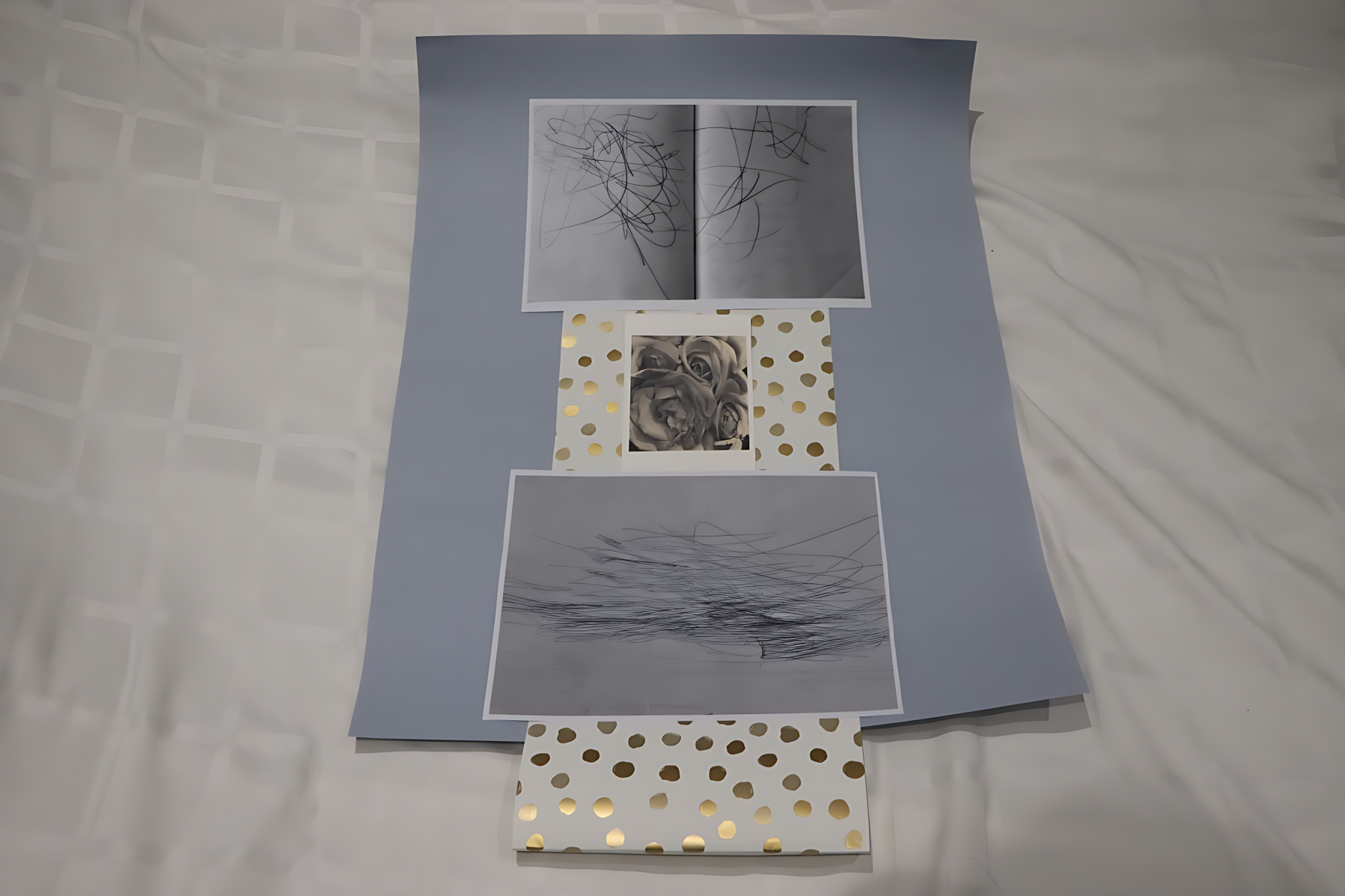
I still have three scribbles of his left. One is inside my copy of Hermann Hesse’s Gertrude. The other two I recently printed and displayed on light blue paper, adding gold-dotted wrapping paper and a postcard from the Centre Pompidou featuring a Tina Modotti black-and-white photograph of roses. These traces of communication remain deeply significant, much like the few cassette tapes we have left with recordings of his voice. One scribble was made in Ludwigsburg in 1976, when he was six years old, between seizures, petit mal, absences, and sometimes grand mal. The other dates from his early teenage years, revealing his urge to express himself. The latter was created closer to his first episode of status epilepticus, its lines denser and less emotive. Today, I wish I could have given him black ink and nicer, more substantial paper.
Meyer’s ability to articulate illness from the inside felt revelatory. From an early age, he turned to making art as a way to cope with pain, stress, and long hospital stays. That practice became an entry point into his life as an artist.
Over time, Meyer’s work expanded into figurative painting, desert landscapes, abstraction, and surreal imagery in which animals appear perched on human heads. His socially engaged projects are especially compelling, particularly “Scarred for Life: Monoprints of Human Scars.” In this series, he creates detailed prints of people’s scars, each representing survival through accident, surgery, or serious illness. Shown in galleries and medical schools worldwide, the project restores dignity to wounded bodies and affirms the beauty of resilience.
Scarred for Life – TedMeyer.com
I was also deeply impressed by his 2016 TED Talk, in which he spoke candidly about his condition and lifelong navigation of medical systems. TED Talks reach a wide audience, and honestly, I could never imagine something like this happening in Germany. As treatment became available for Gaucher disease, allowing him to live without symptoms, Meyer’s work expanded further through collaboration and an increasing focus on the suffering of others. Today, he is an artist in residence at the Hoyt Gallery at the USC Keck School of Medicine, where he curates five exhibitions per year aligned with the first and second year medical curriculum, with each exhibition focused on a specific part of the body. I last saw him there in 2019, when he curated the group exhibition Artist & Researcher 3.
tedmeyer.com/videos – TedMeyer.com
However, Meyer is not only a visual and oral storyteller but also a gifted writer. In 2024, he published The Room Sinatra Died In: And Other Medically Adjacent Stories, a memoir written in a vivid, conversational style that balances gravity with humor, a must-read for anyone living with a chronic illness or caring for someone who does. I will write more about the book in a separate post.
The Exhibition
As I mentioned earlier, I cannot see the exhibit in person and therefore cannot write a full review in the way I usually do—assessing how the works are hung, how they respond to each other, and how the space feels. Yet, what I do know is that it features the work of about twelve artists living with epilepsy, or caretakers of someone with epilepsy, each bringing a unique perspective and approach to expressing their experiences. The exhibition spans multiple art genres, including photography, sculpture, writing, mixed media, and painting.
What drew me in, however, was learning how Pamela Schoenberg came to focus on epilepsy and the stories behind the artists’ work.
But first, what is epilepsy? By definition, epilepsy is a neurological disorder that causes recurring seizures or unusual behaviors, affecting people of all ages in many different ways. A seizure is a brief burst of abnormal activity in the brain that can create short gaps in consciousness, muscle twitches, or prolonged spasms. Most of the time, the cause of a seizure is unknown. In about 30 percent of cases, genetics, head injuries, brain infections, or immune, developmental, or metabolic disorders can contribute to epilepsy.
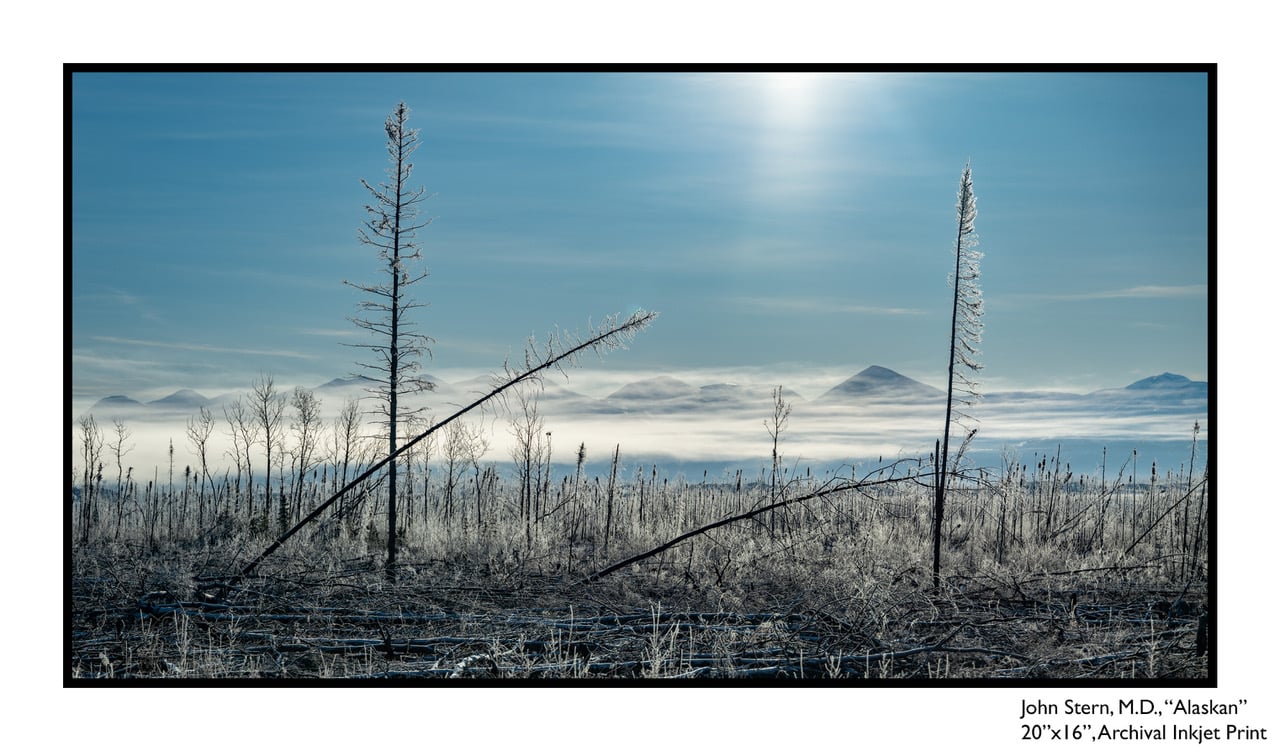
Pamela explained that the idea for this exhibition began during a lunch between her husband, E. Randol Schoenberg, and his friend John Stern, a neurologist, Director of the Epilepsy Clinical Program, and professor in the UCLA Department of Neurology. Stern is also a photographer, exploring what he calls “complex minimalism,” capturing landscapes that balance simple textures and lines with intricate natural details. In both his medical practice and his photography, he cultivates careful attention to detail while keeping the bigger picture in mind. Photography allows him to shift perspectives, notice subtleties, and reflect on the interplay between observation and understanding—skills essential in both medicine and art.
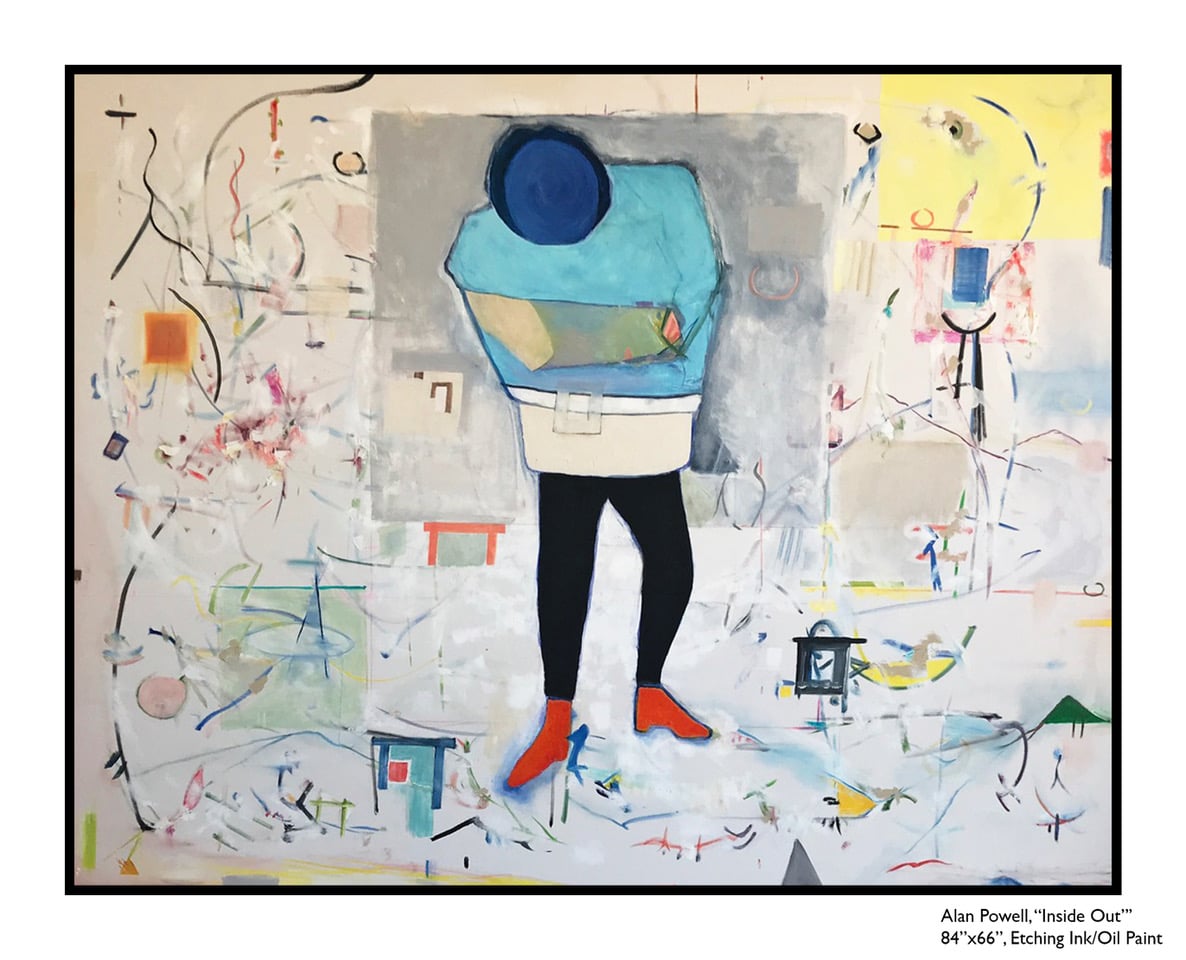
His work will be shown alongside that of Alan Powell, who blends metaphysics, mathematics, and music. Powell’s severe seizure disorder prevented him from painting for six years. After multiple hospitalizations and eventually brain surgery, he has been seizure-free for five years and has returned to the studio with renewed purpose. His image, rendered against a background in a Cy Twombly manner, shows a figure with a lowered head, wearing what seems to be a straight-jacket, evoking the experience of freedom and confinement in epilepsy.
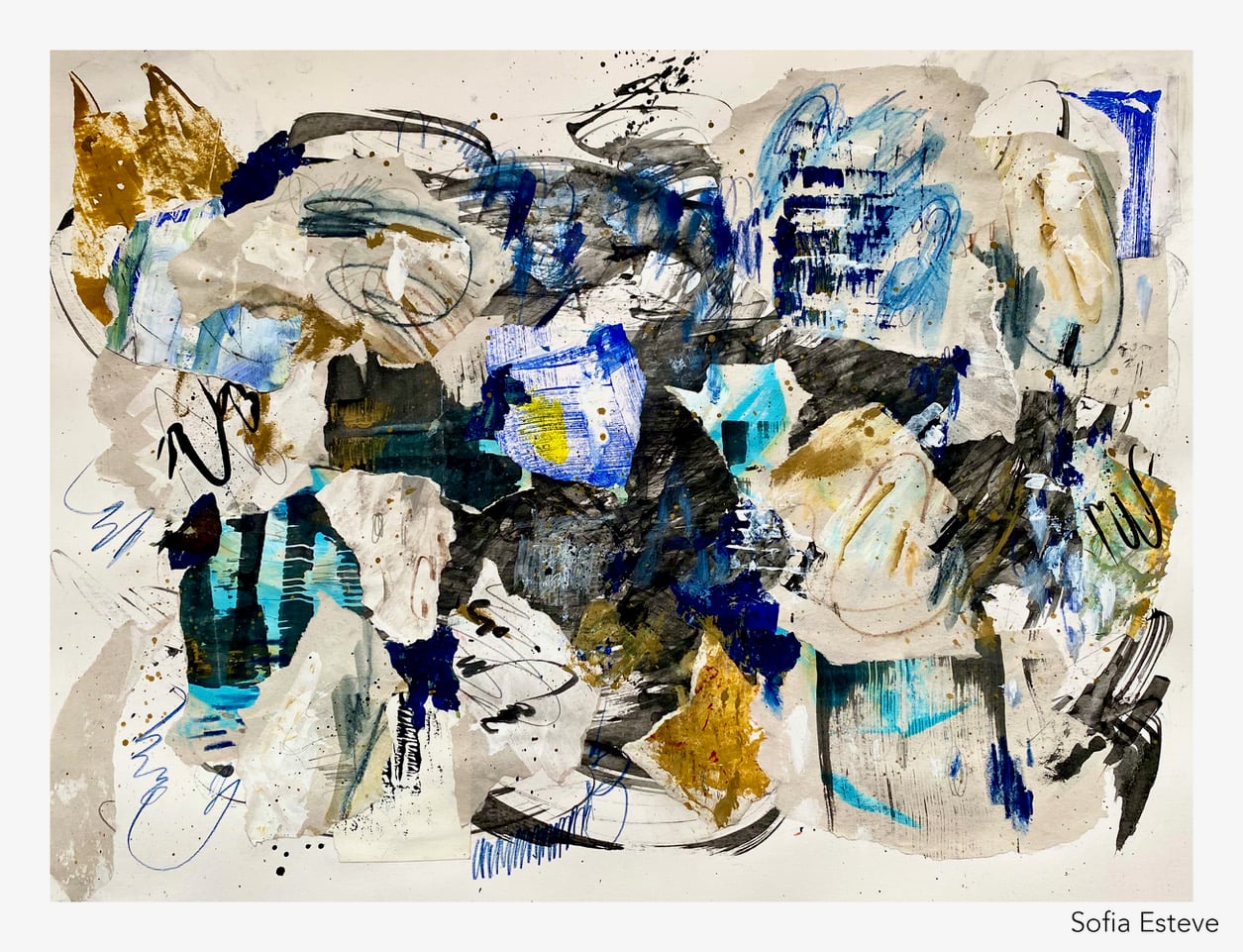
Among the artists with epilepsy is Sofia Esteve. Her mixed-media work, rendered in blues and yellows, translates the emotional ups and downs of living with multifocal epilepsy into abstract forms. Through paint, paper, and canvas, she expresses isolation, lost time, and the search for connection, using art both as a refuge and a way to reach out to others.
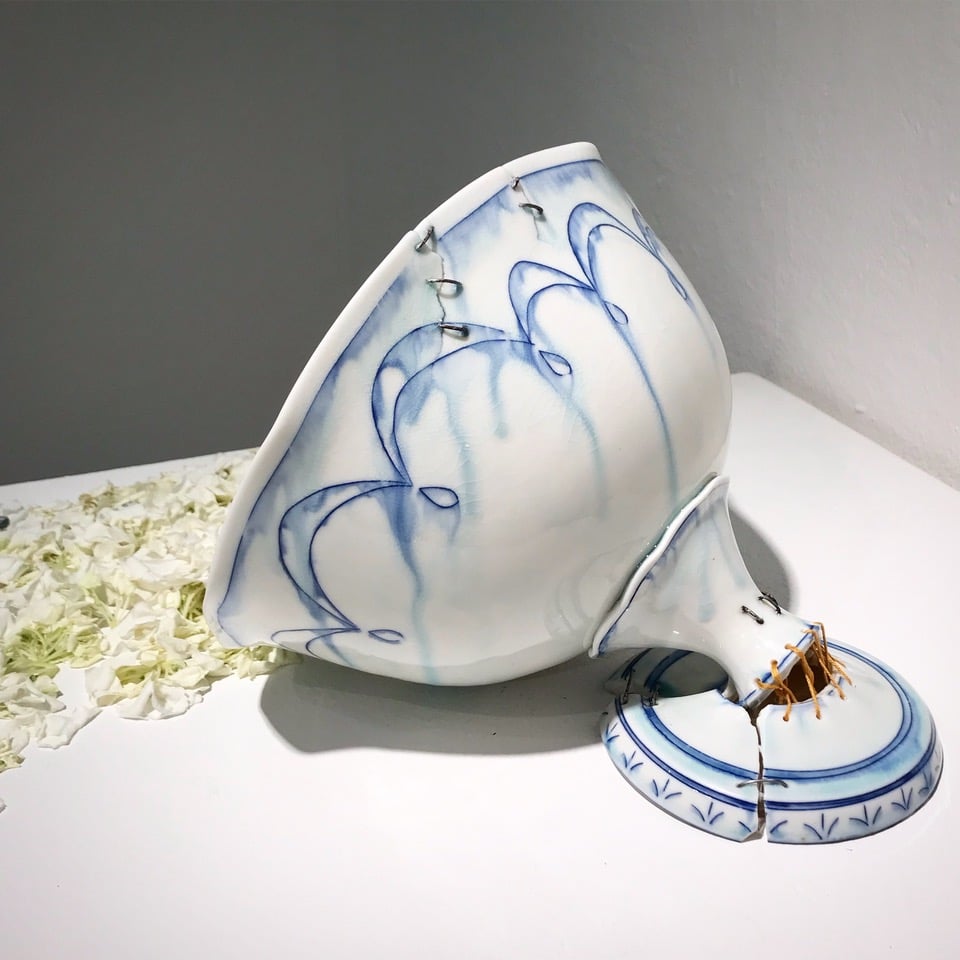
Then there is Amanda Barr, who channels her experiences of stigma, isolation, and discrimination into her ceramics. What began as a personal outlet has become a powerful form of reclamation, allowing her to express herself and transform challenges into creativity. One of her works depicts a white cup with blue decoration, knocked over as if by a tornado, with flower buds spilling out—an apt metaphor for a person struck by epilepsy, suddenly toppled by the force of the condition.
Overall, I think it’s going to be a fascinating exhibition. What I, as the sister of a brother with epilepsy, appreciate most is that the patient artists are not shown separately from the work of non-patients, including medical caretakers. It highlights that creativity and insight are not limited to those defined by diagnosis. The world is not just for one group. We, who are family members of people with epilepsy, also have a place in it. We are experts in our own right and should be recognized, just as anyone else would be.
For more information, please visit the gallery’s website or Instagram. A full list of the artists can be found here:
dnj Gallery | Current Exhibition – Conquer Your Own Rhythm
Instagram