
Leadership With Heart
The Abyss Taught Me That Connection Is Everything
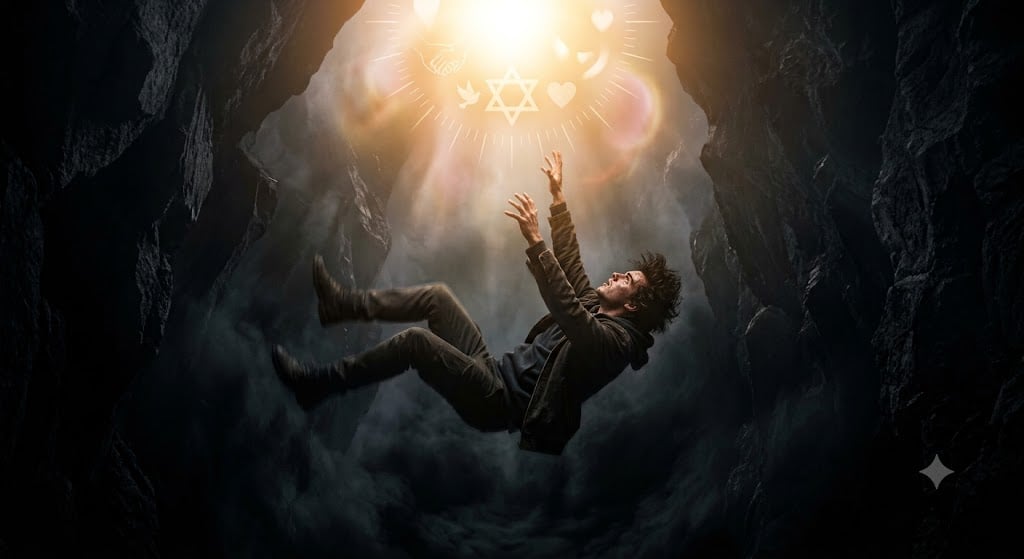
AI generated image
This week I had one of the most frightening dreams of my life. In it, I was severed from everyone I had ever known or loved—not merely alone, but cast into an emptiness beyond light, beyond warmth, beyond relationship itself. It was a darkness with no floor beneath it, a place where love could not reach and meaning simply stopped. The terror was not solitude, but the sense of being abandoned by the entire structure of life—cut off from companionship, from safety, from purpose, and from any possibility of return.
In that moment, the dream felt like a kind of spiritual death: not the end of the body, but the dread that everything we build, love, and become could vanish into nothing. It was a vision of being unmade, not by pain, but by disconnection.
The Meaning of Karet
That is why the Torah’s concept of karet came to mind so powerfully. Karet is often understood as one of the gravest punishments in the Torah, not because it necessarily means physical suffering, but because it means being cut off—from G-d, from covenant, from holiness, and from others. It means being severed from belonging, abandoned, alone, and cut off from the source of life itself. The dream gave that idea emotional force. It showed me, in a way words never could, that the worst punishment is not suffering in the body, but separation in the soul.
For the Jewish people, that same idea exists not only on an individual level but on a national one. The Torah warns that the land itself can “spit out” the people if they abandon the covenant. Exile is the national form of karet: to be scattered among the nations, alone, vulnerable, and defenseless. It is not only geographic displacement. It is spiritual loneliness. It is the pain of being uprooted from home, from belonging, and from the place where Jewish life is meant to flourish.
What Torah Says About Life and Connection
The Torah teaches from the beginning that this is not how we were created to live. “It is not good for man to be alone,” and a man is meant to cleave to his wife. Humanity’s first commandment is to be fruitful and multiply. These are not only instructions about family life. They are a vision of what life is for: to connect, to create, to continue, and to bring more life into the world.
That is what made the dream so painful. It was the opposite of all of that. It was the fear of having no one to cleave to, no future to build, no children to carry forward, no people to belong to, and no place to call home. It felt like life without covenant, without continuity, and without meaning. And yet the Torah insists that this is not our destiny. We are meant for attachment, for relationship, for purpose.
Death, Meaning, and Reunion
The dream also touched a deeper fear that many people carry but rarely say aloud: that death means being thrown into nothingness, where life was meaningless and all love is erased. That fear is so powerful because the soul knows we are made for purpose, not oblivion. Torah answers that fear in two ways. First, it gives us the image of being gathered to our forefathers—death as reunion, not disappearance. Second, it teaches that doing G-d’s will in this world is not lost; it is rewarded with spiritual life and connection in the world to come.
The nightmare changed something important in me. It reminded me that the purpose of this life is not simply to exist, but to live in a way that creates eternal meaning through connection—to G-d, to others, and to something larger than ourselves. The mitzvot are not just obligations; they are bonds. They connect us to G-d in this world and prepare us for a deeper form of life beyond it. Torah teaches that life becomes meaningful through relationship—with G-d and with one another.
Why Zion Matters
That is also why the Torah’s call to Zion feels so urgent. G-d does not ask us to remain scattered in the abyss of abandonment and exile forever. He calls us home to reconnect. The ingathering of the exiles is one of the central hopes of Jewish life: that we will return to our land, to our people, and to the covenant that makes us whole. Aliyah is not just a move across geography. It is an act of personal and national reconnection. It is a step away from fragmentation and toward wholeness, away from exile and toward life.
This has felt especially real since October 7. That day reminded Jews everywhere that we are not meant to live as isolated individuals, vulnerable one by one. We are a people, with a shared history, a shared destiny, and a shared homeland. The attack sharpened something painful but necessary: the understanding that Jewish continuity cannot be taken for granted. In times of loneliness, fear, and uncertainty, the call to return—spiritually, communally, and physically—becomes even more urgent.
What I Woke Up Knowing
When I woke from the dream, I was shaken in a way I can hardly describe. I literally jumped out of bed, breathless and terrified. The loneliness had felt endless, lifeless, and inescapable. But from that fear came gratitude—deep, overwhelming gratitude for family, friends, community, peoplehood, and the gift of being alive in a world where connection is still possible.
It changed the way I see everything. It made me feel, in a very personal way, how precious belonging really is. We often take connection for granted until we imagine what it would mean to lose it. The dream taught me that life is made meaningful not by isolation, but by love and relationship.
That is the great Jewish truth: we are made for light, not darkness; for connection, not abandonment. The abyss of loneliness is real, but it is not the final word. Torah teaches that life becomes meaningful through relationship—with G-d and with one another.
So let the dream stand as both warning and gift. It showed me the void so that, waking, I would recognize what stands against it: a people who choose each other, a land that waits, a covenant that does not expire. Karet is the terror of being cut off. Exile is that same terror, worn by an entire nation across a thousand generations. And still, the answer has never changed: return. Come home. Cling to what is holy, build what is lasting, and choose—again and again, in every generation—connection over the void.
Related Topics
Related Posts