CFO | Empower Society for Good I Author
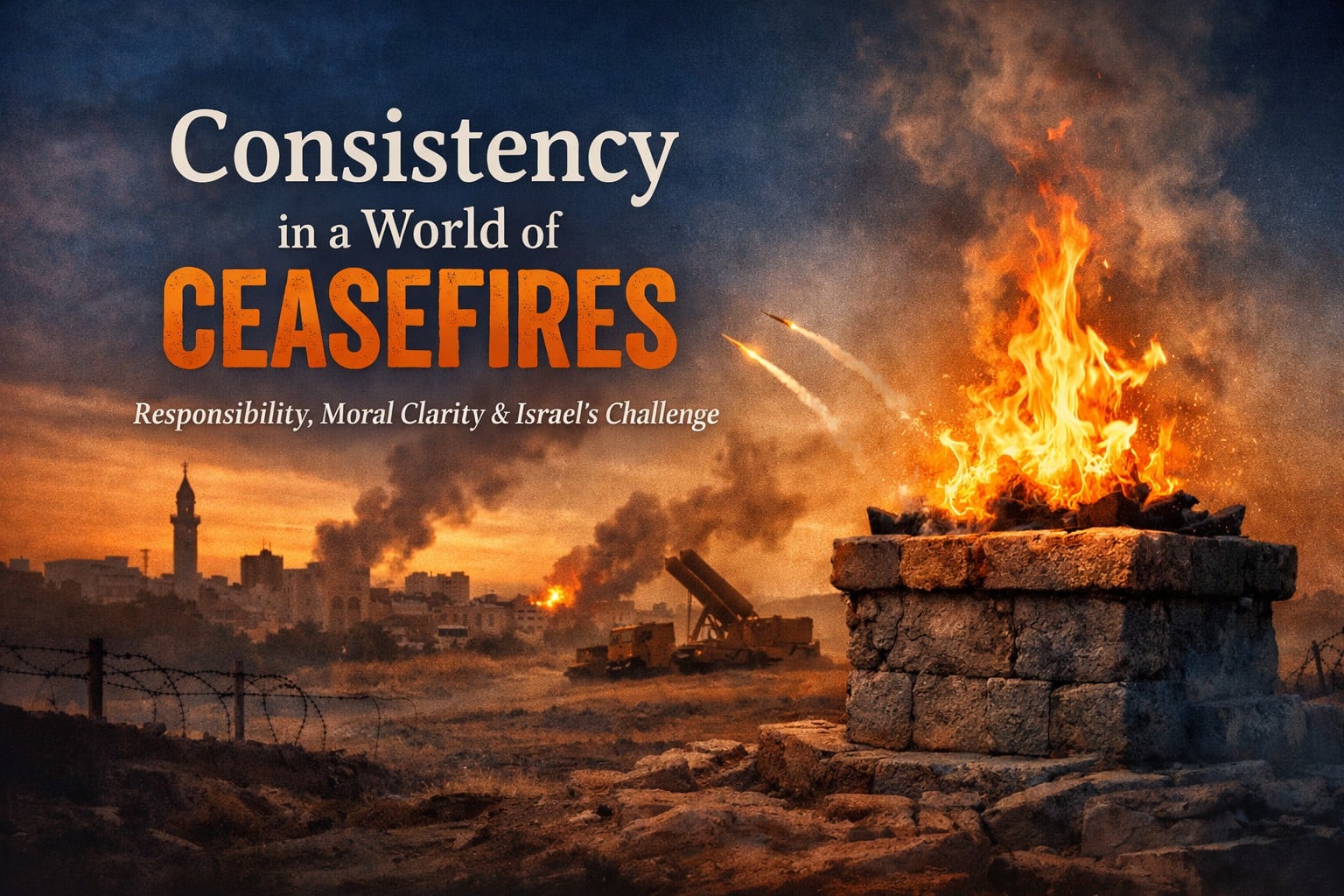
Consistency in a World of Ceasefires
Resilience Under Fire — What Parshat Tzav Teaches About Responsibility in an Unresolved World
We are living through a time of ceasefires—moments where the noise fades, the headlines shift, and the world moves on.
But what happens when the underlying reality has not changed?
Parshat Tzav speaks directly to that moment. It is not about dramatic action, but about something harder: consistency, responsibility, and sustaining a moral mission in an unresolved world.
Parshat Tzav was my Bar Mitzvah portion.
And if I’m honest, it didn’t feel particularly inspiring.
It is filled with details, repetition, and instructions about offerings and rituals. No dramatic stories, no defining moments—just what feels like technical maintenance.
But maybe that’s exactly the point.
Because most of life is not lived in big, dramatic moments.
Most of life is lived in the routine.
At the centre of the parsha is a simple command:
“A constant fire shall be kept burning on the altar; it must not go out.”
(Vayikra 6:6)
At first, this feels like a practical instruction.
But over time, I have come to see it differently.
The Torah is teaching something very deep:
It is easy to feel inspired once.
It is much harder to stay consistent.
The Discipline of Responsibility
If Vayikra taught us that closeness to God begins with responsibility,
Tzav teaches us that responsibility must be sustained.
Not only in moments of clarity.
Not only when it feels meaningful.
But every day.
The fire must continue to burn:
- when no one is watching
- when the moment has passed
- when inspiration fades
Holiness, the Torah suggests, is not built through occasional acts.
It is built through discipline and routine.
Through daily prayer, through learning, and through living a life guided by Halacha.
Through showing up—again and again—with consistency.
And for Israel, this discipline extends beyond the individual.
It is lived:
- in the defense of the country by the IDF
- in the battle for truth in the media
- in the resilience of a society that continues to function under pressure
At the same time, those who oppose Israel demonstrate a different kind of consistency.
Their messaging is persistent.
Their narratives are repeated.
Their hostility does not pause.
In such a world, the challenge becomes even greater.
Not only to act—but to sustain clarity, responsibility, and moral purpose over time.
“In a world of constant pressure, discipline is not optional—it is the foundation of survival.”
When the Fire Appears to Go Out
And perhaps this is where the message of Tzav becomes especially real.
There are moments when the world calls for a ceasefire—when the noise quiets, when headlines move on, and when there is a sense, sometimes genuine and sometimes premature, that the conflict has been contained.
We are hearing this now.
Talks of ceasefire frameworks with Iran, yet without a clear meeting of minds or a shared path forward.
Parallel discussions around Gaza, where any long-term arrangement remains unresolved so long as Hamas retains its military capability and continues to regroup.
Even as ceasefires are discussed, the underlying reality often remains unresolved.
Hamas remains armed.
Periods of calm risk becoming opportunities to rebuild.
Negotiations with Iran reflect competing conditions, not a clear shift in intent.
The surface may grow quieter.
But beneath it, the deeper tensions remain.
The Inner Fire
And this is where Tzav speaks with quiet clarity:
“A constant fire shall be kept burning… it must not go out.”
The Torah is not speaking about moments of intensity.
It is speaking about what must continue after the moment passes.
Because responsibility does not end when the world declares a pause.
Rav Kook helps us see this differently.
The fire is not only on the altar—it reflects an inner fire within the Jewish people, a spiritual energy that must continue to burn regardless of what is happening around it.
It is not a fire of destruction, but a fire of purpose, faith, and moral striving.
It is not dependent on approval, recognition, or even understanding.
It is sustained from within.
Resilience — The Fire That Has Never Gone Out
But sustaining that fire requires something more.
It requires resilience.
This week, we flew back to Israel on an emergency flight after our holiday was unexpectedly extended.
We didn’t have to.
We could have stayed.
We could have remained in one of the most beautiful places in the world—Cape Town, my birthplace—far from the tension, far from the uncertainty, far from the sound of sirens.
There were arguments both for and against.
But we chose to come home.
We bought additional tickets.
We rerouted our journey.
We flew via Paris, where we met others doing the same—some even making Aliyah in the middle of all this.
And it raises a deeper question:
Why?
What Is Home?
What is home?
Is it where life is easiest?
Or is it where your story is?
For the Jewish people, home has never been defined only by comfort.
It has been defined by connection.
By belonging to something that stretches across generations.
To live in Israel today is not simply to live in a country.
It is to live inside a story.
A story of exile and return.
Of destruction and rebuilding.
Of a people who refused to disappear.
Resilience — Then and Now
From exile to survival.
From the Holocaust to rebuilding.
From desert to a vibrant modern state.
And today, once again, resilience is lived daily.
In families whose lives are disrupted by sirens.
In young men and women who leave everything to serve.
In communities that absorb shock and continue forward.
History offers echoes.
During the Blitz, the British people endured relentless bombing—yet it strengthened their resolve.
And here too, something similar can be felt.
Each missile not only creates fear.
It also creates determination.
Solidarity.
Resilience.
A refusal to break.
The Deeper Story — Vehi She’amda
And perhaps this is not only a modern story.
It is the Pesach story—the story we will read next week at the Seder, where we connect the dots of our history and our identity.
A story of memory.
A story of connection.
A story we retell every year—not as history, but as identity.
We say and sing a few times in the various melodies that have entered our ritual:
“Vehi She’amda… in every generation they rise up to destroy us—and the Holy One saves us from their hands.”
This is not only a statement of danger.
It is a statement of continuity.
Generation after generation, the Jewish people have faced threats.
And this year is no exception.
Even now, as missiles are aimed at us, we find ourselves once again living inside that same unfolding story.
Despite or in spite of this war, I look forward to singing Vehi She‘amda
The story continues.
Our story continues.
A Higher Standard — Sustained
So, is Israel held to a higher moral standard?
In many ways, yes. Not always fairly, and not always consistently—but persistently.
Yet this expectation does not come only from the outside world.
It is rooted in the Torah itself.
Tzav adds something deeper:
It is not enough to have a moral vision.
The challenge is to sustain it.
Not just in moments of crisis.
But in moments when others declare the crisis over.
Because consistency is harder than conviction.
Closing Reflection
In a world where conflicts pause but do not always resolve,
where narratives shift but realities remain,
the Torah offers a different vision.
Not perfection.
Not immediate peace.
But persistence.
It may be moral.
It may be a belief in our mission as Jews—our story and our destiny.
But whatever its source, it is real.
And it is this that allows the fire not only to survive—
but to endure.
The world may call it a ceasefire.
But responsibility does not pause.
The story continues.
And the fire must not go out.
Footnote – as I put in the finishing touches of this reflection, the home front has alerted me to an incoming missile.
Related Topics
Related Posts