Constructing Peace / Constructing Images: AI and Human Endeavors
By Joe Nalven + ChatGPT + Claude
What follows is a catalogue essay for an exhibition that was never mounted. It places an AI-generated image of Gaza reconstruction beside the Board of Peace, a body with a charter, a chairman, and member states, and asks the same question of both: what does it actually say, as against what it is reported to say? The tidy answer, that a picture can be perfected and a peace cannot, is where this essay begins rather than where it ends.
. . .
Constructing Peace / Constructing Images
Catalogue Essay
Begin with the sign.
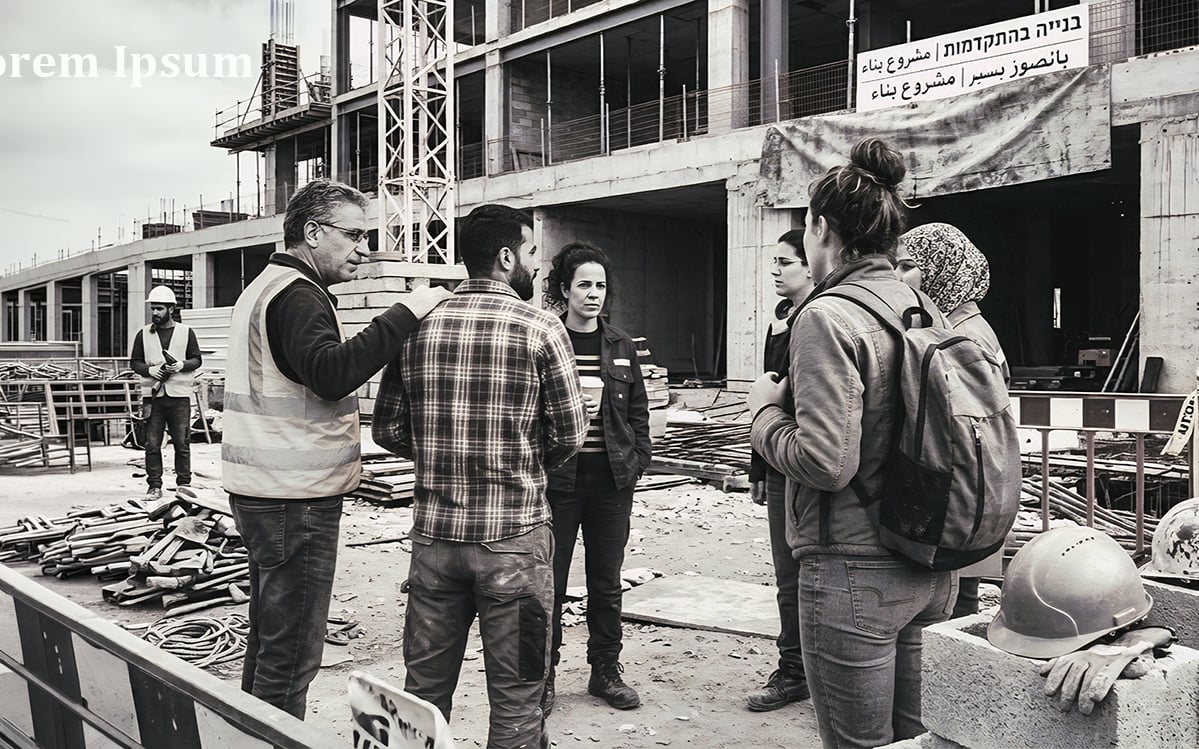
It hangs on a tarp above a half-finished concrete frame, in the image that opens this exhibition. The scene is a construction site. A small group stands in the dust, mid-conversation. One man gestures. A woman holds a coffee cup. Someone carries a backpack. Someone wears a headscarf. A hard hat and a pair of gloves rest on a block in the foreground, arranged the way a photographer would arrange them.
The sign is the point of the picture. It is the object that tells you what the picture means. Two peoples, two scripts, one project, one wall.
Now, read it.
The first line is Hebrew. It says construction in progress. Beside it, in Arabic, a building project. The second line begins with a word that is not a word. It has the shape of Arabic and the weight of Arabic and it exists in no dictionary and no dialect. Next to it sits a second cluster that is almost a word, close enough to a real spoken form that a reader could lean toward it, close enough to the root for walking or proceeding that a translation engine will happily convert it into a sentence. Then the same Arabic phrase from the first line repeats, unchanged, for no reason.
There is no English on the sign at all.
The image was made by an AI machine. When another machine was asked to describe it, that machine reported a trilingual sign in Hebrew, Arabic, and English. It called the sign perfectly centered, perfectly clean, and read it as a symbol of multicultural construction. It reported several workers in hard hats. One figure wears one, far in the background, and he is not part of the meeting.
None of this was malice, and none of it was carelessness in the ordinary sense. It was completion. The image offered a sign that half worked. The description finished it. It supplied the missing language, resolved the noise into meaning, and handed back a scene of mutual legibility that the picture itself does not contain.
. . .
This is what the exhibition is about.
The standard complaint against machine-made imagery is that it looks too clean. The surfaces are smooth. The people stand like models. The debris is arranged. Nothing is out of place, and reality is always out of place. Critics call it slop. The word is dismissive and it is not quite right.
The failure is not smoothness. The failure is confident completion, and it runs in a direction. The model does not invent at random. It fills the gap with the reading the person asking is most likely to want. Given a wall of half-language, it produces coexistence. Given an unclear scene, it produces cooperation. The gap is always closed toward the flattering interpretation, and closed so smoothly that the seam is invisible unless you go and look at the wall yourself.
Almost nobody goes and looks at the wall.
Three machines were shown this sign. The first reported a trilingual message of shared progress. The second, a translation engine, took the almost-word and returned a sentence in the first person: I will walk. The third declined to finish it, said plainly that the characters mean nothing, and explained why models trained on the visual pattern of a right-to-left script produce shapes that pass for writing.
Three readings, one wall. Notice that the sign is not blank. A blank sign invites nothing. This one sits at exactly the distance from meaning that pulls a reader forward. No one placed it there. It landed there, and it works on us anyway, and that pull is the subject of this exhibition.
. . .
The second object in this exhibition is not an object. It is the Board of Peace.
It is tempting to treat it as a hypothesis, a proposal, a thing still being imagined. That temptation is worth naming, because it is the same error the machine made. The Board of Peace is not a proposal. It has a charter, ratified in Davos. It has a chairman. It has member states in the dozens. It has an executive board, a stabilization force, a subsidiary Palestinian committee tasked with administering Gaza, and a disarmament agreement announced in stages. It is an institution that meets and decides and disburses.
So the comparison this exhibition sets up cannot be the easy one. We are not placing an imagined picture beside an imagined peace and observing that both are constructed. That would be a symmetry, and symmetries are comfortable. We are placing a made image beside a made institution, and asking the same question of both: what does it actually say, as against what it is reported to say?
The Board of Peace has its own sign. Every institution does. Its statements arrive polished, in the language of the historic and the monumental, with any conflicting words removed. Some of its critics argue that the structure underneath does not match the surface, and they point to specific things: the concentration of authority, the composition of the executive board, the absence of certain parties from certain rooms. Its defenders point to other specific things: the ceasefire that held, the crossing that reopened, the breadth of states that signed, the endorsement of the Security Council. Both sets of specifics are checkable. Neither is settled by looking at the sign.
That is the discipline this exhibition asks for. Not cynicism, which is only another way of not looking. The discipline of walking up to the wall.
. . .
The main galleries collect work by Israeli and Palestinian artists made in the shadow of reconstruction. Some of it imagines new civic space, new infrastructure, the ordinary machinery of a place that functions. Some of it stays with the rubble and refuses to look up. The works do not illustrate the theme. Several of them contradict it. That is why they are here.
What they share is a resistance to being completed by the viewer. They leave the gap open. A machine will close a gap unless it is asked, narrowly and directly, not to. One of the three declined, and it declined only because the question put to it was about the letters and nothing else. The default runs the other way. Much of the art in these rooms exists to hold a gap open long enough for a person to notice they were about to fill it.
. . .
Then there is the other room.
It holds work by artists who reject the framework this exhibition is organized around. Not artists who have failed to imagine peace. Artists who have considered this arrangement and refused it, for reasons they can state, and do. The word premature appears in their statements. So does the word erasure. Their arguments deserve to be met as arguments and not as symptoms.
We should be honest about what a separate room does. It contains. The main galleries receive the theme, and the objection receives an annex, and the architecture quietly ranks them while the wall text claims otherwise. We have not solved this. We chose the annex over the alternative of excluding the work, and over the alternative of dissolving it into the main hang where it would have read as seasoning. The choice is defensible and it is not clean. Visitors who find the arrangement itself objectionable are reading the building correctly.
. . .
Which brings us to the last thing, which is not about images or institutions.
A machine will one day make a picture that no one can distinguish from a photograph. That is a bounded problem and bounded problems tend to fall. Whether anything called peace arrives in that region on any particular timetable is not a bounded problem and no one honest will tell you otherwise. The essay could end there, and many such essays do, with the tidy observation that the fake is easier to perfect than the real.
But the more useful comparison is not between the image and the institution. It is between the machine and the person standing in front of the image.
The model looked at a broken sign and produced coexistence, because coexistence was the shape of the request. Look at what you do with the same sign. Some viewers of this picture see a beginning. Some see a stage set. Some see an insult. The picture is the same picture. The Hebrew still says construction in progress. The one working Arabic phrase still says building project. The invented word still means nothing, and it means nothing for everyone. What differs is what each of us brings to the wall and lays over the gap.
The same holds for the Board of Peace, and the stakes there are not aesthetic. A person who wants it to work will find the record confirming. A person who expects it to fail will find the record damning. Both will have read real things. Neither will have noticed the moment of filling in, because that moment never announces itself. It arrives feeling exactly like perception.
So the request this exhibition makes of you is old and unfashionable. Know yourself. Before you decide what the picture is doing, notice what you did to it. Ask why this resonated and not that. Ask which reading arrived so quickly that it never presented itself as a reading at all. The fault, as the line goes, is not in our stars.
We are, all of us, very good at finishing signs.
. . .
Note: The image was crafted with Gemini.