
Corrections Aren’t Enough: Hold the New York Times Accountable
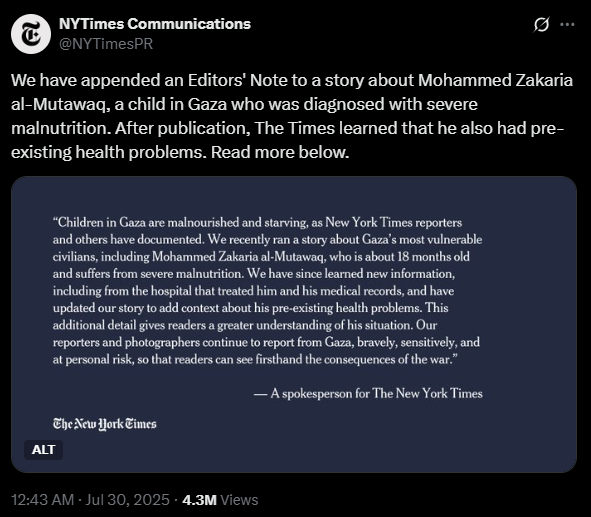
This morning, the New York Times quietly appended an Editors’ Note to one of its Gaza war stories. The subject: an 18-month-old child, Mohammed Zakaria al-Mutawaq, reported as suffering from severe malnutrition. The image was gut-wrenching. The story spread widely, adding fuel to an already emotionally charged global conversation.
But what readers didn’t know and what the Times didn’t include until after publication and backlash, was that the child also had pre-existing health conditions. This critical context came only after the photo had gone viral and the narrative had taken root.
This isn’t just about an oversight. This is about the most influential newspaper in the world shaping public perception with incomplete—and in this case, misleading—information. In a region as complex and sensitive as Israel and Gaza, the impact is not theoretical. It’s real. And dangerous.
A Pattern, Not a One-Off
This isn’t the first time the Times has stumbled in its coverage of Israel. From questionable sourcing to misleading headlines, there is a long-standing frustration with how the outlet frames stories about the region. Apologies and corrections are issued, but they often come too late after the damage has been done.
In an era of misinformation, trust in the press has never been more fragile. Every mistake chips away at public confidence, fuels accusations of bias, and opens the door for extremists on all sides to weaponize media narratives.
Corrections Are Not Enough
If the Times wants to maintain its role as a journalistic standard-bearer, it must be willing to treat misinformation, especially its own, with the seriousness it demands.
That means:
-
Independent accountability mechanisms for how stories are sourced and verified, especially in conflict zones.
-
Internal and external consequences for editorial failures. A correction box isn’t sufficient when the reputational and geopolitical damage is already done.
-
Transparency about the timeline of how stories are updated and what led to the original publication.
-
More diverse voices in the newsroom, especially when covering regions as nuanced and emotionally charged as the Middle East.
The Stakes Are Too High
Journalism is not about amplifying the most emotionally potent narrative at the expense of the full truth. It’s about telling the story that is both powerful and accurate.
When the New York Times gets it wrong, it doesn’t just mislead it legitimizes the growing skepticism that all news is biased, all media is agenda-driven, and all corrections are too little, too late. And more importantly, it leads to real-world consequences that can be dangerous and fatal.
If the Times wants to earn back trust, not just among Israelis but among anyone who still believes in the power of truthful journalism, it must show that getting it wrong has consequences.
Otherwise, how are we supposed to believe they’ll get it right next time?