Consultant and writer exploring policy, society, and identity
Could Jews Live in a Palestinian State?
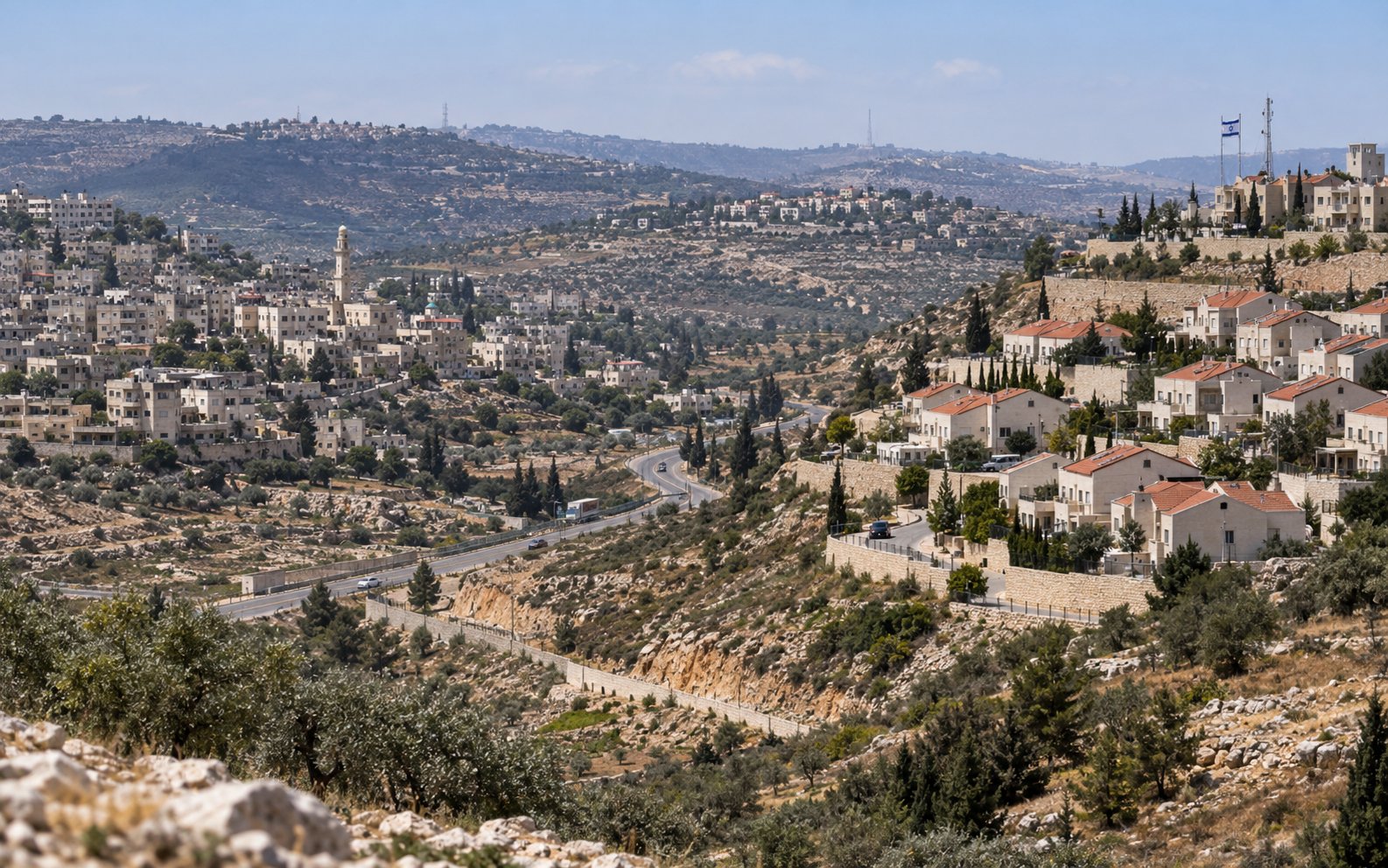
AI Composite Illustration (Bernard Markowicz)
Separating the right to live in the land from the right to rule it. The first post tested Omer Bartov’s argument against settler violence and unequal enforcement in the West Bank. This post moves from diagnosis to possibility: could Jews remain in Judea and Samaria while accepting Palestinian sovereignty? The conventional two-state formula usually assumes that most Israelis living beyond an agreed border would return to Israel. Religious-nationalist settlers respond that Jews cannot be forbidden from living in their ancestral homeland. That objection deserves to be taken seriously. But it leads to a question that is rarely asked:
What if Jews could remain—but as citizens or permanent residents of Palestine?
The question separates four things often treated as identical: historical attachment, residence, citizenship and sovereignty. The idea is not new.
- In 2014, Benjamin Netanyahu raised the possibility that settlers might remain in a future Palestinian state. Some settlers said they would consider it because their attachment was to the land itself, not necessarily to the government controlling it. The proposal angered members of Netanyahu’s coalition and Palestinian negotiators alike.
- A year later, Labor member of Knesset Hilik Bar proposed that settlers unwilling to relocate might become residents or citizens of Palestine. “If there can be a Jewish community in London and Berlin,” he argued, “then there can be a Jewish community in Palestine.”
- Palestinian responses have also contained an important distinction. Hanan Ashrawi said that Jews, like people of other religions, could apply for Palestinian citizenship. What Palestinian leaders rejected were extraterritorial settlement enclaves that remained under Israeli law and military protection.
In other words, the objection was not necessarily to Jews living in Palestine. It was to extensions of Israeli sovereignty operating inside it.
Three different arrangements
- One possibility is full Palestinian citizenship. Jewish residents would vote in Palestinian elections, pay Palestinian taxes and live under Palestinian law. This would be the clearest counterpart to Palestinian Arab citizenship in Israel. It would also demand the greatest change from settlers. They would have to transfer their national political allegiance and trust Palestinian courts and security forces.
- A second model would allow settlers to retain Israeli citizenship while becoming permanent residents of Palestine. They would accept Palestinian sovereignty and law, vote locally where they live and continue voting in Israeli national elections as Israeli citizens. Palestinians could receive reciprocal residence rights in Israel while retaining Palestinian citizenship. This is broadly the approach developed by A Land for All and the Holy Land Confederation.
- A third arrangement would leave Israeli settlements as protected Israeli enclaves inside Palestine. That would preserve Israeli law or military authority over the settlements.
This third model is not a meaningful acceptance of Palestinian sovereignty. It would reproduce the fragmented authority that already exists. The serious choice is between citizenship and permanent residence, not continued Israeli control under a different name.
What do settlers actually claim?
For some religious Jews, living in Judea and Samaria fulfills a biblically grounded connection to the land. If residence is the central claim, Palestinian sovereignty should not make Jewish life there impossible. But for the ideological settlement movement, residence and sovereignty are often inseparable. Settlement is understood not simply as living in a place but as advancing Jewish national redemption. Palestinian sovereignty is therefore seen as denying Jewish title to the land.
Security reinforces the theological objection. Settlers would have to live without routine protection from the Israeli army. After decades of violence, and especially after October 7, many would regard that as reckless. These fears cannot be dismissed. A Jewish minority in Palestine would need credible protection. But the proposal reveals the nature of the disagreement. Is the non-negotiable demand a Jewish right to live in the land, or an Israeli right to rule it?
Palestinians face their own test
Palestinians have strong reasons to distrust the proposal. Settlements were created and expanded under military occupation. Some stand on or restrict access to privately owned Palestinian land. Leaving every settlement in place could reward territorial expansion and transform an illegal or contested situation into protected private property.
A hostile, armed settler population could also destabilize a new state. Israeli citizenship might become a reason for Israel to intervene whenever disputes arose. Meanwhile, Palestinians could reasonably reject a right of Jewish residence that was not matched by meaningful rights for Palestinian refugees. A negotiated agreement therefore could not simply declare that all settlers may stay. It would require a land tribunal, restitution or compensation, removal of homes built on unlawfully taken property, disarmament, security screening and Palestinian authority over policing. People convicted of serious violence might be excluded. New unilateral settlement would have to end. Reciprocal Palestinian residence rights in Israel would also be necessary if the proposal were to embody equality rather than preserve advantage.
The analogy with Arab citizens of Israel
If Israel can be a Jewish national state with a Palestinian Arab minority, Palestine should in principle be able to become a Palestinian national state with a Jewish minority. But the analogy is also a warning. Palestinian citizens of Israel possess citizenship and voting rights, yet many describe persistent inequalities in land allocation, planning, public investment and national recognition.
A future Palestine should not merely reproduce those shortcomings in reverse. Jewish residents would require enforceable rights to property, religious practice, Hebrew education, communal institutions and access to holy places. Palestinian constitutional drafts contain equality provisions, but constitutional language would need independent courts and reliable enforcement. Equality cannot mean alternating which population is dominant.
An institutional problem, not just a moral aspiration
The permanent-residence model raises practical questions: which state would prosecute a resident accused of violence? Who would collect taxes and provide schools, health care and utilities? Could residency pass to children? Would residents be permitted to serve in the Israeli military? How would weapons be regulated? What would happen when citizenship and residence obligations conflicted?
The Holy Land Confederation proposal addresses many of these questions. It keeps sovereign authority with the state in which a person resides, while national political rights remain with the state of citizenship. It also contemplates trial periods and denial of residence to people who threaten the agreement. These provisions make the proposal complex. They also make it real enough to evaluate.
What this adds to Bartov
Bartov argues that Zionism became a state ideology of domination. A confederal model asks whether Jewish self-determination can be preserved without extending Israeli political control everywhere Jews live. Israel would remain the state in which Jews exercise national self-determination. Palestine would provide the same for Palestinians. Neither state would have to be ethnically empty, and neither people would have to surrender its attachment to the wider homeland.
The proposal has little current political support. Trust is low, Palestinian institutions are weak, most ideological settlers reject Palestinian sovereignty and many Palestinians regard the settlements themselves as instruments of dispossession. But political difficulty does not make the question meaningless. It helps identify the real obstacles. A homeland is where a people belongs. A state is the institution that governs. Peace may require Israelis and Palestinians to accept that the two do not have to occupy precisely the same map.
Could Jews live safely under Palestinian sovereignty? Could Palestinians protect Jewish communities without treating them as extensions of occupation? If either answer must always be no, then the obstacle is no longer geography alone. It is the belief that belonging requires exclusive control.
Sources
- A Land for All: founding principles
- The Century Foundation: Two States, Together
- Holy Land Confederation legal system
- Times of Israel: Palestinians say yes to Jews, no to Israeli enclaves
- Times of Israel: proposal allowing settlers to remain
- Christian Science Monitor: settlers willing to remain
***
Related Topics
Related Posts