
Counter-Terror Without Counterinsurgency
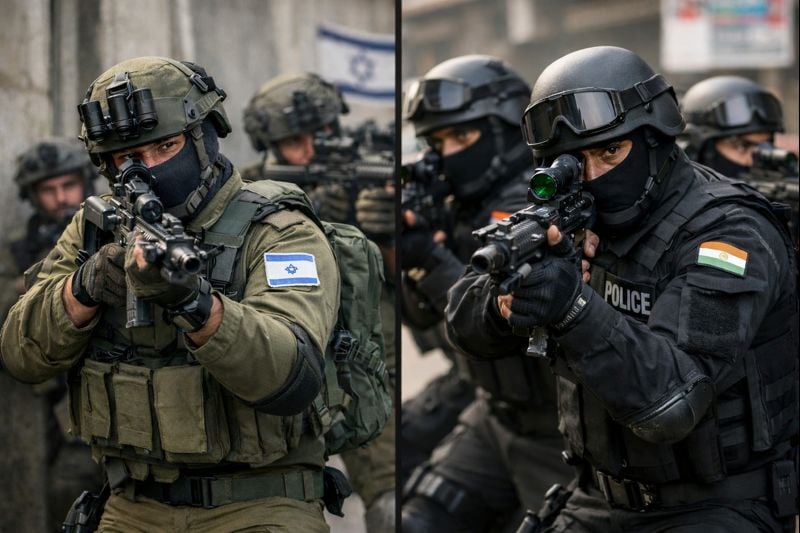
Discussions on modern conflict place all wars in same category. In practice, states operate across very different strategic modes, and confusing them produces bad policy and worse analysis. Contemporary violence fits into three operational buckets: conventional war, counterinsurgency, and counter-terrorism. Conventional war involves state militaries fighting for decisive outcomes and territorial control. Counterinsurgency is population-centric, combining military force with governance and political legitimacy. Counter-terrorism is something else entirely: a security posture focused on degrading terrorist networks, with no ambition to politically transform the societies from which they emerge.
Seen through this framework, Israel and India have independently converged on a strikingly similar counter-terror model, despite radically different geographies, cultures, and political systems. Neither country treats terrorism primarily as a symptom of local governance failure. India has dealt for decades with jihadist violence linked to Kashmir and beyond while Israel has confronted terror organizations rooted in Palestinian militancy and wider Islamist movements for generations.
In both contexts, the violence draws legitimacy from ideological narratives that extend well beyond material grievances. Territorial reclamation, religious obligation, and civilizational struggle do not meaningfully shift with improved administration or economic development. As a result, neither state approaches terrorism as a problem to be “solved” through nation-building or population-centric reform.
Instead, both countries have embraced precision over presence. Israel’s counter-terror posture relies heavily on airpower, special operations, and intelligence-driven targeting. Precision-guided munitions allow Israeli forces to strike terrorist leadership, weapons depots, and operational infrastructure without committing to prolonged ground control. The objective is disruption and deterrence, not occupation or governance. This allows Israel to simultaneously pursue counter-terror operations in Gaza, Lebanon, Syria, Yemen, Iraq, and Iran without overstretching their resources.
India’s approach follows the same strategic logic. Operation Sindoor in May 2025 marked India’s most significant strikes on Pakistani territory since 1971. Following the Pahalgam attack that killed twenty-six civilians, India conducted precision strikes against terrorist infrastructure across Pakistan, targeting headquarters associated with Lashkar-e-Taiba and Jaish-e-Mohammed. The operation employed precision-guided munitions like the domestically made BrahMos cruise missiles, and domestically integrated SCALP missiles. India’s chief of defense staff later emphasized that clearly defined objectives created space for punitive action within the escalation ladder, with no attempt to seize or hold territory.
The convergence extends to operational tempo. Both states have shifted toward persistent, low-intensity campaigns rather than episodic responses. Israel openly describes this as “mowing the grass”—regular operations to degrade terrorist capabilities before they reach critical mass. India, though more constrained by Pakistan’s nuclear threshold, has gradually normalized cross-border strikes as an instrument of statecraft. In both cases, the pattern is recurring, calibrated violence designed to keep threats manageable rather than decisively eliminated.
Counter-terrorism in both countries is intelligence-driven rather than territory-driven. Israel’s intelligence fusion, combining signals intelligence, human sources, and persistent surveillance, enables rapid targeting cycles. Operation Sindoor demonstrated India’s evolution in the same direction, with long-range precision weapons expanding operational reach while limiting exposure. The underlying assumption is identical: terrorist threats are networked and mobile, not defined by lines on a map.
Equally important is what both states deliberately avoid. Neither treats counter-terror as a prelude to counterinsurgency. Large-scale occupation, population management, and political reconstruction expand the surface area of conflict and generate self-sustaining escalation dynamics. India’s strikes explicitly avoided territorial objectives, preserving escalation control below the nuclear threshold. Israel’s withdrawals from southern Lebanon and Gaza reflected a similar recognition that permanent ground control often creates more problems than it solves.
This approach faces predictable criticism. Human rights organizations point to civilian casualties. Strategic theorists warn that “mowing the grass” is endless and morally corrosive. These critiques have force, but the counterargument advanced by both states is empirical: the alternatives have failed more dramatically. The United States spent two decades and trillions of dollars attempting to transform Afghanistan and Iraq, Israel’s territorial withdrawals empowered rather than pacified Hamas, and India’s diplomatic engagement with Pakistan has not ended cross-border terrorism. The question, then, is not whether the current approach is ideal, but whether any available alternative has proven more effective or less costly.
Israel and India have developed a distinct mode of warfare that sits between policing and conventional war, prioritizing restraint, precision, and strategic clarity over illusions of final resolution. Terrorism is treated as a security threat requiring operational response, not a governance problem demanding political transformation. Precision strikes substitute for territorial control, intelligence dominance matters more than permanent presence. Both states aim for deterrence, not transformation.
The convergence is striking precisely because it emerged independently, under different constraints, against different adversaries. Yet the strategic logic remains the same. In an era where many states still confuse counter-terrorism with nation-building, Israel and India illustrate a hard lesson learned the difficult way: counter-terrorism is not counterinsurgency, and pretending otherwise produces disasters far more reliably than it produces peace.