London based entrepreneur, cybersecurity analyst doing a PhD in AI
The Measure of a Nation Is Its Weakest Citizen
Every civilisation celebrates strength.
Strong economies.
Strong militaries.
Strong leaders.
Strong institutions.
Strength is visible.
It is easy to admire.
Yet the Hebrew Bible and the Quran both arrive at a profoundly counterintuitive conclusion:
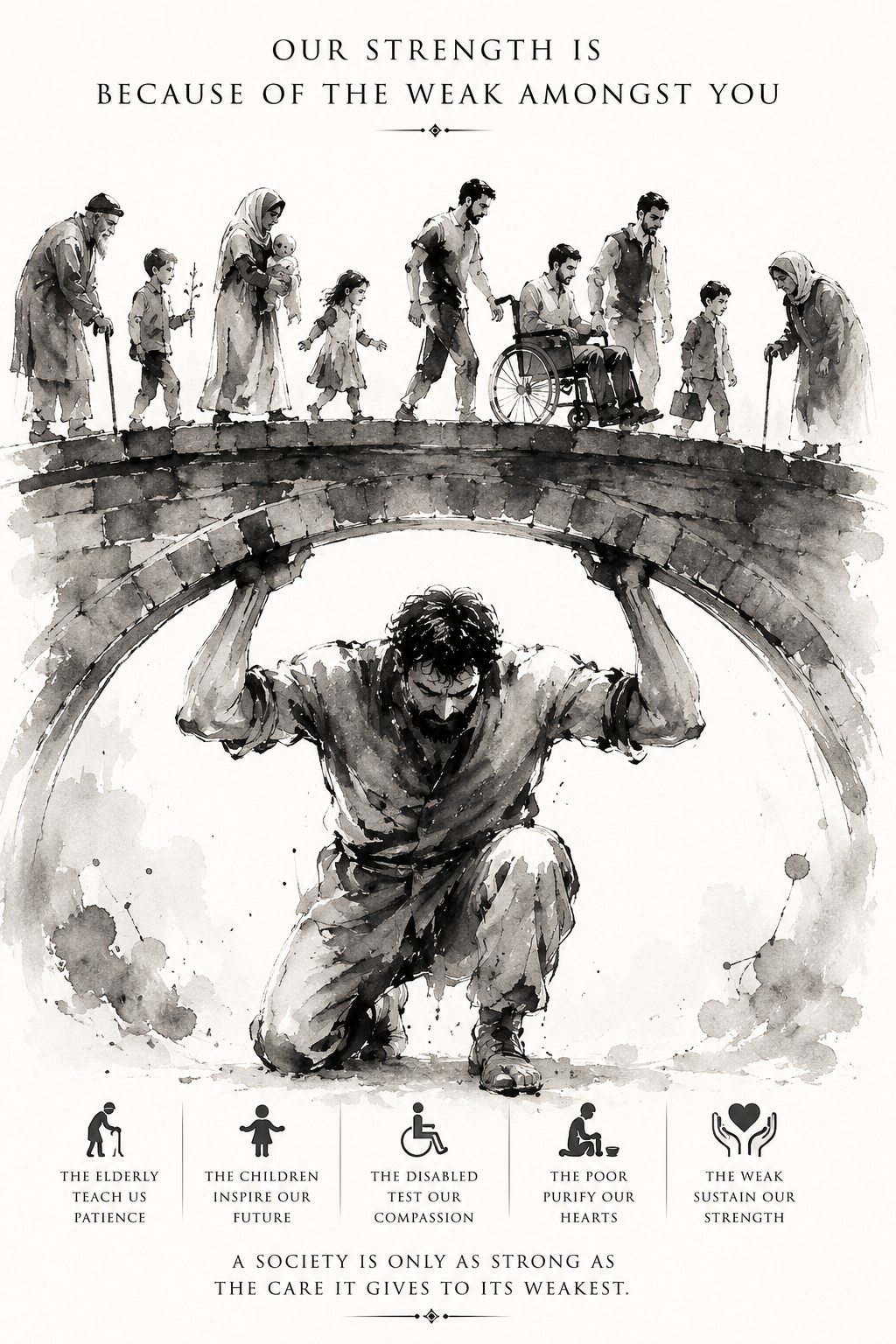
A society’s greatest strength is not found in its strongest people.
It is revealed by how it treats its weakest.
The Prophet Muhammad ﷺ is reported to have said:
“Are you given victory and provision except because of your weak?”
(Sahih al-Bukhari)
It is one of the most remarkable inversions in religious literature.
Human beings instinctively attribute success to generals, entrepreneurs, politicians and inventors.
The hadith directs our attention elsewhere.
To the widow.
The orphan.
The poor.
The vulnerable.
The overlooked.
It suggests that a society’s blessings cannot be understood merely through military strength or economic output. They are intimately connected to whether those with power recognise their obligations to those without it.
The Hebrew Bible speaks with striking clarity.
“You shall not pervert the justice due to the stranger or to the fatherless, nor take a widow’s garment in pledge. But you shall remember that you were a slave in Egypt.”
Deuteronomy 24:17–18
Notice the reasoning.
Justice is not grounded in sentiment.
It is grounded in memory.
Israel is commanded to remember what vulnerability felt like.
Its own history of weakness becomes the foundation of its moral responsibility.
Memory becomes an institution of justice.
This principle runs throughout the Hebrew Bible.
The orphan.
The widow.
The stranger.
Again and again they appear—not because they are numerous, but because they possess the least power to defend themselves.
The moral health of the nation is measured by whether justice reaches those who cannot purchase it.
Modern economics increasingly arrives at a similar conclusion.
Nobel laureate Amartya Sen argued that development should be measured not merely by wealth, but by people’s capabilities—the genuine freedom to live healthy, educated and productive lives.
Human capital is not created by concentrating opportunity among the already successful.
It grows when barriers preventing others from contributing are removed.
The child who receives an education today may become tomorrow’s physician.
The refugee who finds stability may become tomorrow’s entrepreneur.
The disabled student given access may become tomorrow’s engineer.
The elderly citizen treated with dignity reminds every younger generation that human worth is not conditional upon productivity.
Compassion is not merely kindness.
It is long-term investment.
History repeatedly demonstrates that societies ignoring their most vulnerable eventually weaken themselves.
Extreme inequality erodes trust.
Persistent exclusion wastes talent.
Communities that abandon justice find themselves paying later through instability, poorer health, reduced productivity and fractured institutions.
The costs simply arrive on a different balance sheet.
Perhaps that is why both the Hebrew Bible and the Quran insist that strength begins where the world least expects to find it.
Not in the palace.
Not in the marketplace.
But in the dignity afforded to those who have the least.
The temptation of every prosperous society is to believe that the successful carry everyone else.
The deeper truth may be the reverse.
A civilisation remains worthy of its success only so long as it remembers those unable to compete for it.
The measure of a nation is therefore not the height of its tallest buildings.
Nor the size of its economy.
Nor the sophistication of its weapons.
It is whether the widow finds justice.
Whether the orphan finds protection.
Whether the stranger finds dignity.
Whether the vulnerable are seen not as burdens, but as fellow human beings whose wellbeing ultimately shapes the destiny of everyone else.
Perhaps that is what both the Hebrew Bible and the Prophet Muhammad ﷺ were teaching all along.
The strong do not make a civilisation great.
They reveal how great it already is.
The weak do.
The Prophet ﷺ turns that assumption upside down:
- Your military victories…
- Your prosperity…
- Your provision…
…are not despite the weak.
They are because of them.
Ibn Hajar al-Asqalani, in Fath al-Bari, explains that the weak are a source of divine blessing because of:
- their sincerity,
- their humility,
- and their supplications (duʿā’).
He writes that while the strong contribute through courage and physical effort, the weak contribute through sincerity and prayer, and both are indispensable.
The hadith is not simply saying, “Be kind to the weak.” It is making a much deeper claim:
A civilisation misunderstands the source of its own strength if it believes prosperity comes only from its strongest members.
That pairs beautifully with the repeated concern of the Hebrew Bible for the widow, the orphan, and the stranger, suggesting that the moral and societal strength of a nation is reflected in how it treats those with the least power.
Related Topics