
Clarity for Leaders in Law, Policy, Finance, and Covenant
Covenant vs. Construct: A Black Jewish Stance
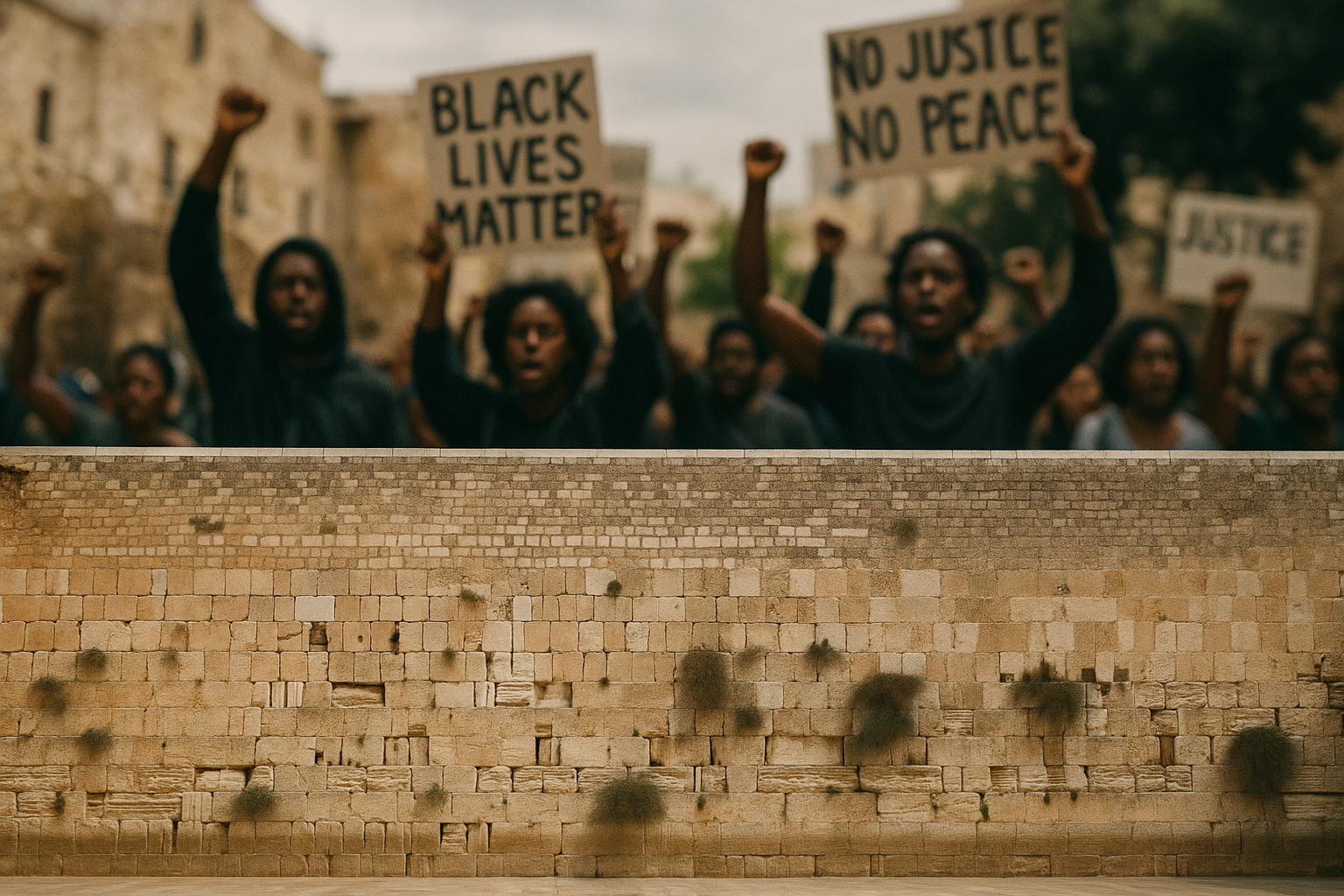
The Western Wall in Jerusalem stands as a symbol of covenantal endurance, juxtaposed with protest imagery of the African diaspora — a contrast between rooted continuity and modern grievance politics.
I write from love for both the African American and Jewish communities. My heritage binds me to both, but my covenant binds me first to truth. If the Jewish people were in error, I would say so. But they are not. They remain heirs of an unbroken covenant, a people whose continuity I will not allow to be erased. This stance is not grievance; it is fidelity — to history, to justice, and to the G-d who keeps covenant.
_______________________________________
Covenant and Civilization
Over the past twenty years, the escalation of attacks on Jews has been horrifying to watch. In the last five years, these hostilities have intensified into near-daily assaults. Since October 7, 2023, my own family has not been spared: the mezuzah was torn from our home, my niece’s school in North Toronto was targeted by gunfire, and my children were kept home due to bomb threats. This pattern repeats itself in classrooms, legislatures, media outlets, and even in institutions that claim to stand for justice. I am no stranger to prejudice. What compels me to write now is not only the persistence of antisemitism but its growing prevalence among those who cloak themselves in the language of diversity, equity, and inclusion. Once a champion of DEI, I warned years ago that it risked becoming a stage for selective compassion. That warning has now materialized, particularly within the African American community, where growing numbers loudly proclaim pro-Hamas solidarity under the guise of Palestinian justice while wielding DEI as a weapon against Jews.
My identity is not abstract. I am a first-generation Canadian, the daughter of Aruban and Vincentian parents, carrying the legacy of the Garifuna, a people forged from African and Indigenous Kalinago under colonial disruption. I am also Jewish by genetics and covenant, part of a people whose civilization has endured more than three millennia of exile, survival, and fidelity to law. These are not identities in conflict; they are the truth of who I am. Yet I have been told repeatedly that I must choose between my African descent and my Jewishness. What is really being demanded is that I privilege a narrative of trauma over a covenant of continuity.
Such demands are not only ignorant; they attempt to erase both my personhood and my Jewishness. Jews encompass every racial phenotype yet share a genetic indigeneity that binds us across continents and centuries. DNA studies confirm Jewish continuity from the Levant into Africa, Europe, and beyond. Priestly markers such as the Cohen Modal Haplotype appear among Jewish communities in Morocco, Yemen, and within the Lemba of southern Africa. Jewishness is not a lifestyle preference but a covenantal reality: an ethno-civilizational people tied by covenant, genetics, law, land, memory, and lineage. Some within the Black diaspora reduce Ashkenazi Jews to “whiteness” in America, collapsing them into the nation’s racial hierarchy. Worse still, this reframes Jewishness into Ashkenazi narratives alone, silencing Sephardi, Mizrahi, Ethiopian, Indian, and African Jews who exist equally within the Jewish family. To call Jews “white” is not solidarity. It is erasure twice over: of covenantal truth and of Jewish diversity.
Jewish presence has long endured across Africa. Communities flourished in Egypt, Carthage, Libya, Morocco, and Tunisia from antiquity through the medieval period. In Ethiopia, Beta Israel preserved Torah traditions for centuries and are recognized today as heirs of Israel. Across the Sahel, Jewish traders moved through Mali and Timbuktu, while Sephardic exiles resettled in Senegambia and Cape Verde after the expulsions of 1492 and 1497. Along the Swahili coast, Yemenite Jews extended trade into the Horn of Africa. In the south, the Lemba of Zimbabwe and South Africa maintained Jewish practices, including priestly clans linked to the Kohanim of Israel. Taken together, these histories prove Jewish civilization was never confined to the Middle East or Europe but has also been rooted in African soil.
By contrast, the modern term “Black” is a colonial construct, collapsing Yoruba, Ashanti, Nubian, and Ethiopian specificity into a single undifferentiated color. It functions as shorthand for the racialized experience of the diaspora, but it is not civilizational. In some contexts, Blackness has even been exalted as the central object of loyalty. What is being elevated in those moments is not a blueprint of continuity but a memorialization of trauma. And whenever trauma is enthroned as identity, it fragments memory, turns pain into grievance, and leaves people more defined by the wound than by the future.
Jewish history has never denied suffering. The slavery of Egypt, the exile of Babylon, the destruction of the Temple, the expulsions of Europe, and the Shoah are remembered in ritual and liturgy. Yet remembrance has never been the foundation of Jewish identity. Covenant is, and it endures. Even in exile, identity was built not on the weight of pain but on Torah and law sustained across generations. Where others risked elevating trauma into identity, Jews preserved a blueprint that transformed survival into continuity.
Some Africans in the diaspora argue that their attachment to trauma is inevitable because slavery and segregation remain within living memory. Diasporic Africans endured more than 450 years of enslavement through the transatlantic system, and the aftershocks still reverberate. Today, modern slavery persists: in Brazil, more than 25,000 people continue to endure forced labor. Trauma is real, and its generational imprint undeniable. Yet Jews also bear trauma, from Egypt to Babylon to Auschwitz. The difference is that Jewish civilization never sanctified suffering as identity. Memory of persecution was preserved, but always within covenant. Torah transformed pain into obligation, not grievance. Exile became a call to holiness, not a license to worship victimhood. That blueprint preserved Jewish continuity whether in the synagogue, study hall, or public square.
The Jewish people are not merely adherents of a faith but participants in an unbroken civilization. They sustained genetics, law, language, land, and institutions across millennia. The Torah, codified in halakhah, functioned as constitution. Archaeology affirms this continuity, from the Dead Sea Scrolls to synagogue inscriptions across the Roman Empire. Even in dispersion, Jews carried their civilization intact, preserving it as binding law.
Africa also produced great civilizations — Egyptian, Nubian, Ethiopian, Ashanti, Yoruba, Zulu, and Malian. Some endure in name and practice: the Yoruba in Nigeria and Benin, the Ashanti in Ghana, the Ethiopians in their Orthodox liturgies and imperial memory. These are living cultures, not extinct relics. Yet they are not “Black” in the racial sense. Yoruba are Yoruba. Ashanti are Ashanti. Ethiopians are Ethiopians. To collapse them under the single label “Black” is to flatten their specificity into a colonial category forged through the Atlantic system of slavery and empire.
The distinction must be made not to diminish Africa but to honor it. The term “Black” was born of rupture. Millions were torn from their languages, laws, and lands, reduced to a color rather than sustained as civilizations. Out of that wound, new diasporic cultures emerged: African American, Afro-Canadian, Afro-Caribbean, Afro-Brazilian. They are profound achievements of resilience, yet they are not continuous civilizations in the covenantal sense. They are cultural formations born of fracture rather than the sustained law and covenant that preserved Israel. Africans are evolutionary; Jews are civilizational. Africa gave the world its biological origin; Israel gave the world its covenantal destiny. One is the origin of the body of humanity, the other the keeper of humanity’s moral continuity.
This difference is captured in the scriptural mandate recited even in exile: “This Book of the Torah shall not depart from your mouth, but you shall meditate on it day and night, so that you may be careful to do according to all that is written in it. For then you will make your way prosperous, and then you will have good success” (Sefer Yehoshua 1:8). The command is not metaphorical. It is the blueprint of continuity. Jewish civilization was designed to survive dispersion by making Torah, memory, and obligation portable.
Conversely, African civilizations relied largely on oral transmission. Folklore and proverb preserved wisdom, but oral systems proved fragile under colonization and forced displacement through enslavement. Continuity fractured, identities were violently uprooted, and much was lost. The Jewish experience demonstrates what occurs when law is written, recited, and carried across centuries: exile does not erase identity; it refines it.
Erasure, Appropriation & Covenant Continuity
Modern debates on race and solidarity have birthed distortions that are as dangerous as they are hypocritical. Among the most glaring is the attempt to cast Jews as white oppressors. In 1967, James Baldwin argued that “Negroes are anti-Semitic because they are anti-white,” collapsing Jewishness into America’s racial hierarchy. His words have since been weaponized to suggest that Jews were absorbed into whiteness as beneficiaries of empire while Black Americans remained its victims. That framing strips Jews of their history of exile and indigeneity, forcing them into a colonial template alien to their covenantal reality.
Scholars have sometimes reinforced this distortion. Karen Brodkin’s How the Jews Became White Folks was meant as an analysis of American racial constructs, but it has been misused as proof that Jews themselves are complicit in colonialism. To reduce Jewish identity to assimilation is to erase its genetic, covenantal, and archaeological reality. Jews did not “become white.” They remained exiles, preserving continuity through covenant and law while navigating categories imposed by empire.
Appropriation compounds the erasure. From the trauma of slavery emerged the Hebrew Israelite movement, claiming African Americans are the “true Jews” and historic Jewry impostors. Their claims are not grounded in Torah, halakhah, or archaeology but in pain reshaped into counterfeit lineage. This does not heal rupture; it weaponizes it, turning longing for rootedness into hostility against Jews who preserved identity through dispersion. Instead of solidarity, grievance mutates into theft.
The hypocrisy deepens when silence falls on Arab enslavement of Africans. For centuries, Arab Muslims conducted a vast slave trade across North Africa, the Middle East, and the Indian Ocean — a trade that long outlasted the transatlantic system and persists in some regions even now. In Mauritania, slavery was criminalized only in 1981, yet reports of forced servitude continue. Human Rights Watch has documented African migrants enslaved in Libya. Yet many of the same voices that denounce Israel deflect when confronted with these realities. If global justice is the standard, outrage cannot be selective.
I have also encountered another tactic. When asked whether they support Israel’s right to exist, some in the Black diaspora reply with innuendo: “Ask the Ethiopians.” The reference points to a discredited sterilization story rejected by Ethiopian-Israeli leaders themselves. To recycle it as proof of systemic racism in Israel is not truth-seeking but distortion. Racism exists in Israel as it does everywhere, yet only in Israel are isolated grievances universalized as a moral litmus test while the atrocities committed against Jews are minimized or excused. This is not balance. It is moral evasion, inversion, and subversion.
Rhetoric has consequences. Louis Farrakhan’s sermons declaring Jews oppressors have inspired violence, including the 2019 Jersey City kosher market shooting carried out by adherents of extremist Black Hebrew Israelite ideology. When such distortions are amplified through media and DEI platforms, trauma becomes weaponized grievance. The result is not solidarity but division, not justice but incitement.
The most sobering evidence of these distortions comes from data. According to the Anti-Defamation League, 36 percent of African Americans agreed with at least six antisemitic tropes — the highest figure in any U.S. demographic group. Polling after the October 7 Hamas massacre showed 43 percent of Black Americans favored a ceasefire; by April 2024 that number had surged to 68 percent demanding a permanent halt. Sympathy with Gaza was rising, yet not anchored in historical truth. More than 1,000 African American pastors even urged the White House to push for an immediate ceasefire, cloaking their appeal in compassion while ignoring Hamas’s genocidal charter. Compassion untethered from justice collapses into sentimentality.
Meanwhile, the PRRI Structural Racism Index (2022) revealed that Jewish Americans score slightly lower than average on systemic racism attitudes. This undercuts claims of entrenched Jewish anti-Black racism and highlights a stark imbalance: Jews are falsely cast as oppressors while absorbing a disproportionate share of bigotry.
Influential voices in media and academia have carried these distortions further. Ta-Nehisi Coates collapsed Jewish continuity into grievance by aligning it with Gazan victimhood. Marc Lamont Hill stood before the UN, declaring “from the river to the sea,” a phrase long recognized as a call for Israel’s destruction. Joy Reid has been reported to invoke antisemitic tropes; Ilhan Omar used “Benjamins” and dual-loyalty insinuations; Kanye West and Kyrie Irving broadcast antisemitic conspiracy theories to millions. Their platforms magnified bigotry into virality, making antisemitism appear like cultural debate rather than hatred. These narratives then spill into Canada, the Caribbean, and Africa, shaping discourse far beyond U.S. borders.
Yet the story is not one of unbroken hostility. Within African American life, courageous voices have risen. Van Jones condemned Kanye West’s rhetoric. Charles Barkley denounced Kyrie Irving’s conduct. Floyd Mayweather and Shaquille O’Neal voiced unequivocal support for Jews. These leaders prove that antisemitism in the Black community is real and rising, but not universal. It is contested, and it can be resisted.
The deeper danger lies not only in rhetoric but in a distortion of justice itself. The prophet declared: “He has told you, O man, what is good; and what does the Lord require of you but to act justly, to love mercy, and to walk humbly with your God” (Sefer Michah 6:8). Justice in Torah is not political sentiment but moral order. Mercy flows righteously when anchored in justice, which is foundationally holiness. Humility grounds both. As the Lubavitcher Rebbe, Menachem Mendel Schneerson, warned, compassion without discipline becomes cruelty. To act justly is not to indulge grievance but to embody righteousness.
Both liberal African Americans and liberal Jews make the same mistake: they elevate constructs into identities, “Blackness” or “progressive Judaism,” and then confuse those constructs with continuity. But constructs collapse under history’s weight. Identity rooted in covenant endures; identity built on trauma or politics fractures. DEI promised inclusion, but too often became a cudgel against Jews. Its unraveling should surprise no one. What was wielded as an idol cannot stand as a principle.
The contrast remains stark. Jews endured more than three millennia of trauma, yet never sanctified suffering as identity. They preserved covenant through Torah and halakhah, transforming pain into obligation. Africans in the diaspora were severed from civilizations and often left with trauma at the center of identity. That wound deserves healing, but healing cannot come by scapegoating Jews, appropriating Jewishness, or remaining silent about Arab slavery while raising voices only against Israel.
The call now is for solidarity. Jews and African Americans once marched together in the civil rights movement, bound by shared memory of oppression and hope for justice. That solidarity must be rebuilt, but on truth, not distortion. Jews must refuse erasure, whether by being reduced to “whiteness” or cast as colonizers. African Americans must confront antisemitism in their own ranks and reject the idolatry of trauma. Both must reclaim covenantal truth: humanity’s origin and destiny are inseparable. Africa gave the world its biological beginnings; Israel gave the world its covenantal law. One without the other leaves us fractured. Together, they form the foundation of continuity.
The task is difficult but not impossible. To African Americans, I say: learn from Jewish resilience, which turned exile into continuity by anchoring identity in covenant. To Jews I say: do not retreat into silence, but bear witness with courage. And to both communities I say: return to one another not in grievance but in solidarity, not in distortion but in covenantal truth. Only then can our peoples resist erasure and recover the possibility of walking humbly together toward justice.
_______________________________________
Please Note: Evidence in this piece has been weighed according to preponderance standards of historical and forensic scholarship, as well as thresholds of common generalization used across comparative civilizational analysis. In addition, there are also communities such as the Igbo in Nigeria and oral traditions among the Ashanti in Ghana and Benin that claim descent from ancient Israel. While their historical lineage remains debated, at this time, they are not formally recognized; their practices and self-identification reflect the wider resonance of Jewish identity across Africa.
Related Topics
Related Posts