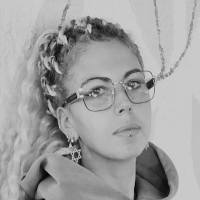
French-Israeli Visual Artist and Writer
Created and Creating – Bereshit 5787
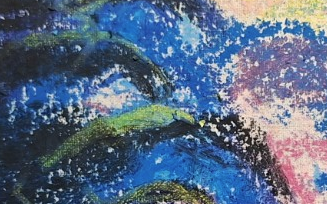
Oil pastel on cotton by Morgane Koresh, 2026.
A Note on This Series: I approach the weekly Torah portion not as a religious scholar or someone seeking to offer an authoritative interpretation, but as a secular Jew for whom Jewish texts remain a source of curiosity, questioning, and spiritual reflection. My reading is shaped by commentaries, personal experience, and the circumstances of my life at the moment I encounter the text. As a visual artist and writer, I am particularly interested in what happens when these encounters become part of a creative process. This is an attempt to enter into conversation with the parasha, rather than to explain it.
Created and Creating – Bereshit 5787
“In the beginning God created the heavens and the earth.”
Before we encounter the journeys, conflicts, laws, and relationships that will unfold throughout the Torah, we encounter creation.
Light and darkness. Water and land. Vegetation, animals, and eventually humanity.
And then, in Genesis 1:27, we read that human beings are created b’tzelem Elohim, in the image of God.
What does it mean to be created in God’s image?
Jewish thinkers have offered different interpretations of this question throughout the centuries. I do not pretend to resolve it. But one way I personally understand these words is through our capacity to create.
We are created beings, but we are also creating beings.
We can bring new life into the world, but we can also imagine things that do not yet exist, develop ideas, give them form, and bring them into existence.
Human creation is not equivalent to divine creation. Yet the capacity to create is something I recognize as fundamental to our human experience.
As a visual artist and writer, this is where I find myself encountering Bereshit this year. Not only in what we create, but in what happens to us through the act of creating.
In the second chapter of Bereshit, God forms the animals and brings them to ha-adam (the human being) to see what he will call them.
God creates; ha-adam names.
These are not equivalent acts, yet I find something meaningful in this invitation to participate. Ha-adam is not merely observing a completed world but is given a role within it.
In my own experience, creation often begins with an encounter.
Something awakens my curiosity: a text, a fragment of history, an image, a question, or another person’s experience. I read, research, learn, and try to understand.
We do not create in isolation from the world around us. We create from within it, drawing on what we have learned, inherited, encountered, and questioned.
And the process itself can change us.
An idea develops differently than expected. A sentence reveals something I had not fully understood. A material suggests a possibility I had not considered.
Even when what we create remains entirely private, the act of making can transform us. Sometimes only slightly, through the acquisition of knowledge or a new skill. Sometimes more profoundly, through a change in how we understand something.
We create, and in the process, we also participate in creating ourselves.
But what happens when what we create is no longer ours alone to encounter?
In Bereshit, creation does not end with the appearance of a completed world. Human beings are created, and questions of agency, choice, responsibility, and relationships begin to emerge.
In the garden, ha-adam is given responsibilities and boundaries. And in Genesis 2:18, God observes that it is not good for ha-adam to be alone.
The creation of humanity is followed by the possibility, and perhaps the necessity, of relationships.
I find myself thinking about this when considering what happens after we create something.
When we share what we have made, we allow others to encounter it through their own experiences, knowledge, memories, and interpretations.
They may understand something differently from how we intended. They may challenge it, recognize something in it that we had not noticed, or change our understanding in return.
This is also where vulnerability enters.
Sharing something we have created means accepting that we cannot determine how others will receive it or what relationships may emerge from that encounter.
We may hope for something meaningful, but we cannot guarantee it.
And perhaps it is precisely this uncertainty that makes the possibility of a meaningful relationship so valuable. We open ourselves not only to disappointment or rejection, but also to discoveries, conversations, and connections we could never have anticipated.
There is no transaction here, no expectation that what we offer must be returned in equal measure. There is simply the possibility of an encounter, and a willingness to be changed by it.
This brings me to a passage near the end of Bereshit that particularly struck me.
In Genesis 6:6, after witnessing what humanity has become, God is described as grieving in His heart.
I find this moment extraordinary.
The same God who brings humanity into existence, who gives human beings the capacity to choose and act, is now described as grieving over what they have become.
I do not pretend to understand what divine grief means. But the choice of this word strikes me. It makes me wonder whether creating beings with agency also means opening oneself to a form of vulnerability.
Not because creation inevitably leads to suffering, but because allowing something to exist beyond ourselves means accepting that its future may not correspond to what we hoped.
And this is what first drew me toward the act of creation in Bereshit this year.
Not only the possibility of bringing something into existence, but the relationship that may follow. Its uncertainty. Its potential to disappoint us, surprise us, or transform us in ways we could never have imagined.
Returning to Bereshit, I am struck by how quickly creation becomes a story of relationships.
Between God and humanity, between human beings, and between humanity and the world it inhabits.
These relationships involve agency. Ha-adam names, chooses, acts, and eventually makes decisions that carry consequences.
The world of Bereshit is not simply a collection of things brought into existence. It is a world in which encounters and relationships begin to unfold.
I am not suggesting that divine creation and artistic creation are comparable experiences, or that the biblical narrative offers a theory of artistic practice.
But I find something meaningful in encountering these passages through my own experience of creating.
Creation is not only about bringing something new into existence. It can also be about what becomes possible afterward.
The knowledge we acquire. The changes we experience through making. The encounters we initiate when we share. The relationships that may develop beyond our intentions.
As I read Bereshit this year, I find myself returning to the idea that we are both created and creating beings.
We inherit a world that already exists, with its histories, knowledge, relationships, and possibilities. And from within that world, we continue to create.
But perhaps what stays with me most is the tension between the ability to bring something into existence and the vulnerability of allowing it to develop beyond our intentions.
I began this parasha thinking about creation as an extraordinary capacity. I leave it thinking also about what we expose ourselves to when we create, particularly when we choose to share what we have made.
The possibility of disappointment is real. So is the possibility of discovering something meaningful that we could never have reached alone.
Perhaps that is part of what makes creation so compelling to me today. Not only what we are capable of bringing into the world, but what we are willing to open ourselves to in doing so.
Related Topics