Solicitor & foreign policy adviser
Crosetto, the mouse that roared at Israel
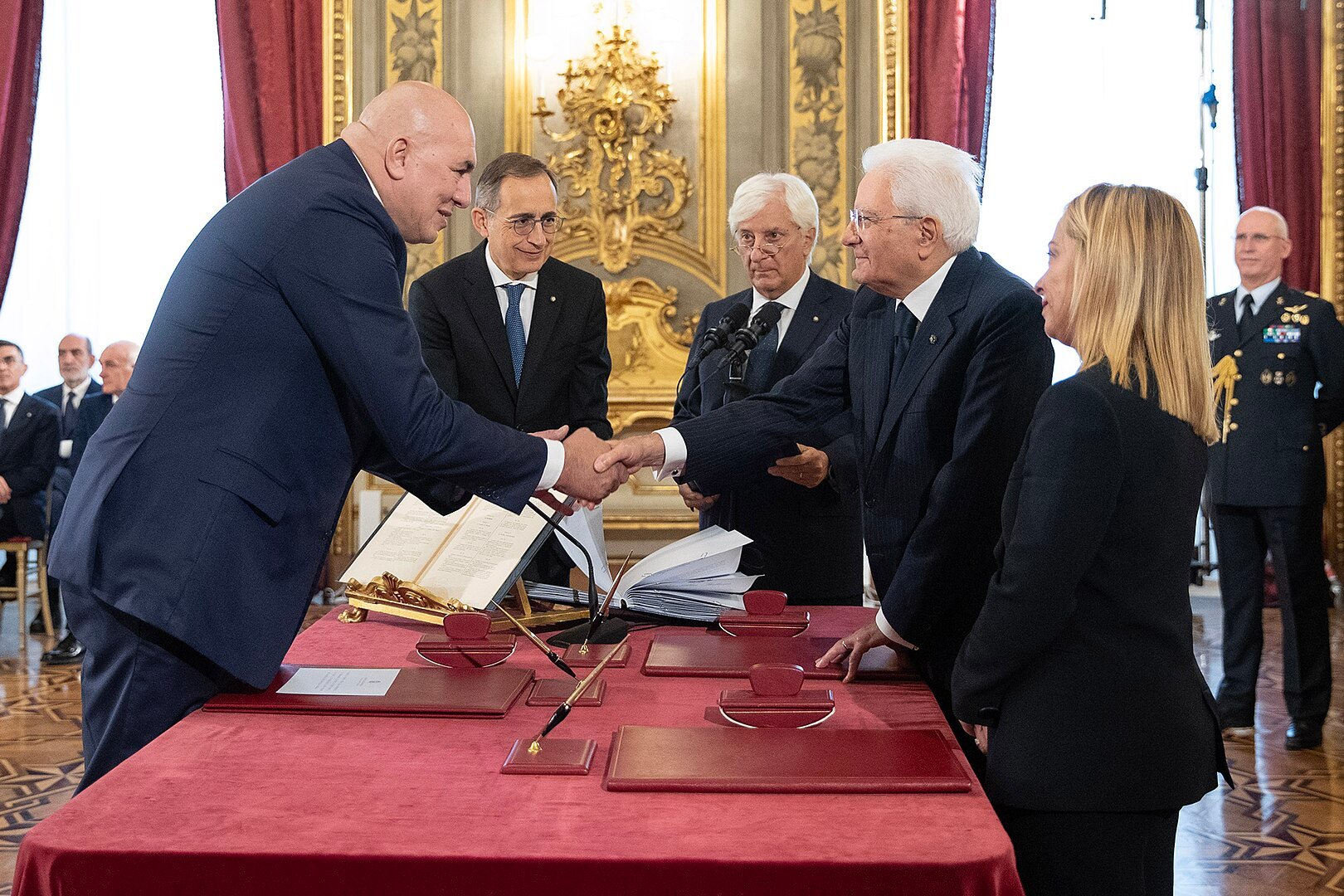
Guido Crosetto with President Sergio Mattarella (Photo by Quirinale.it - Wikipedia Commons)
Guido Crosetto has done it again. On 11 August, Italy’s defence minister climbed onto his moral soapbox to declare that Israel had “lost its reason and humanity,” likening Benjamin Netanyahu’s conduct in Gaza and the West Bank to Vladimir Putin’s. He even floated the idea of sanctions—though, in his telling, not as punishment, but as a kind of benevolent therapy to “save the Israeli people” from their elected government. It was a familiar performance: high on rhetoric, low on consequence, delivered by a man whose office commands no leverage over Israeli policy, and, as recent history shows, not even over his own house.
In September 2024, Crosetto was reduced to complaining in public that AISE, Italy’s intelligence agency, “does not inform me or even cooperate,” a statement that sounded less like the words of a minister in control than those of an exasperated customer service caller. The row prompted a parliamentary probe and the intervention of COPASIR, Italy’s intelligence oversight body, to patch things up. If you can’t get your own spies to return your calls, the idea that you might bend the will of Jerusalem is, at best, comic opera.
The 11 August broadside was also riddled with conceptual errors. Crosetto spoke as though Israeli military operations were conceived out of malice rather than as a direct and legally recognised exercise of self-defence after the largest anti-Jewish massacre since 1945. His suggestion that the Israeli public must be “saved” from their government is a colonial-era hangover dressed in humanitarian gift paper. And his Putin comparison was a lazy symmetry that collapses under the most basic scrutiny: one is an unprovoked war of conquest; the other a defensive war against a genocidal militia embedded among civilians.
Israel’s reaction was telling. There was no late-night prime ministerial rebuttal, no grand statement from the foreign ministry. Jerusalem left it to a single tweet from the Israeli Embassy in Rome—polite but firm—reminding the public that Israel continues to provide humanitarian aid to Gaza, in cooperation with Italy, and rejecting Crosetto’s insinuations. It was the diplomatic equivalent of checking your watch mid-conversation.
Nor is this Crosetto’s first turn in the anti-Israel chorus. Like an ageing television diva trying to revive her ratings, he periodically steps back into the spotlight by throwing a rhetorical punch in Jerusalem’s direction. In April 2025, he sermonised that “a Palestinian child is worth as much as a Ukrainian child or an Italian child” and urged Israel to “acknowledge its mistakes” over Gaza. In October 2024, after Israeli fire hit UNIFIL posts housing Italian peacekeepers, he thundered that it was “not a mistake” but “a possible war crime,” summoning the Israeli ambassador for a formal scolding. Each time, the pattern has been identical: grand pronouncements in Rome, indifference in Jerusalem, zero effect on policy.
All this unfolds against the backdrop of Italy’s foreign policy, which is less a strategy than a mood. In one corner, Crosetto waves his moral banners; in the other, Foreign Minister Antonio Tajani issues mixed signals, sometimes within the same news cycle. The result is the usual Italian job, overlapping egos, contradictory messages, and a diplomatic posture so impalpable it could be sold as a fragrance.
Crosetto may imagine himself speaking truth to power. In reality, he is the defence minister of a NATO member whose strategic weight exists in decibels rather than kilotons. Like a noisy spectator wandering in after the credits, he turns up at the battlefield long after the war has moved on, and shouts at the smoke.
Related Topics