
From the battlefield to the ballot box
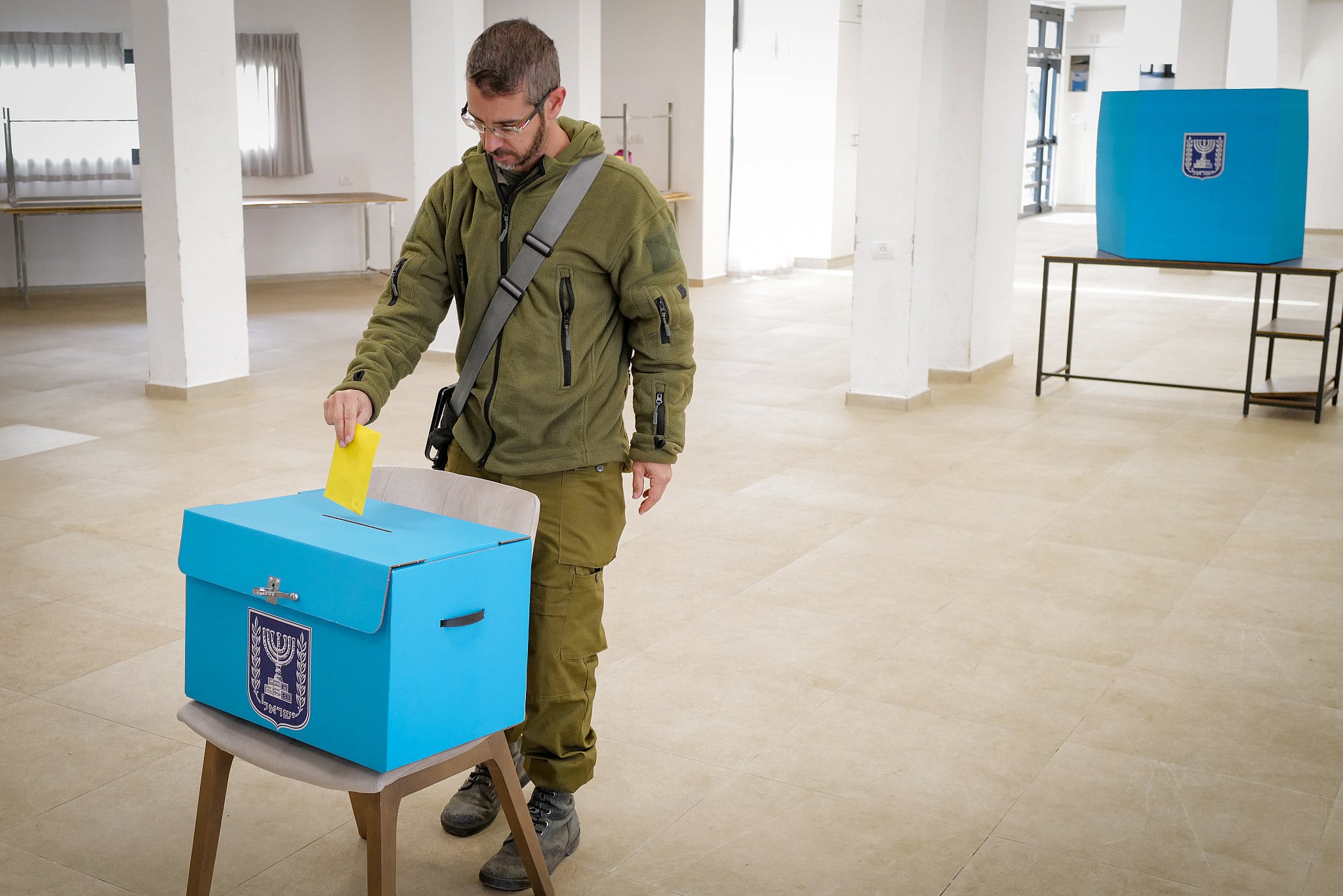
With an Israeli election coming in October, it is inevitable that the campaign will feature endless accusations and counteraccusations regarding responsibility and accountability for October 7, 2023, and the protracted and bitter war that followed it.
Unfortunately, most of the accusations will miss their mark. While both the government and the opposition bear some of the responsibility for the horrors of the Black Sabbath and the victory that followed – a victory that has not yet been fully internalized by the Israeli public – the ultimate cause of both was that Israel…is a democracy.
Why do democracies usually struggle at the beginning of wars? Simply put, in a democracy, you cannot effectively wage war without wide support from the populace.
Consider that there are three types of war – wars of aggression, wars of prevention, and wars of defense. For a modern democracy, launching a war of aggression is extremely difficult, albeit not impossible. Making a case to voters that their children should be put in harm’s way for economic advantage or territorial aggrandizement is a hard sell. And justifying aggression on ideological grounds is a challenge when – as in most democracies – the public does not adhere to a single ideological perspective.
It is this inability to mobilize public support for wars of aggression that accounts for what is known as “the democratic peace” – a robust statistical relationship identified by social scientists that shows that democracies rarely initiate wars.
Preventative wars are equally difficult to conduct. Once again, a case must be made to voters, and the justifications for a preventative war are often subtle or opaque. To understand them requires a degree of cognitive effort beyond what most voters are willing to invest.
Defensive wars, however, are far easier for democracies to sell to voters. In such situations, it is the enemy rather than the government that makes the case for war – and unfortunately the case made is usually compelling. Little cognitive effort is required to understand that your country must engage in a war when rockets are falling on your children’s heads.
The problem that democracies face with defensive wars, however, is not political but military.
Once prevention is off the table, initiative has been ceded to potential enemies who get to choose when to attack. Not surprisingly, they tend to initiate hostilities at the most inopportune time for their democratic opponent.
In essence, enemies strike when they perceive that a democracy has let down its guard. The only way to prevent this is for democracies to never let down their guard. Good luck with that! It is so unlikely that at the university where I teach, generals and admirals attending courses often receive a lecture called “The Certainty of Surprise.”
Recent history illustrates the point. Consider that both President Clinton and President GW Bush were fully aware of the danger emanating from al-Qaeda. After all, Osama Bin Laden was placed on the FBI’s “most wanted” list in 1999. But that did not stop 9/11. The only real way to disrupt the al-Qaeda threat to America’s homeland was an invasion of Afghanistan. But that was not even remotely an option for either president before 9/11. The public would not stand for it. But on 9/12, Operation Enduring Freedom had become a political imperative. The American public demanded it.
Now consider Gaza. Ignore silly ideas like “mowing the lawn.” Since June 2007, the only way Israel could truly end the threat from Hamas was to invade the Strip and destroy the enemy in detail. It did not do so under Prime Minister Olmert. It did not do so under Prime Minister Netanyahu. It did not do so under Prime Ministers Bennett and Lapid. And it did not do so when Prime Minister Netanyahu returned to power.
Had any of these leaders chosen to wage a preventative war to end the threat from Hamas, there would have been public outrage as rockets came down and the casualty count went up. And you can be sure that had Netanyahu invaded Gaza, Bennett and Lapid would have been his fiercest critics, while Netanyahu would have been their fiercest critic had either Bennett or Lapid made the same decision.
That is how democratic politics works.
So let’s be honest. Absent an Israeli preventative invasion of the Strip, a Hamas attack on Israel was not a matter of “if” but of “when”, and the “when” was when Hamas sensed that the human guardians of Israel were sleeping, as they simply must from time to time.
In writing this, it is not my intention to suggest that Israel eschew its democratic form of government for reasons of national security. In fact, considerations of national security make it imperative that Israel not only preserve but strengthen its democratic political institutions.
Quite simply, the same body of research that finds that democracies rarely instigate wars and generally get off to a poor start when they take place also finds that democracies are far more likely to prevail in military conflicts than their authoritarian rivals. Indeed, studies suggest that democracies win roughly 80% of the wars they engage in, while authoritarian regimes win roughly 40% of their wars.
It is something of a mystery as to why democracies perform so much better than dictatorships on the battlefield. One of the earliest papers to study this, Reiter and Stamm (1988), tested multiple explanations and ruled all of them out. By process of elimination, they concluded that “soldiers fight better under democratic governance than under other regime types.”
No one is sure why the soldiers (and sailors) who serve democratic regimes fight “better,” but I do have a hypothesis that I articulated in Survival: The Economic Foundations of American National Security, a book I wrote back in 2016:
“I believe that the free society’s need to accommodate each citizen’s personal definition of the collective, far from being a military handicap, provides it with its greatest military advantage over societies that identify, codify, or sanctify a collective purpose. People have a strong sense of self-preservation, and will only willingly sacrifice their physical lives if by doing so they preserve aspects of their lives that they hold even more precious — their sense of who and what they are. By allowing each individual to define what their country means to them, democracies ensure that the collective is an extension of the individual’s personal identity rather than something exogenous that has been tacked on. Hence, it is something the individual is willing to die for.”
And that brings us back to the October election. My (admittedly unsolicited) advice to Israel’s electorate is to ignore the political recriminations about the Gaza War and vote for the candidates and parties that offer the most compelling vision of Israel’s future and the most viable program for attaining that vision and guiding the country to a safe shore during these trying times.