
Cryptocurrency Cannot Buy Consent—or Restore International Trust
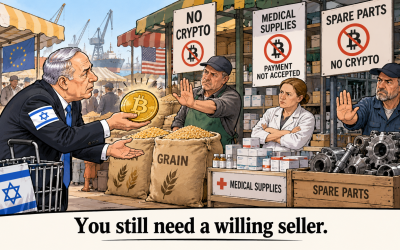 Netanyahu’s cryptocurrency proposal cannot overcome the realities of international trade. If the opposition falls short of 61 seats, actively pursuing a coalition with Ra’am may be crucial to averting economic catastrophe.
Prime Minister Benjamin Netanyahu has warned that Israel could face international banking sanctions and said he requested a plan involving cryptocurrency and blockchain technology to circumvent them. Preparing for emergencies is legitimate. But can changing a payment mechanism preserve an economy whose foreign partners may no longer be willing—or permitted—to do business with it?
The difficulty lies in a basic principle of commerce: every international transaction requires a willing counterparty.
Suppose an Israeli importer needs grain. Payment might be offered in Bitcoin or a stablecoin, but why should a foreign supplier accept the associated regulatory risks, currency uncertainty and conversion costs? And why should that supplier deliver if sanctions prohibit the sale, or if another customer can pay through ordinary banking channels?
The same questions apply to military spare parts, medical devices, pharmaceuticals and advanced industrial equipment. A token transfer cannot compel a manufacturer to export, maintain equipment, provide technical support or obtain necessary licenses. Nor does it solve the reverse problem: Israel needs foreign buyers for its technologies and services, and foreign investors willing to commit capital.
Cryptocurrency can transfer value. It cannot compel anyone to buy, sell, invest or cooperate.
There is also a legal limit. The payment method is ordinarily part of the parties’ contractual understanding, while trade restrictions remain effective regardless of the technology used. The US Treasury confirms that sanctions obligations apply to digital-currency transactions just as they apply to conventional payments, for those subject to its jurisdiction. Cryptocurrency may help willing parties settle some lawful transactions; it cannot replace the legal, logistical and institutional relationships that make trade possible.
The Bank of Israel has warned that cryptocurrency is not a route around sanctions and has emphasized maintaining relations with major trading partners. That warning points beyond monetary technology to the responsibility of political leadership: the first task is to prevent damaging isolation, not merely to devise methods of paying within it.
Netanyahu’s proposal is absurd not because emergency planning is inherently wrong, but because it treats the danger of international isolation as a payment problem to be worked around. If Israel reaches a point where suppliers hesitate to sell, investors withdraw, and banks refuse to process transactions, the consequences for essential imports, employment and national security could be catastrophic. No cryptocurrency can restore commercial cooperation once it has broken down. The October 27 election therefore acquires an urgency extending far beyond ordinary party politics.
If the opposition bloc fails to secure 61 Knesset seats on its own, its leaders must actively seek to negotiate and form a government with Dr. Mansour Abbas’s Ra’am party. Political differences must not become an insurmountable obstacle when the country’s economic future is at stake. Such a coalition may prove crucial to averting a national catastrophe and safeguarding the future of Israel and all its citizens, Jews and Arabs alike.