Education, Allyship, and Questions That Matter.
Featured Post
‘Cunningham? That doesn’t sound very Jewish’
What does it mean to stand with the Jewish people even though I am not Jewish — and why is that responsibility mine, too?
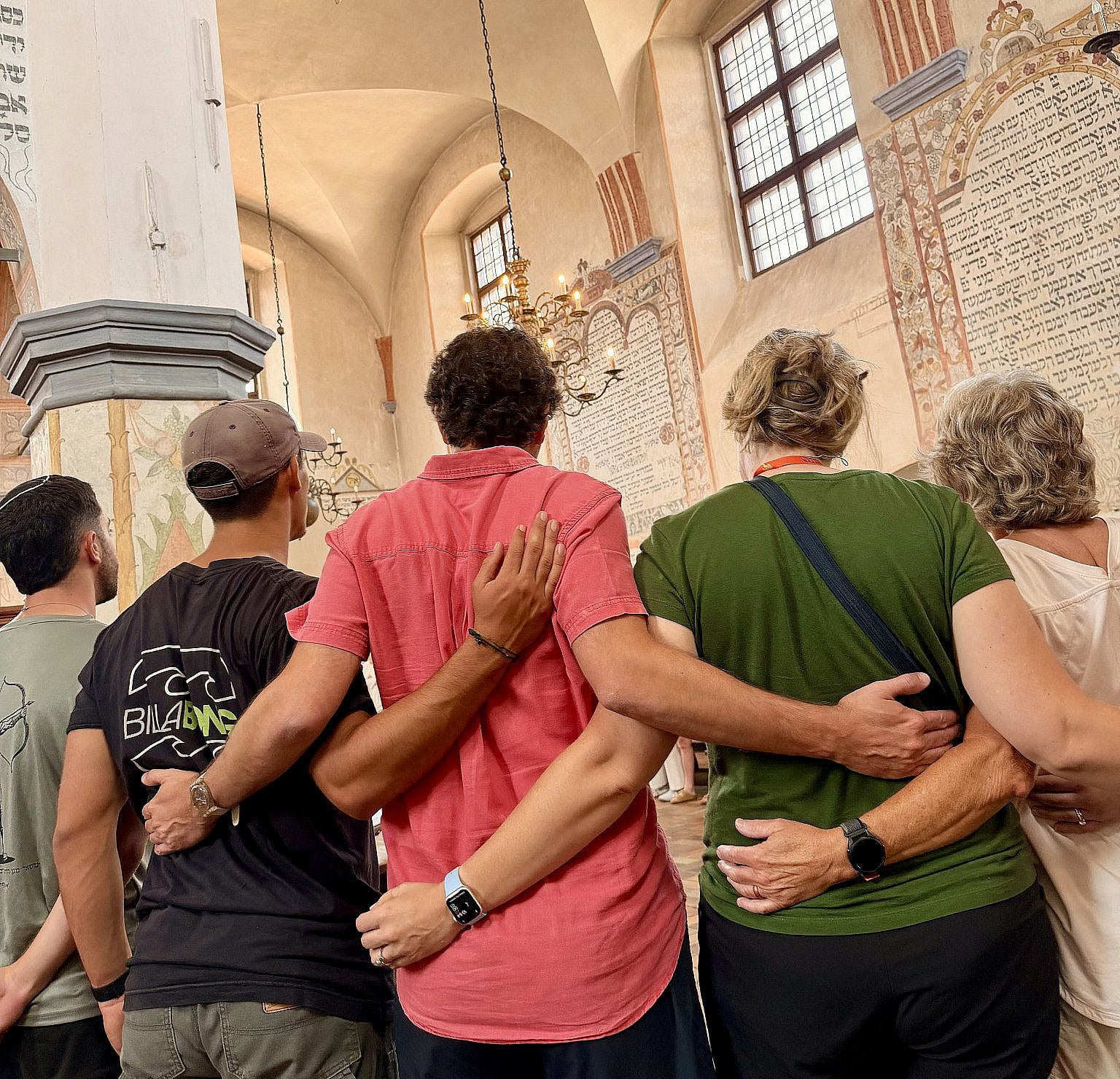
American Holocaust educators and Israeli pre-service teens unite to sing Hatikvah at the Tykocin synagogue in Poland (Courtesy)
At almost every event, lecture, or in-school presentation – whether the topic of the day is the Holocaust, Jewish identity, antisemitism, or Israel – I know I am going to be asked one very specific question:
“Why do you do this work?”
The emphasis on “you” is obvious. Over time, I’ve come to realize that this question most often is actually masking other questions, with the main one being:
“Are you Jewish?”
People instantly assume that someone working in Holocaust education, Jewish advocacy, or antisemitism research is Jewish. The surprise on their faces when they realize I am not Jewish is unmistakable – and I see it from both Jews and non-Jews. I get the same stare of disbelief, with the same question behind their eyes: Why would someone non-Jewish do this work?
The tone of the conversation changes after I identify myself as non-Jewish. Intrigue rises, and the questions come quicker. There is a particular curiosity about someone who is not Jewish choosing to teach a topic everyone should know about.
Logically, this shouldn’t be the case. Simple math tells us that 0.2% of the world’s population cannot be expected to carry this work alone. Jewish people aren’t responsible for teaching everyone else about Jewish history; everyone else has a responsibility to learn.
The truth is that many people who work in this space are not Jewish. I am not an anomaly. In fact, in my own experience, more than 95 percent of the Holocaust educators I work with, teach, and mentor are not Jewish. Nevertheless, we have chosen to devote our professional lives to Holocaust education, teaching Jewish history and identity, and combating antisemitism. We have chosen to step into a space where we will sometimes be challenged, questioned, misunderstood, or even hated.
To me, there should be no “why?” attached to this.
We do this work because we are called to it and believe it is ours to do. Because Jewish people should not have to carry the responsibility of educating the world about antisemitism and Jewish history alone. Because being a global citizen means knowing about people who aren’t like you. Because there is something about learning the history of the Holocaust that makes you want to be a better person. Because, as we say at my Holocaust education organization, we can’t not do this work.
During presentations, I also identify myself directly as an ally of the Jewish people. Naming it, especially in front of middle and high school students and people who identify with me, is important and powerful. They need to hear a non-Jewish person say, very clearly: I stand with the Jewish people. Non-Jewish people have both a responsibility and an important role to play.
So, what does meaningful allyship actually look, sound, and feel like? What does it mean to be an ally when you are working inside someone else’s history and identity?
Meaningful allyship looks like seeking opportunities to learn what being Jewish means, educating yourself on what Jew-hatred has looked like historically and what it looks like today, and paying attention to events in the world that would otherwise not catch your attention. It sounds like being the person who raises the concern so your Jewish colleague doesn’t always have to. It sounds like challenging disinformation and Jew-hatred when you hear it, even when no Jewish person is in the room. It sounds like refusing to reduce Jews to a religion, a victim group, or a lesson from history.
Being a Jewish ally feels like knowing you’re on the right side of history, despite the uncertainty and even fear it may bring in the moment, and understanding that someone else’s history, identity, and safety can matter deeply to you, even when it is not your own.
Being non-Jewish and doing this work means being prepared to answer any and all questions – because you will be asked the questions that someone is just too scared to ask a Jewish person. It means using your position as a non-Jew to enter into spaces where a Jewish person may not be able to go – because you may be perceived as less biased. It means understanding that most people will have an opinion about what you do – and it may not always be what you expect. It also means having a thick skin and being prepared to receive ignorance and flat-out hate.
Allyship also means knowing when it is better not to speak. An ally also listens. An ally listens to Jewish voices and stories and accepts corrections. Being an ally doesn’t mean you always have to have the answer, but that you have the desire to find it. You have to be willing to learn, to be uncomfortable, and sometimes, just to listen.
Everyone can be an ally of the Jewish people. You do not need to be Jewish to call out antisemitism or teach about Jewish identity. You do not need to be Jewish to go to synagogue or a Jewish festival and have conversations. You do not need to be Jewish to want a better world for Jewish kids, just as you want one for your own children.
No, Cunningham is not commonly a “Jewish last name.” No, I am not a descendant of a Holocaust survivor. No, I did not marry a Jewish person or an Israeli. I am not Jewish, and no one in my family is, but that does not mean Jewish safety and Jewish lives are irrelevant to me.
I cannot speak for the Jewish people or as a Jewish person. I won’t pretend to. But I can speak as a non-Jewish person who has decided that Jewish history is human history, that antisemitism is everyone’s problem, and that Jewish people should not have to stand alone against it. That kind of allyship has power. It also comes with responsibility. And that responsibility belongs to all of us.
Related Topics