The views expressed herein are solely mine.
Cut Puerto Rico Loose, Back Dominican Power
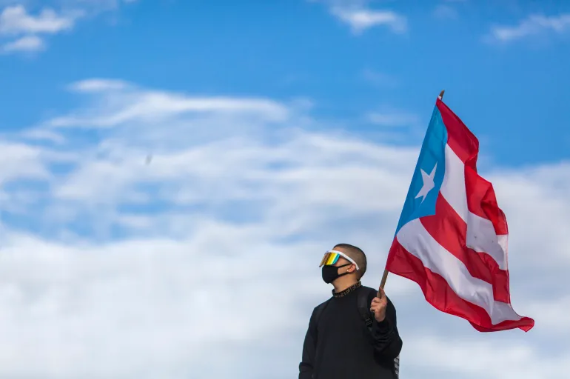
Latin trap and reggaeton singer Benito Antonio Martinez Ocasio, known by his stage name Bad Bunny, holds a Puerto Rican flag before a protest march against then-Governor Ricardo Rossello, in San Juan, Puerto Rico, July 17, 2019 [Dennis M Rivera Pichardo/AP Photo]
Bizarrely, Washington treats Puerto Rico and the Dominican Republic as interchangeable Caribbean dots—when they are anything but.
One is a furious American unincorporated territory dependent that survives on U.S. taxpayers while screaming “colonialism.”
The other is a rising ally that hosts U.S. aircraft, helps crush narco-traffickers, and is riding an economic boom that reinforces American interests—not drains them.
Start with the money.
Current federal government data show Puerto Rico pulls in $35–40 billion in federal awards and obligations every year.
Yet in 2023 it only sent $5–5.4 billion back in federal taxes—mostly payroll contributions.
Tragically, even if you adjust categories, the pattern does not budge: Washington sends roughly eight federal dollars for every one dollar collected.
That is not a partnership.
That is dependency.
Then comes the demographic absurdity: nearly six million Puerto Ricans now live in the 50 states—almost double the 3.2 million who remain on the island.
And that is where the irony bites.
The same political class that fuels anti-U.S. rhetoric in Puerto Rico survives because millions of Puerto Ricans have already voted with their feet, moving to, working in, and prospering within the United States.
In other words, the island denounces “colonialism” while its own people overwhelmingly choose the mainland for safety, jobs, opportunity, and stability.
Manifestly, the numbers prove it: the tax base, military service, and civic power that strengthen the United States come from Puerto Ricans in Florida, New York, and Pennsylvania—not from a territory kept alive by federal transfers while complaining about “colonial rule.”
Meanwhile, local cultural elites—led by Puerto Rican socialist-millionaire superstar Bad Bunny (yeah, a very contradictory description that perfectly describes the character) and campus activists—push an explicit campaign for independence or “free association,” framed as liberation from U.S. oversight.
Patently, the island depends on federal cash, exports its people, and defines its identity in opposition to the United States.
Strategically, the picture gets even worse.
Look no further than Vieques—the Puerto Rican island where U.S. forces operated until 2003. After years of protests, more than 1,400 arrests, and a full-blown political crusade, activists ultimately shut down a core Navy training range and forced the closure of the largest U.S. naval base in Latin America—one that directly and indirectly employed over 7,000 people.
Sadly, that fight became the template for anti-military mobilization across the island, fueled by academics who portray the U.S.–Puerto Rico relationship as a colonial “occupation.”
Therefore, no credible power projection can be sustained in a setting where activists frame the U.S. uniform as a foreign presence.
From a national-interest perspective, it is irrational for Washington to pump tens of billions into a territory that blocks training ranges, derails energy reforms, attacks U.S.-linked utilities, and still demands the US Treasury keep paying its bills.
Now look across the Mona Passage, toward the Caribbean’s most dynamic success story in recent years.
The Dominican Republic just did what Puerto Rico never will: it formally authorized U.S. use of restricted military zones—including San Isidro Air Base and Las Américas International Airport—to bolster regional air and maritime interdiction.
Now, U.S. aircraft can refuel, stage equipment, and coordinate counter-narcotics missions directly from Dominican soil.
Concurrently, President Luis Abinader publicly attributes a tenfold increase in drug seizures to this partnership and positions it domestically as a sovereign, technical security alliance rather than a foreign occupation.
That is how a real ally behaves.
And unlike Puerto Rico, the Dominican Republic is not asking Washington to keep it alive—it is turning itself into a Caribbean growth engine.
Furthermore, Santo Domingo shattered the 11-million-visitor mark in 2024, pulling in $11 billion in tourism. At the same time, FDI is surging—$1.3 billion into tourism, $1.1 billion into energy, and $800 million into real estate—precisely the sectors that anchor Western stakes in Dominican stability. And complementing it all, a 470-megawatt gas-fired plant backed by Western capital is locking the Dominican energy grid into U.S.-indexed LNG markets for decades.
Thus, this is a country that uses its alignment with the U.S. to grow—not American guilt to secure bailouts. And with that reality on the table, the strategic choice becomes brutally obvious: Puerto Rico drains; the Dominican Republic delivers.
Currently, Puerto Rico is a society full of contradictions: more of its citizens live on the U.S. mainland than on the island yet rage against America; its elites posture in opposition to the United States; and Washington spends multiples of what it collects just to keep the lights on.
Moreover, San Juan is a place that still does not know what it wants—unlike the Dominican Republic.
Today, Santo Domingo opens its runways to U.S. aircraft, anchors counter-narcotics missions, attracts billions in Western investment, and stabilizes the Caribbean.
From an America First perspective, the answer is obvious: give Puerto Rico a real way out and stop pretending its current territorial status is either sustainable or moral.
Unquestionably, it is time to let Puerto Ricans choose genuine nationhood instead of clinging to a status that breeds resentment on the island and exhaustion in the States.
At the same time, the U.S. should double down on the Dominican Republic: lock in long-term defense and energy agreements, expand counter-narcotics cooperation, and prioritize Dominican infrastructure and security investment over yet another Puerto Rican bailout.
This way, you reward the partner who opens bases and fights with you—not the territory that cashes checks and screams “Yankee go home.”
And that contrast leads to the cultural detonation now looming.
When Bad Bunny steps onto the Super Bowl stage in three months, he won’t just perform—he will revive the same anti-U.S. narrative he weaponized last election, telling Puerto Ricans that supporting the pro-statehood party meant “you do not love Puerto Rico.”
That message did not just sting; it accelerated the island’s sprint toward independence, pushing the movement from under 15% three years ago to nearly half the electorate in the last vote.
Given this situation, if JD Vance becomes president, the breakup will doubtlessly happen fast. Once he sees the numbers—tens of billions poured into a territory that gives almost nothing back while sneering at the country funding it—he won’t entertain fantasies of decades-long “subsidized independence.”
Without a doubt, this former Marine will deliver the type of independence separatists do not want—fast, clean, and without the endless federal welfare.
At the same time, the Dominican Republic—not Puerto Rico—is the true strategic center of gravity in the Caribbean: open bases, joint counter-narcotics missions, U.S.-linked LNG, booming tourism and real estate, and unwavering alignment with Western interests.
Puerto Rico burns American money and attacks American power. The Dominican Republic strengthens both.
And once that Super Bowl spotlight amplifies Bad Bunny’s anti-U.S. script, the contrast becomes impossible to ignore:
A hostile, dependent territory on one side.
A rising, pro-American ally on the other hand.
The choice writes itself: cut Puerto Rico loose and anchor America’s future in the Dominican Republic—the only Caribbean partner worth defending.
Related Topics
Related Posts