
Strategic Intelligence Consultant & Insights Advisor
Cyprus is becoming Israel’s Strategic Rear
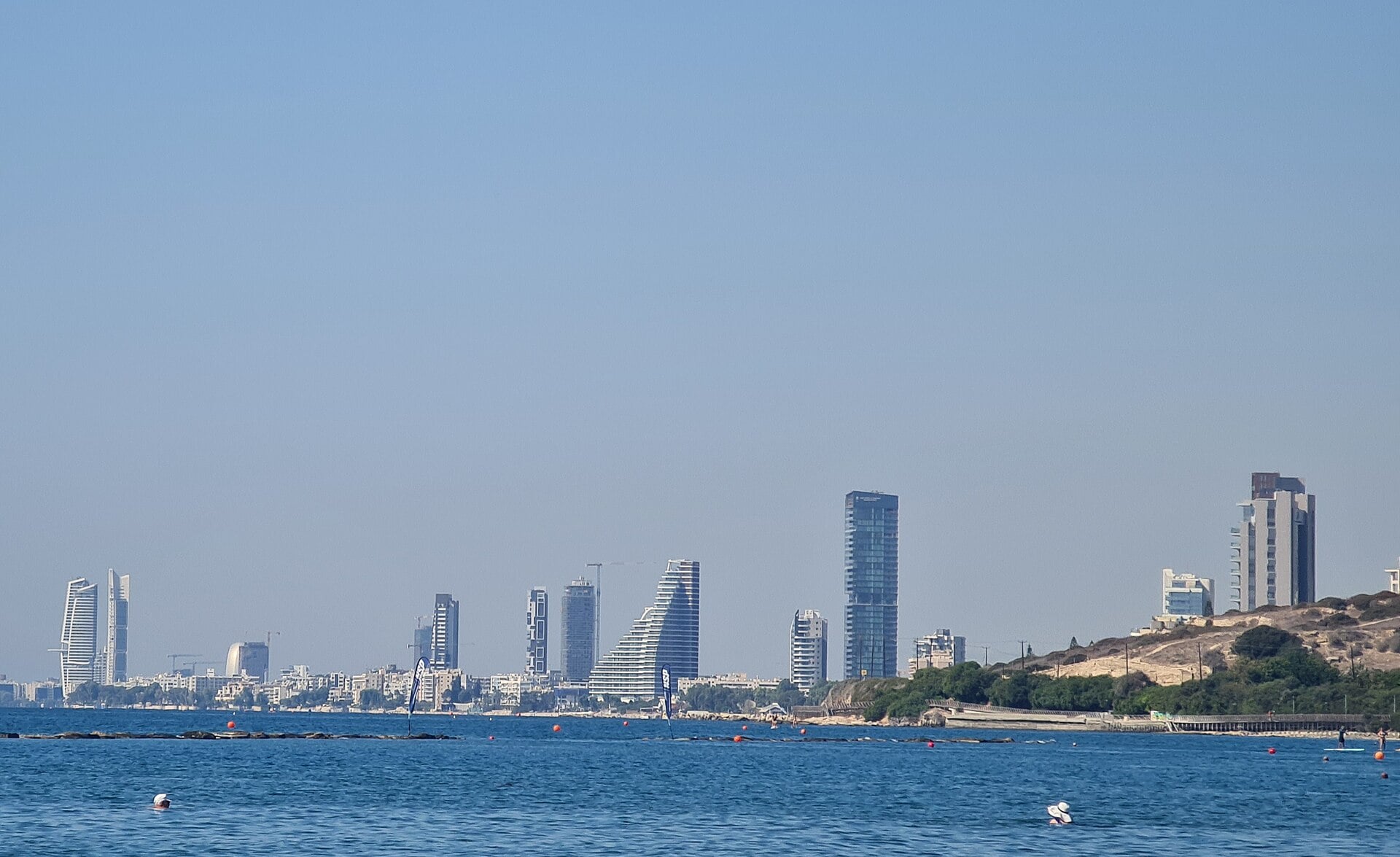
Limassol Skyline (Wikimedia)
Cyprus is still seen as a holiday island and a frozen, peripheral conflict. But geography, intelligence relevance, defence cooperation, energy links, EU membership and post-October 7 crisis logistics have quietly made it one of Israel’s most useful strategic partners in the Eastern Mediterranean.
For most Israelis, Cyprus is a postcard. Forty minutes by air, blue water, package tourists, civil weddings for couples the rabbinate will not marry, and a conflict so old and so frozen that almost no one thinks about it. That picture is now badly out of date. Quietly, without a treaty and without a ceremony, Cyprus has moved close to the centre of Israel’s strategic environment in the Eastern Mediterranean.
Let me be precise, because precision matters here. Cyprus has not become an Israeli base. It is not a military power. It has not signed an alliance with Jerusalem, and it is not a risk-free sanctuary. What it has become is something subtler, and in a crisis more immediately useful: a nearby, trusted, EU-anchored partner that offers Israel proximity without dependency and depth without obligation. In this region, usefulness can matter as much as size.
October 7 made the point impossible to ignore. Within days, Cyprus became a refuge and a transit point for Israelis and foreign nationals fleeing the war. Nicosia activated ESTIA, its national plan for evacuating civilians through Cyprus, and the island filled with people heading out of Israel and, later, evacuated by sea. Reuters reported the first American citizens arriving in Limassol by boat. None of this was theoretical contingency planning. It was real evacuation logistics, happening forty minutes from Tel Aviv, run by a friendly government inside the European Union.
Then came Amalthea, the Cyprus-backed maritime corridor for aid to Gaza. The European Council formally welcomed it, an international statement endorsed it, and the first aid ship left Cyprus in March 2024. One can argue about the scale or the long-term viability of that corridor. The strategic lesson stands regardless: when the region needed a nearby, Western-facing platform that could inspect, stage and dispatch humanitarian cargo toward Gaza, Cyprus was the platform that emerged. No one else volunteered.
Cyprus matters for a darker reason too. It has become a recurring arena in the shadow war with Iran, though here every responsible writer owes the reader some discipline. Not every intelligence allegation becomes a courtroom verdict. But the pattern is too persistent to wave away. Israeli officials accused Iran over a 2021 plot on the island. The Mossad later said it had broken up a hit squad targeting Israelis there in 2023. Reuters and the Associated Press reported a further alleged plot against Israelis and Jews, and in June 2025 Israel again pointed at the Revolutionary Guards after Cyprus arrested a British man on suspicion of terrorism and espionage.
The court record, though, imposes its own caution. In the long-running 2021 case, the defendant was finally sentenced in late 2025 for conspiracy and weapons possession, after the terrorism-related charges had been dropped. So no, one cannot honestly write that Cyprus is the scene of proven Iranian terror attacks. That would be propaganda, not analysis. What one can say is firmer and more interesting: Cyprus appears, again and again, in intelligence-linked allegations involving Iranian and proxy activity against Israeli and Jewish targets. That alone has changed how Israel sees the island.
The island’s division sharpens the problem. In late 2023 a Cypriot official told the Associated Press that an alleged Iranian handler had operated from the illegal Turkish-controlled north before crossing the official Republic of Cyprus; Turkish Cypriot authorities denied it, and the claim remains contested. But the structural point is hard to argue with. An island split by a buffer zone, with an unrecognised northern entity and tens of thousands of foreign troops on its soil, inevitably offers jurisdictional seams that hostile actors will probe.
If intelligence is one side of Cyprus’s value, military cooperation is the other, and it is no longer symbolic. In 2022 the IDF’s “Beyond the Horizon / Agapinor” exercise brought the 98th Division, air force squadrons, naval and ground special forces, intelligence units, evacuation drills and logistics to Cyprus, explicitly to rehearse operations deep in enemy territory. The chief of staff at the time, Aviv Kohavi, flew out to watch it and spoke openly about widening the relationship.
That drill did not appear from nowhere. Israeli troops had trained on the island years earlier, in the mountains, dense brush and built-up terrain that planners prize. The Troodos range is the point. Israel simply does not have many nearby places to simulate the mix of mountain geography, village density, distance from home base and air-ground coordination that a tougher northern campaign would demand. Cyprus offers exactly that, without a transcontinental deployment.
This is part of why the Israel-Cyprus-Greece triangle has proven so durable. Institutionalised in 2016 and reinforced by the US-backed “3+1” format, it has survived even Israel’s periodic attempts to repair relations with Turkey. That resilience is not sentimental. The triangle rests on hard interests: energy routes, maritime security, the resilience of offshore infrastructure, coordination among democracies that share sea lanes. As late as December 2025, Jerusalem hosted the tenth trilateral summit, with plans for expanded joint exercises in 2026.
Cyprus’s EU membership adds a layer few of Israel’s regional partners can match. Israel has friends in the neighbourhood, but very few that are both physically close to the Levant and seated inside Brussels. That combination matters for diplomacy, for sanctions debates, for infrastructure money, for humanitarian coordination, and for the long argument over how Europe frames the Eastern Mediterranean. A trusted EU state forty minutes away is not a luxury. It is an asset.
The British bases add yet another layer, but they must be described honestly. Akrotiri and Dhekelia are United Kingdom sovereign territory, not Cypriot real estate, and it is sloppy to fold them into the Republic of Cyprus. Still, their presence raises the island’s overall weight. British parliamentary material treats Cyprus as a permanent joint operating base for UK activity in the region, with RAF Akrotiri as London’s main Middle East hub for combat aircraft, transport and surveillance. In 2024, as tensions rose, Britain rapidly flew in hundreds more personnel.
Meanwhile the Republic of Cyprus is building its own sovereign infrastructure. The US-backed CYCLOPS centre in Larnaca trains officials in land, maritime and port security; by 2025 President Nikos Christodoulides said it had trained more than 2,000 officials from more than twenty countries. The island also runs ARGONAUT, its multinational naval exercise. This is what strategic repositioning actually looks like: not slogans, but ports, training centres and interoperability.
Energy keeps Cyprus in the game, even though the grand EastMed pipeline dream has cooled. Israel and Cyprus delimited their maritime zones back in 2010. The Aphrodite field, found in 2011, is still undeveloped but very much alive; in 2025 Cyprus approved an updated plan and signed agreements with Egypt that could finally move its gas to existing liquefaction plants. The Israel-Cyprus-Greece electricity interconnector remains an EU project of common interest. The commercial endgame is uncertain. The strategic direction is not.
Turkey is the unavoidable shadow over all of it, and serious analysis should avoid caricature. Ankara reads the Eastern Mediterranean through its own maritime claims, rejects Nicosia’s authority over the whole island, opposes blocs from which it is excluded, and keeps a large army in the north. None of that makes Cyprus-Israel cooperation inherently anti-Turkish. But it does mean every drill, cable, gas route and arms deal sits inside a contested geometry.
Christodoulides seems to grasp this better than most. Since October 2023 his government has tried to present Cyprus not merely as a country with a problem, the unresolved Cyprus question, but as a country with services to offer: evacuation, humanitarian corridors, training, defence coordination, a bridge between Europe and the Middle East. That is a deliberate foreign-policy choice, not branding.
The limits are real, and Israelis should hold them in mind. Cyprus is small, divided and exposed. It cannot promise sanctuary in a full regional war. Hezbollah’s 2024 threat against the island, and Nicosia’s nervous insistence on neutrality, showed exactly how narrow its margin can be.
So the right conclusion is not that Cyprus is becoming powerful. It is that Cyprus is becoming indispensable in a specific, modern way: a trusted bridge state, a nearby rear, a democratic EU partner, and one of the most underrated actors in Israel’s strategic environment. None of this requires a base, a treaty or a slogan. It rests on geography, institutions and a decade of accumulated habit, which is precisely why it is more durable than the diplomatic mood of any given year.
Israelis should see it as such, not as a substitute for Washington, not as a hidden base, but as something rarer and, in the right crisis, more useful: a small state with unusually high strategic value. The next time the region convulses, the planes, the ships and the people will move toward Cyprus before they move anywhere else. In the Eastern Mediterranean of 2026, that is no small thing, and it is no longer something Israel, or the Israeli public, can afford to overlook.
Related Topics
Related Posts