A Correspondent in Tel Aviv
Cyprus’s Election: A Reason for Israeli Concern?
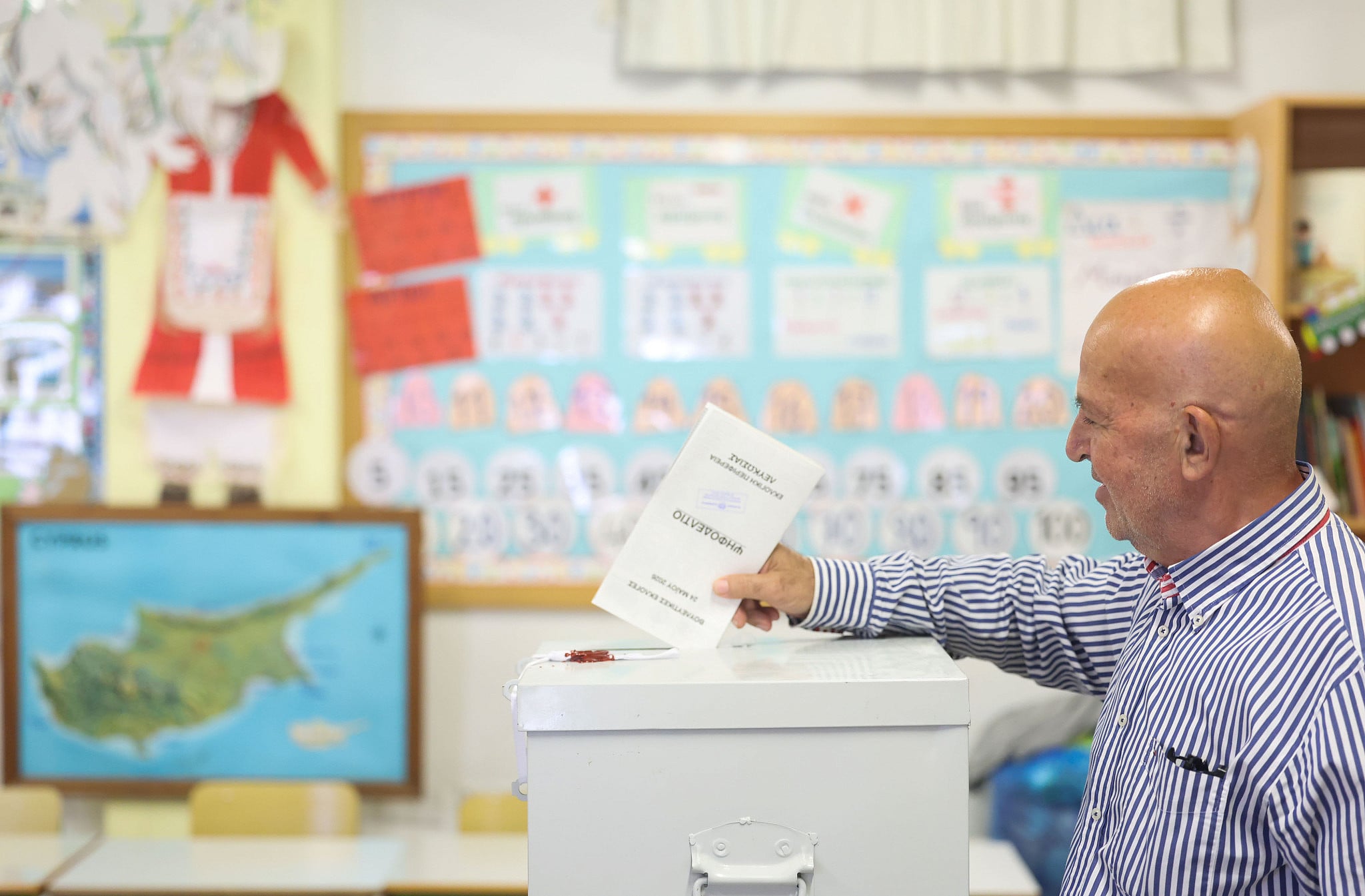
An elderly Cypriot casting his vote. Photo: Stavros Ioannides (Press and Information Office of the Republic of Cyprus)
In June 2025, AKEL, Cyprus’s communist party — one of the few to survive the fall of the Iron Curtain without fading into irrelevance — held its congress.
Unlike previous gatherings, it drew attention beyond the party’s base because of strikingly antisemitic remarks by its secretary-general, Stefanos Stefanou, which were highly unusual in Cyprus’s public discourse.
“Recently, we have been witnessing the emergence of closed-off areas — ghettos — created by Israeli nationals, with Zionist schools and synagogues being established and sweeping acquisitions of major economic assets and large tracts of land,” Stefanou said. “This is happening at a time when serious newspapers in Israel are speaking of a deliberate policy of Israeli expansion into Cyprus. We are not saying this out of xenophobia or antisemitism.”
“After all,” he added, “AKEL, which provided substantial humanitarian assistance to many Jews who arrived in Cyprus after World War II and were held by the British in detention camps, cannot be accused of such motives.”
This was no slip of the tongue. It was part of Stefanou’s written speech. That AKEL’s leader would cynically exploit such a historically charged subject to make such a crude and absurd argument shocked many.
The Palestinian representative in Nicosia, Abdallah Attari — a member of the diplomatic corps since Cyprus recognized a Palestinian state in 1989 — was a guest of honor at the Congress. Seated in the front row, he appeared delighted as Stefanou launched into repeated anti-Israel and antisemitic tirades.
Attari is known for his disdain for diplomatic courtesy. He has caused scenes at events attended by Israel’s – popular – ambassador in Nicosia, publicly attacked journalists who do not share his views — myself included — and taken positions that clearly owe more to Hamas than to Ramallah. He has also publicly urged the Cypriot government to pressure Israel to release Marwan Barghouti, who is serving multiple life sentences for terrorism and murder, including the cold-blooded murder of Father Germanos, a Greek Orthodox monk near Ma’ale Adumim in 2001.
Stefanou also used the congress to portray President Nikos Christodoulides as “the recycled continuation of the Anastasiades–DISY era”: unconvincing on the Cyprus problem, soft on corruption, poor on energy and social policy, biased in favor of employers, hostile to dissent, and idle while Cypriot land was, in his telling, being bought up by Israeli nationals.
The sight of a Greek-speaking foreign diplomat attending the main opposition party’s congress and applauding a toxic speech filled with personal attacks and unfounded accusations against the president was unprecedented. It infuriated the government, which nevertheless chose not to go public. Three months later, Attari publicly attacked center-right DISY, the island’s largest party.
AKEL already had a decades-long record of hostility toward Israel. After the October 7 massacre, it issued a disgraceful statement referring to a “new cycle of bloodshed in Israel and Palestine” and declaring that the killing of civilians, “whoever commits them,” was condemnable — shocking even moderate left-wing supporters.
The party framed the violence mainly through Israel’s alleged culpability, arguing that “the cycle” could end only “by ending the Israeli occupation.” A couple of weeks later, Stefanou received not the Israeli ambassador, but the Iranian ambassador, in his office to discuss the matter.
To some extent, AKEL’s result in last Sunday’s parliamentary election in Cyprus — 23.9%, up from 22.3% in 2021 — can also be linked to its habit of recycling Hamas propaganda while posing as a champion of justice and human rights. This, despite having nothing to say about Putin’s atrocities in Ukraine, the slaughter of protesters in Iran, or any other crime that does not fit its ideological script.
AKEL, however, has no link to a militant left, which — unlike in Greece — has never really existed in Cyprus. It is a populist party trying to survive, willing to descend into the most toxic rhetoric to do so. Like most communist parties today, it has become a political caricature: a party whose reflex is to dismiss whatever it cannot control, understand, or exploit.
Feidias Panayiotou, the YouTuber-turned-politician, recently followed the same path. His newly founded Direct Democracy party, projected at nearly 10% before the ballot, finished with just 5.2%. He, too, had posted a reel claiming that Israelis want to buy the island. Compared with the 71,330 votes he won in the European elections two years ago, his party received only 20,159 last Sunday — mostly from politically clueless young voters who still see him as “cool.” Widely viewed in Cyprus more as a clown than a politician, Feidias is also regarded as a useful nuisance for Moscow-friendly disruption inside the EU.
Even Cyprus’s far right is not hostile to Israel. Quite the opposite: ELAM, which won 10.9%, strongly backs cooperation with Israel, calling it a key ally on defense, energy and regional crises, and supporting Israel’s right to self-defense.
Last January, a poll for the state broadcaster CyBC showed strong support for the Israel–Cyprus–Greece partnership: 71% said it benefits Cyprus, while only 14% disagreed. Asked which country Cyprus could rely on to strengthen its defense, 41% of Greek Cypriots named Israel, ahead of Greece at 27%. In 2024, Israel had stood at just 9.5%, while Greece was at 45% — a dramatic shift in perceptions of Israel’s strategic value.
Despite decades of efforts to turn Cypriots against Israel, most people on the island know Israel well, respect the Jewish state, admire its achievements, and welcome Israelis as visitors or as members of Cyprus’s growing Jewish community.
The government, for its part, has acted firmly against violations of the law.
There is no doubt that Israel’s public image has taken a serious hit globally over the past two and a half years. No doubt about that.
But it has done little to change the broader perception in Cyprus — one reaffirmed by the election result. The vocal minority will always be there.
Most Cypriots couldn’t care less about such theatrics.
Related Topics
Related Posts