Hadassah Educators Council, Hadassah Writers' Circle
Daffodil Blossoms Planted in My Life Bank Account
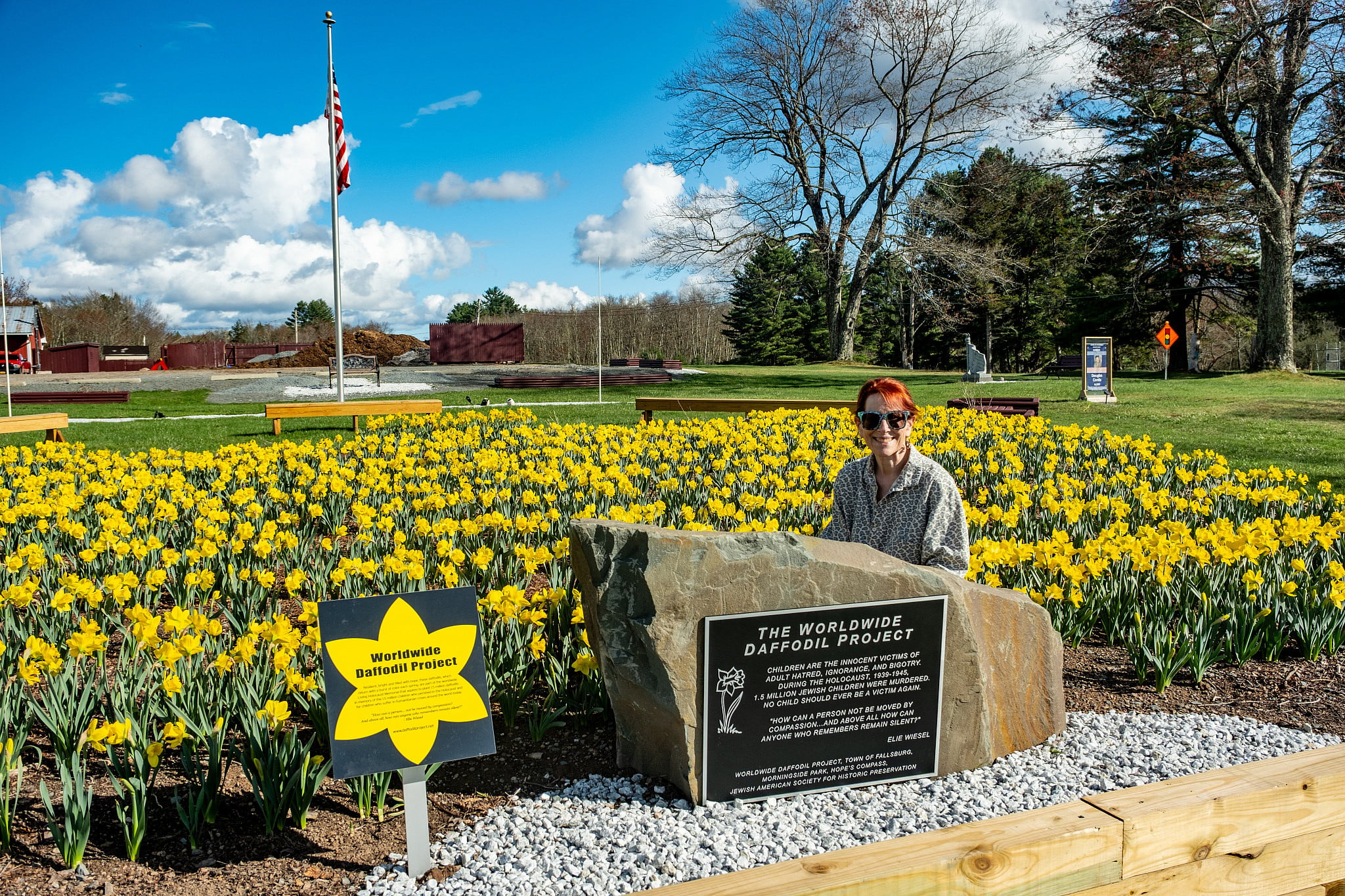
The author at The Daffodil Project at Morningside Park and Campground, Fallsburg, New York. Photo courtesy of the author.
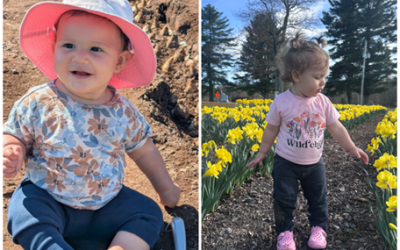
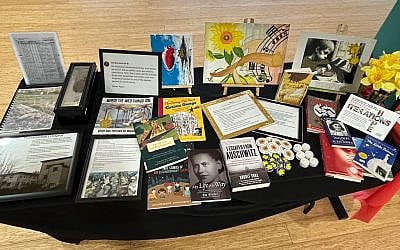
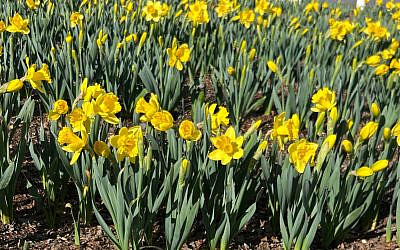
Sitting with tootsies in the soil, watching a toddler take tentative steps among the rows of daffodils, an emotional glance, a hat to shield the sun, two flowered shirts — these are images of a hopeful future that fill my heart with joy.
The images capture moments at an event in Morningside Park and Campground, located in Fallsburg, N.Y. To date, it marks the largest planting of yellow daffodil bulbs in Sullivan County, as part of the worldwide Daffodil Project (www.daffodilproject.net), supported by the Jewish American Society for Historic Preservation.
The sea of six thousand yellow daffodils, honoring the memory of the children who perished in the Holocaust, are framed by hand-laid wooden beams, inserted by the crew at the Town of Fallsburg Park and Campground.
As a volunteer ambassador for the Daffodil Project, I greet people each time we put out a call for volunteers to gather and plant. Who will come? It is never certain. How many will come? Undetermined. What I do know is that someone else will be by my side, standing in the soil, digging holes and placing bulbs. And I know, as certain as I type these words for you to read, that I am richer for this experience.
Am I richer with money in the bank? That I am not. So, how am I richer? Through the smiles, the intergenerational chatter, the hugs and the visitors who provide deposits in the bank of hope.
What happens next? Perhaps another organization will reach out to create a daffodil garden. Perhaps someone will pause to look at the sea of daffodils, to smell and to touch them. Someone else may reflect, while another person may enjoy a picnic nearby. Recently I heard that some teens stopped at the garden in Liberty, N.Y., to stage a prom proposal. That is certainly something filled with hope and heart.
Another next step is educating people about the Holocaust. The Daffodil Project offers multiple resources on its website. Partners can tailor those materials to their communities. People can share and exchange; it is dynamic.
As an educator and an adult host of a Holocaust program, I recently experienced a shocking moment — one that, until then, had only been a statistic in my mind. A small group of teens approached the display table. I noticed one youth standing a little bit behind the others. Making eye contact, I asked if there was a question. Slight pause, a look down and then the teen spoke these words: “Miss, what is the Holocaust? I’ve never heard of it.”
I don’t remember my immediate reaction, but based on what my colleague told me afterwards, I did not emit an audible gasp. Supposedly, I handled it well. What I can share is that this was the first time a teenage student ever told me that. What was my response? I thanked the youth for having the courage to ask me the question and then, knowing time was short, I shared a brief description of the Holocaust. Finally, making eye contact with the adult chaperone and the youth, I offered encouragement to continue learning about the topic by going to the school library and reaching out to me.
This student, less than 20 years of age, is the personification of data from a 2020 NBC News report. At that time, Kit Ramgopal stated, “A nationwide survey released Wednesday shows a ‘worrying lack of basic Holocaust knowledge’ among adults under 40, including over one in 10 respondents who did not recall ever having heard the word Holocaust before.’” The survey also revealed a “shocking lack of Holocaust knowledge among millennials and Gen Zs.”
I would like to believe that a yearly educational program can start a ripple of learning. Research in Canada led educators to say, “We strongly believe that Holocaust literacy results in a student body more likely to prevent bullying, discrimination and other intergroup conflicts at early, nonviolent stages, as well as a generation of future leaders positioned to prevent and mitigate conflict at late, violent stages.”
How is it that these students had not known about the Holocaust? I can run through a list of possible explanations: The student was absent when the Holocaust was taught; the student moved a lot and missed the lessons about the Holocaust; the curriculum in certain schools does not include the Holocaust; books about the Holocaust were banned; a teacher glossed over the topic during lessons about that period of history. You may think of others.
In that moment when the student at the program told me he had not heard of the Holocaust, I chose to believe it was true. I chose not to look incredulous or to ask about where the youth grew up or went to school. This was not a moment to be an inquisitor or to place blame. This was a moment to reach out and teach.
Will I ever know the impact of my gesture to reply with a kind tone in my voice and nonjudgemental eye contact? Probably not. But just this spring, strangers who traversed Sullivan County and saw the daffodil gardens shared posts and photos with me. Since 2022, we have planted 12,000 yellow daffodil bulbs — creating gardens of 250 daffodils to gardens with thousands.
Those are not simply numbers. Each one represents a child, a human being. That is indelible. The Daffodil Project, embraced by our Hadassah members, represents the crux of Hadassah, an organization which provides pathways for people to advocate, to speak up, to take action and to learn. Among the opportunities to participate are advocating for the adoption of the Never Again Holocaust Education Act and joining the Hadassah Educators Council.
Occasionally, I’m asked why I volunteer as an ambassador for the Daffodil Project or write about it for the Hadassah Writers’ Circle. Here is the answer, from the daughter of a Holocaust survivor, who said to me: “Hope, in each daffodil, I see my dad’s brothers and sisters (the people I never got to meet).”
–
Hope is a member of the Hadassah Writers’ Circle, a dynamic and diverse writing group for leaders and members to express their thoughts and feelings about all the things Hadassah does to make the world a better place. It’s where they celebrate their personal Hadassah journeys and share their Jewish values, family traditions and interpretations of Jewish texts. Hadassah members are proud of their Zionist mission and their role as keepers of the flame of Jewish values, traditions and beliefs as well as advocating for women’s empowerment and health equity for all. Since 2019, the Hadassah Writers’ Circle has published nearly 800 columns in The Times of Israel Blogs and other Jewish media outlets. Interested in writing? Please contact hwc@hadassah.org.
Related Topics