The views expressed herein are solely mine.
Damascus at the Gate: Israel Must Strike Now
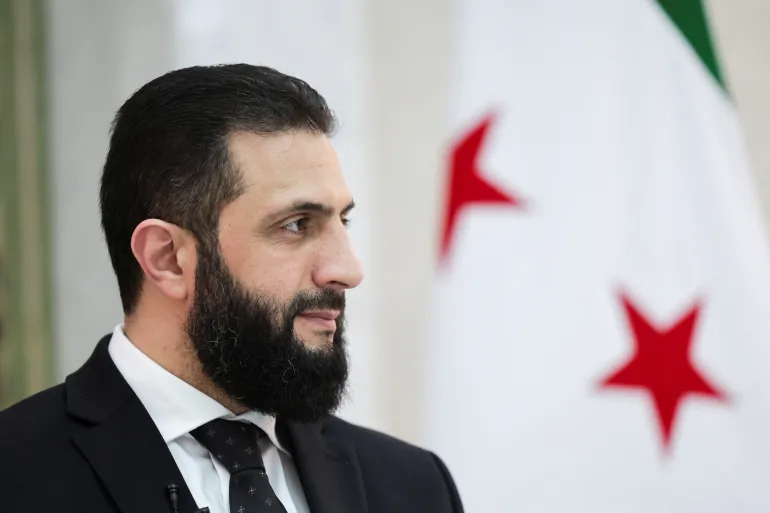
Syria’s interim President Ahmed al-Sharaa at the presidential palace in Damascus, Syria, March 10, 2025 [Khalil Ashawi/Reuters]
The Middle East is shifting again—and this time, Israel has the upper hand. The once-unthinkable idea of peace with Syria, long a spearhead for Iran’s ambitions, is suddenly real. What hangs in the balance is not just a treaty but Israel’s survival, energy security, and strategic dominance.
In Paris, Israel’s Strategic Affairs Minister, Ron Dermer, sat across from Syria’s foreign minister, Assad al-Shaibani, in talks that would have been dismissed as fantasy just a year ago. The Syrians asked for relief—symbolic recognition, economic oxygen, and the chance to claw back sovereignty. Israel demanded the essentials: a permanent buffer along the Golan Heights, guarantees of demilitarization, and freedom to keep Iran’s proxies out of range. These are not Oslo-style photo ops; they are war-room negotiations between a weak regime and a strong Israel that knows the cost of hesitation.
Certainly, the stakes grew higher today when Syria’s interim president announced that an agreement with Israel could come “in the coming days.” He added a striking warning: any deal must strengthen, not endanger, Syria’s leadership. Unquestionably, Syria’s interim president invoked the ghost of Anwar Sadat—assassinated for daring to make peace with Israel—and declared that he hopes Syria’s path will mirror the Abraham Accord states, whose leaders grew stronger, richer, and more influential after siding with Jerusalem.
For Israel, the benefits are obvious: peace with Syria would drive a wedge between Damascus and Tehran, block Hezbollah’s drugs and weapons pipeline, and even open Syrian skies for Israeli pilots with tacit approval. What has long been a shadow war could finally become open strategic depth against Iran.
For Syria, the deal is no less crucial. Security-wise, it would ease the suffocating grip of Iran and reduce the risk of becoming a battlefield for proxies. Economically, the chance to route Azeri gas and oil through Syria to Israel—and perhaps onward to Europe—could mean billions in revenue and a rare path out of sanctions. Most importantly, it would give Damascus the breathing room to rebuild its shattered intelligence and security services, once feared across the Arab world but now hollowed out by war and foreign control.
On the other hand, the Druze minority on both sides of the border would also stand to gain. In Syria, they have endured decades of dictatorship and war. In Israel, they are loyal citizens who fight in the IDF, serve in parliament, and shed blood alongside Jewish soldiers. Thus, a peace deal could reconnect divided families and stabilize their communities. And for the Druze villages of Mount Hermon, the strategic high ground that serves as Israel’s “eyes of the nation,” peace would mean both security and survival. Hermon is non-negotiable; its radars and outposts are the shield that protects the Galilee from Hezbollah rockets, Iranian drones, and Turkish eyes.
This is why the moment is historic. Israel cannot afford illusions of “peace for peace.” The deal must be hard, cold, and transactional: land for leverage, recognition for deterrence, economic lifelines for Damascus in exchange for strategic lifelines for Jerusalem. Iran will rage, Hezbollah will threaten, and radicals will call betrayal—but every step Syria takes away from Tehran is another nail in the coffin of Iran’s regional empire.
History itself validates this urgency. The prophets warned of Damascus as both a threat and a sign, its fate tied to Israel’s survival. The Golan, once the ground where Syrian tanks poured into the Galilee, is now the shield of Israeli families. To secure it with both sword and pen is not weakness—it is wisdom, born of Jewish history and hardened by war.
Cautious optimism is the order of the day. Syria needs money, Israel needs security, and Washington wants another win for the Abraham Accords. The stars are aligning. But alignment without action is worthless. Jerusalem must seize the moment, lock in the gains, and turn a historic enemy into the next unlikely partner. Damascus is at the gate—and Israel must strike now.
Related Topics
Related Posts