A Moroccan Journalist
Dan Illouz Interview: ‘About a million Israelis carry Morocco in their names’
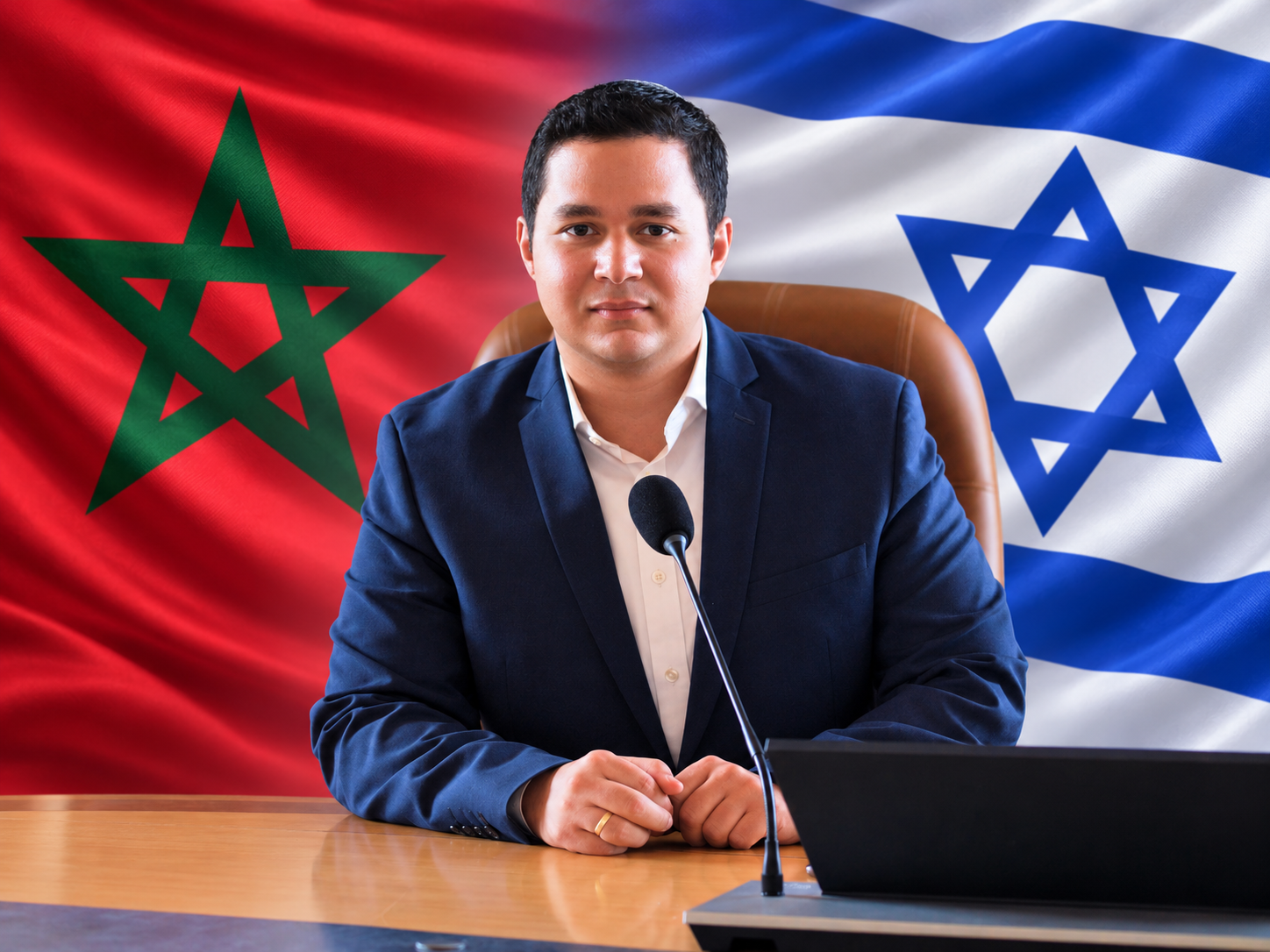
Former Israeli Knesset member Dan Illouz, of Moroccan Jewish descent, pictured against a background featuring the flags of Morocco and Israel. (AI-edited image based on an original photograph by Sharon Hasson/Wikimedia Commons, licensed under CC BY-SA 4.0.)
When Dan Illouz stood before an international gathering of parliamentarians in Marrakech in June 2023, his presence carried a significance that extended beyond the diplomatic rapprochement between Israel and Morocco. The Israeli lawmaker, born in Montreal to Moroccan Jewish parents, had returned to the country of his family’s origins, this time as an elected representative of the Jewish state. His father had grown up in Fez, while his mother came from Safi.
Addressing the first Parliamentary Conference on Interfaith Dialogue, organized by the Inter-Parliamentary Union (IPU) and Morocco’s Parliament under the patronage of King Mohammed VI, Illouz urged countries that had yet to establish relations with Israel to embrace the Abraham Accords. He delivered his remarks in four languages before an audience that included parliamentarians from across the Arab and Muslim worlds. The moment captured something of the unusual intersection of identities that has shaped his political life: an Israeli legislator, raised in Canada, speaking about regional reconciliation in the country where his family history began.
Born in Montreal in 1986, Illouz studied law at McGill University before immigrating to Israel in 2009, at the age of 23. He subsequently served in the Israel Defense Forces (IDF), worked in the public and legal sectors, and earned a master’s degree in public policy from the Hebrew University of Jerusalem. His political career began at the municipal level, serving on the Jerusalem City Council between 2018 and 2021, before he entered the Knesset in 2023 as a member of Prime Minister Benjamin Netanyahu’s Likud party.
During his parliamentary tenure, he served on the Foreign Affairs and Defense Committee and co-chaired the Abraham Accords Caucus, an initiative intended to consolidate and expand Israel’s diplomatic relationships with Arab countries. Yet throughout this progression, his Moroccan origins remained a conspicuous part of his public identity rather than simply a biographical detail.
Illouz has repeatedly used public appearances to express that attachment. In November 2025, a video circulated of him speaking Moroccan Darija during proceedings in the Knesset, paying tribute to his father, who was born in Fez, and addressing his mother affectionately in the language of their family’s homeland. His connection to Moroccan culture has also found expression in the Mimouna celebrations he has hosted in Jerusalem, preserving a festival traditionally observed by Moroccan Jews at the conclusion of Passover.
In a February 2026 interview with the Moroccan publication Le360, he described Morocco as fundamental to his personal identity, recalling the Andalusian melodies, family traditions, and culinary heritage that accompanied his upbringing. His account also touched on a more difficult historical experience: the marginalization of Moroccan and other Mizrahi cultural traditions within Israeli society, an issue that continues to inform debates about identity, recognition, and representation.
That concern has also informed his legislative activities. In December 2025, while serving as acting chair of a meeting of the Knesset’s Committee for Immigration, Absorption and Diaspora Affairs, Illouz advanced a bill proposing an official commemoration of nineteenth-century Jewish immigration from North Africa, particularly the movement beginning around 1840. He argued that conventional accounts of Zionism had insufficiently acknowledged the contributions of North African and Middle Eastern Jews who settled in the Land of Israel before the immigration waves conventionally associated with the emergence of modern political Zionism.
His proposal envisaged an annual remembrance day, parliamentary discussions, academic events, and educational activities. Although the initiative was a legislative proposal rather than an enacted law, it illustrated his effort to challenge the historical marginalization of Mizrahi contributions and broaden the narrative of Israel’s formation beyond its predominantly European reference points.
His interest in Moroccan heritage has accompanied a diplomatic engagement with the kingdom. During the June 2023 parliamentary gathering in Marrakech, Illouz participated in a four-member Israeli delegation alongside Danny Danon, Yifat Shasha-Biton, and Elazar Stern. He used the occasion to advocate wider normalization with Israel, even as Iranian delegates reportedly walked out during his address. The visit took place in the context of a rapidly developing bilateral relationship following the resumption of official Morocco–Israel ties in December 2020.
Israel subsequently recognized Moroccan sovereignty over Western Sahara in July 2023, adding an important diplomatic dimension to the relationship. The war in Gaza after October 7, however, introduced profound tensions between the continuity of official cooperation and the considerably more critical attitudes toward Israel among sections of Moroccan public opinion. These developments form part of the political and diplomatic landscape through which Illouz assesses the future of relations between the two countries.
His own political career has meanwhile undergone a consequential transformation. Although he entered the Knesset under Likud’s banner, Illouz increasingly clashed with Netanyahu’s leadership, particularly over proposed exemptions from military service for ultra-Orthodox Jewish men at a time when Israel’s armed forces were confronting substantial wartime demands. His opposition to legislation associated with these arrangements brought him into conflict with his parliamentary colleagues and contributed to his removal from committee positions and restrictions on his legislative activity. He also criticized Netanyahu’s handling of the aftermath of October 7, arguing that the prime minister had failed to accept sufficient responsibility for the events.
On July 15, 2026, Illouz announced that he would not seek another place on Likud’s electoral list. On August 5, he joined Yisrael Beytenu, the opposition party led by former Defense and Finance Minister Avigdor Liberman, and on August 11 formally resigned from the Knesset, relinquishing the seat he had obtained through Likud.
The transition was more than a change of party affiliation. Founded in 1999, Yisrael Beytenu initially appealed primarily to immigrants from the former Soviet Union but subsequently expanded its political identity around a combination of assertive national-security positions, economic liberalism, and secular approaches to the relationship between religion and state. Its opposition to broad exemptions from military conscription for ultra-Orthodox men was particularly compatible with Illouz’s increasingly public disagreements with Likud.
He has maintained that his departure reflected what he considered the ruling party’s abandonment of its original ideological commitments, rather than any fundamental movement away from his own right-wing convictions. With Israel approaching its October 27 parliamentary elections, Illouz is seeking to continue his political career under a different banner, carrying with him both his disputes with Netanyahu’s leadership and his longstanding interest in Israel’s relationships with Morocco and the wider region.
In the following written interview, Illouz reflects on the Moroccan traditions that shaped his childhood, the symbolism of returning to Marrakech as an Israeli lawmaker, the possibilities and limitations of parliamentary diplomacy, and the durability of Morocco-Israel relations amid regional tensions. He also discusses his political realignment, Israel’s recognition of Moroccan sovereignty over Western Sahara, relations with Algeria, and a proposal for bringing the younger generations of the two countries together through their shared Andalusian musical heritage.
Adil Faouzi: 1. Your father comes from Fez and your mother from Safi, yet you were born and raised in Montreal. What specific memories, family traditions, or conversations most shaped your understanding of Morocco growing up? Did visiting the country challenge any of the image you had inherited?
Dan Illouz:
My father grew up in Fez, the city of Maimonides and the Qarawiyyin. He left at eighteen, for Paris, then Geneva, then Montreal. My mother came from Safi and grew up partly in Toulouse.
Montreal had two Jewish communities, an English-speaking Ashkenazi one and a French-speaking Moroccan one, and ours kept its traditions almost untouched. At Maimonide school we learned piyyutim and the Moroccan cantillation of the Torah instead of music class. At home, the Shabbat table was open to everyone, religious and secular, family and strangers.
Morocco was never a foreign country in our home. It lived in the food, in the Andalusian music, in the Arabic and Judeo-Arabic my father still speaks, and in the way my parents said the names Fez and Safi. I carry it the same way.
Visiting Morocco did not break the picture I grew up with. It confirmed it: the depth, the beauty, the learning. The image that was challenged was the one I met in Israel, where for years Moroccan culture was looked down on, perhaps because it sounded like the culture of an enemy. Peace changed that. Today it is the culture of a friend.
Adil Faouzi: 2. In 2023, you traveled to Marrakech as part of an Israeli parliamentary delegation attending an international conference on interfaith dialogue. What did you discover about Morocco and its people during that visit, and was there a particular encounter that left a lasting impression?
Dan Illouz:
I came in June 2023 with a Knesset delegation to the first Parliamentary Conference on Interfaith Dialogue. It was held by the IPU and Morocco’s parliament under the patronage of King Mohammed VI. Sitting behind a sign that said ISRAEL, I told the hall: “As a proud Israeli, I stand before you today in Morocco, a proud Arab country, as living evidence of the peace that we can achieve when we focus on our common bonds.”
Everywhere I went, I was moved by the richness of Moroccan culture. It felt less like a diplomatic mission than a family reunion.
My grandfather was a waiter in a cinema café in Fez. Two generations later, his grandson came back as a lawmaker of the Jewish state, invited by Morocco’s own parliament. For me, that is what this peace means.
Adil Faouzi: 3. You chaired the Knesset’s Abraham Accords Caucus and advocated closer regional relations. Looking back, what did parliamentary diplomacy actually accomplish in the Moroccan case that conventional government-to-government diplomacy could not?
Dan Illouz:
I won’t overstate it. Governments made the Morocco-Israel relationship, and governments sustain it.
What parliaments add is presence when nothing is being signed. Ministers meet when there is an agreement on the table. Members of parliament meet in between, in forums like the IPU, where Israel is often isolated, and Morocco is heard.
As co-chair of the Knesset’s Abraham Accords caucus, I met the envoys of the Accords countries, Morocco’s among them. In Marrakech, Israeli lawmakers sat in a Moroccan hall as guests. These are small things. But ties between peoples are built from small things repeated, and parliaments are where the people’s representatives sit.
Adil Faouzi: 4. Morocco-Israel relations have demonstrated considerable institutional continuity, even as public attitudes have become more complicated since October 2023. How do you understand this divergence between official cooperation and public sentiment? What would genuine people-to-people reconciliation require?
Dan Illouz:
I understand the gap, and I don’t dismiss it. October 7 and the war that followed tested every relationship Israel has. Public feeling moves with the headlines; states have to see further.
Morocco and Israel did. The relationship held because both states know it is bigger than one war, and because it rests on something older than any agreement.
Real reconciliation needs people to meet. It is hard to stay a stranger to someone you have shared a table with; my parents’ Shabbat table taught me that.
It also needs memory. About a million Israelis carry Morocco in their names, their music, their food, and their prayers. That is not a diplomatic asset. It is family.
Adil Faouzi: 5. Your recent departure from Likud and transition to Yisrael Beytenu mark a new chapter in your political career. Has this transition changed how you intend to advance Israel’s relations with Morocco and the wider region, particularly outside the institutional framework of the Knesset?
Dan Illouz:
The address changed. The commitment didn’t. I left Likud because it stopped acting on the values that brought me to it.
I joined Avigdor Liberman’s Israel Beytenu because it still holds them: a Zionist Israel that wins its wars, a free economy, and one table for secular, traditional and religious Jews.
Israel Beytenu was built by immigrants who never stopped carrying their origins with them. It understands a Jew born in Montreal to a father from Fez. I gave up my Knesset seat to run on the party’s list.
My work on Morocco never depended on a title. It continues in Moroccan and French-language media, in conversations like this one, and in the human ties between our peoples, which no election can cancel.
Adil Faouzi: 6. Israel formally recognized Moroccan sovereignty over Western Sahara in July 2023, a decision you have publicly welcomed. Beyond the declaration itself, what concrete diplomatic steps should Israel take to give that recognition practical meaning, including the possibility of opening a consulate in Dakhla? And given Algeria’s opposition to Morocco’s position on the Sahara and its concerns about Morocco-Israel security cooperation, how can the two countries strengthen their partnership without further aggravating regional tensions?
Dan Illouz:
Recognition has to mean something on the ground. In 2023, Israel said it was examining a consulate in Dakhla. It should open it.
Beyond the flag, the practical meaning is economic: Israeli water, agriculture, and renewable-energy companies working in the southern provinces with Moroccan partners, under Moroccan law. That is what recognition looks like when it is real.
As for Algeria, our partnership with Morocco is aimed at no one. Morocco’s dispute with Algeria began decades before our two countries renewed ties, and Israel stepping back would not end it. The way to avoid raising tensions is to keep the partnership what it is: defensive, open, and about prosperity.
We have no quarrel with the Algerian people, and the door of the Abraham Accords is open to every country in the region. What Israel will not accept is Iran using North Africa as another front. That is not a threat to Algeria. It is a warning to Tehran.
Adil Faouzi: 7. If you were to identify one concrete initiative that Morocco and Israel should pursue over the next five years, beyond diplomatic representation and official agreements, what would it be? What would make that initiative meaningful to ordinary people in both countries?
Dan Illouz:
A joint youth Andalusian orchestra, half Moroccan and half Israeli. The same music lived in the synagogues of Fez and in the homes of their Muslim neighbors, and both our countries still play it.
Young musicians from Fez, Tetouan, Ashdod and Jerusalem would rehearse together. They would perform in both countries every year, in town squares and community halls, not only on concert stages.
What makes it meaningful is that music needs no translation. A grandmother in Ashdod hears the songs of her childhood sung by a young man from Fez. A Moroccan teenager discovers that the piyyutim of his Jewish neighbors carry the melodies of his own grandparents. That is how a friendship moves from signed agreements into people’s homes.
Related Topics