
Author of Just, Reasonable Multiculturalism (2021)
Israel’s Coalition Test: Eisenkot’s Moment
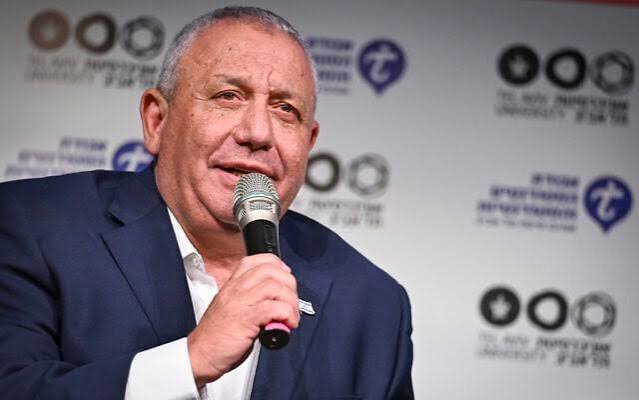
Yashar party chairman Gadi Eisenkot speaks during an election conference at Tel Aviv University, October 18, 2026. (Avshalom Sassoni/Flash90)
The current political stalemate in Israel has once again brought to the fore a basic question in the public discourse: Can a government claim to represent the democratic interests of the country while excluding the elected representatives of its Arab citizens? Gadi Eisenkot’s Change Bloc of four parties holds 48 seats in the 120-seat Knesset. The two Arab parties, Ra’am and the Joint List, have taken a historic 19 seats. With their support, Eisenkot could have a parliamentary majority of 67. But there are still formidable political and ideological obstacles to cooperation.
Eisenkot has laid out four principles for possible coalition partners: recognition of Israel as a Jewish, democratic, liberal and egalitarian state; commitment to the values of the Declaration of Independence; acceptance of universal military, national or civilian service (which is problematic for the two ultra-Orthodox parties); and recognition of Hamas as a terrorist organisation whose military and governing capabilities must be dismantled.
Opponents to the inclusion of Arab parties in the coalition raise the following arguments. First, the question of Arab parties’ acceptance of the character of Israel as the nation-state of the Jewish people and its Zionist foundations is a matter of contention. Second, they raise concerns about the parties’ attitude toward Hamas and other terrorist organisations. The refusal of Ra’am to define Hamas as a terrorist organisation is especially problematic. Third, opponents are concerned that Arab parties would hinder government decisions on Gaza, Iran and Israeli security operations in Syria and Lebanon. Fourth, they argue that issues relating to war, national security and the future of the territories should be backed by a Jewish majority in parliament. Finally, they pose the question of whether a coalition of parties with different ideological priorities and political goals can be stable, especially after the trauma of October 7, 2023.
These are issues that should be taken seriously. Israel faces constant security threats, and no government can function effectively if its coalition partners disagree on the fundamental right of the state to defend itself. Nor should it be without conditions to participate in government. Any coalition partner must accept collective responsibility for government, reject political violence and recognise Israel’s democratic institutions. Those are their legitimate expectations.
However, the case for Arab parties is equally strong. The most compelling arguments are from democracy and equality. Arab citizens make up about 21 percent of the Israeli population and have the right to participate fully in politics. The denial of equal citizenship by excluding their elected representatives based on them being Arab, or not sharing the Zionist ideology, is a violation of equal citizenship. A democratic state cannot make the adoption of a common national identity or political ideology a prerequisite for citizens to be recognised as entitled to participate in government.
The concepts of citizenship and national identity are not the same. Arab citizens need not identify as Zionists to recognise the democratic legitimacy of the State of Israel, to respect its laws and to participate constructively in its political institutions. To demand ideological uniformity would indeed be to impose a particularly narrow conception of democracy. We must not confuse political loyalty to the constitutional and democratic order with agreement on every aspect of the state’s national identity.
There is also a strong practical case. Arab parties have been prepared to play the game of parliamentary politics, to try to make real changes in the lives of their constituents. Ra’am’s participation in the 2021 Bennett-Lapid government was a historic first: an independent Arab party joined an Israeli governing coalition for the first time. The very fact that it took place showed that cooperation was possible across national and ideological lines in the face of considerable political opposition. The Rabin government (1992–1995) too relied on external parliamentary support from Arab parties, showing that cooperation need not always be in the form of full coalition membership.
Furthermore, the Arab parties are not politically homogeneous. Ra’am, under Mansour Abbas, has embraced a pragmatic approach of engagement with Israeli political institutions, while the Joint List embodies a different political tradition and approach to the Palestinian question. To treat both sides as interchangeable is to ignore important distinctions that may matter in the negotiation. A more constructive approach would be a differentiated one based on the actual positions and conduct of each party rather than blanket exclusion.
The political arithmetic is compelling. Arab parties helped secure Eisenkot’s mandate, and their 19 seats could provide the parliamentary foundation for a government committed to ending Netanyahu’s rule. Yet, by mid-November, Eisenkot was reportedly concentrating on negotiations with the ultra-Orthodox parties and had opened discussions with Likud about a possible national unity government. Both alternatives raise serious political and ideological concerns.
United Torah Judaism’s rejection of Zionism as a secular nationalist ideology rests on a fundamentally different conception of Jewish nationhood: Jewish identity is defined primarily through religious observance and the Torah, while national redemption is understood as a matter of divine intervention rather than human political action. Shas, although more politically pragmatic and electorally engaged, also advances a religiously conservative vision of state and society. Both parties exhibit hierarchical, insufficiently democratic internal structures and political worldviews that contrast with and challenge liberal-democratic principles. Their potential inclusion in a coalition raises legitimate questions about the democratic character of the government and the concessions required to secure their support. Both parties also oppose the conscription of yeshiva students into the Israel Defense Forces (IDF), defending the exemption of full-time religious students from compulsory military service. This position raises fundamental questions of equality, civic responsibility and the equitable sharing of the burden of national security.
A partnership with Likud presents an even more consequential danger. It could enable Netanyahu to retain power and evade political accountability for the failures surrounding 7 October 2023, including his opposition to an independent state commission of inquiry. It would also risk legitimising his continued assault on judicial independence and the institutional checks and balances of Israeli democracy, while perpetuating a politics of polarisation, incitement and hostility. A unity government that preserves Netanyahu’s political dominance would seriously risk reproducing precisely the policies and institutional damage that Eisenkot’s candidacy is supposed to challenge.
These alternatives cloud the democratic question at the heart of the debate. And the question relates to the place of Arab parties in Israel’s political system. Here is a workable compromise.
Arab parties could back a government from outside the coalition or be junior partners without sensitive security posts. Clear agreements could set limits on their involvement in military and diplomatic decisions and create common commitments to parliamentary democracy, the rule of law and the rejection of terrorism. Abbas stated that his party is unequivocally against terrorism and violence against civilians. Trust on both sides, political responsibility and the acceptance that coalition partners do not have to agree on every issue would be necessary for such arrangements.
I believe the question of whether Arab parties should be included is not one that should be based on ethnicity, nor on an abstract requirement of ideological conformity. The crucial questions are whether they accept the democratic rules of Israel’s political system, acknowledge the country’s constitutional framework, reject terrorism and political violence, and are willing to abide by collective governmental decisions. These standards should be applied equally to the Jewish and Arab parties. They should also be applied to religious and secular parties, including those whose political positions undermine fundamental democratic principles.
Israel cannot survive indefinitely as a political system that considers a significant portion of its population legitimate to vote but illegitimate to share in governing. While a Jewish majority may be a legitimate political preference, it should not be an ethnic prerequisite for democratic participation. Eisenkot’s challenge is larger than amassing 61 votes. It is an opportunity to demonstrate that Israel can safeguard its Jewish national character and reinforce its democratic infrastructure. Excluding Arab citizens from political power will not resolve the tensions between Israel’s national identity and its democratic commitments. Eisenkot needs to engage in politics in a constructive, democratic way.
Related Topics
Related Posts