
Highlight Nepal’s presence in the Global Context
Dashain Away from Home: Nepalis in Israel
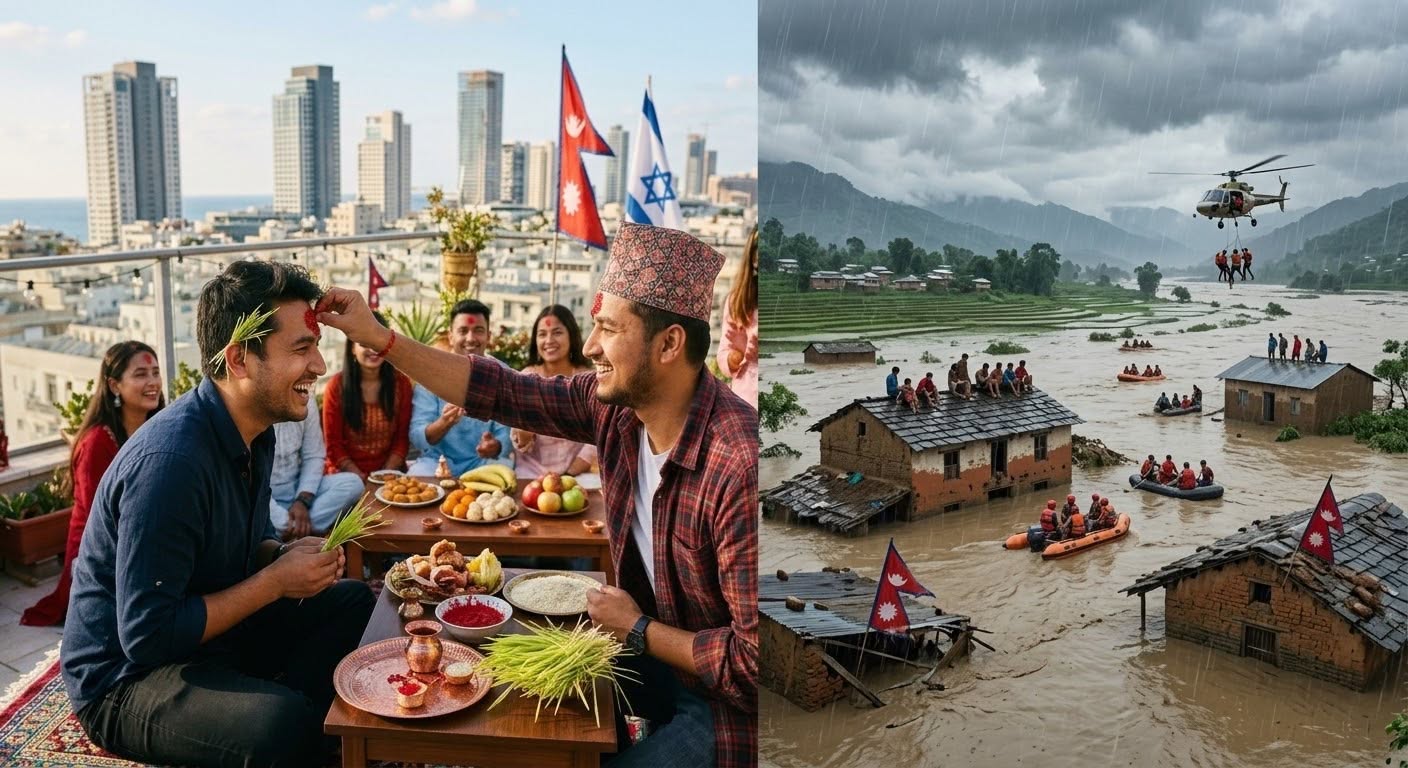
This photo was created using AI
Thousands of miles away from home, with work responsibilities on our shoulders and memories of our families in our hearts. This year, Dashain is not just a festival of happiness for many Nepalis. It is also a time of missing home, feeling the pain of being unable to return, and worrying about loved ones affected by disasters back in Nepal.
As Dashain approaches, a different kind of excitement begins to fill Nepal. Markets become crowded, homes are cleaned, and families start preparing to buy new clothes. Swings are set up in villages, relatives make plans to meet, and family members living far away begin counting the days until they can return home.
For those who spend most of the year working hard, Dashain brings a chance to sit together with family, share happiness and talk about the difficulties of life.
Perhaps the greatest joy of Dashain is being able to meet our loved ones after a long time apart.
But not everyone gets to enjoy that happiness.
Even in Nepal, some people cannot celebrate Dashain as they wish. Some struggle with financial problems, while others live far from their families. Some are dealing with the pain of losing loved ones.
And for Nepalis like us who live abroad, Dashain brings happiness along with a painful question: Will I have to miss another Dashain at home this year?
For Nepalis living in Israel who must go to work during the festival, this question is nothing new. The years pass, and Dashain comes around again, but the chance to return home does not always come with it.
People come abroad with dreams of building a better future for their families. Yet, sometimes, in trying to provide a better life for their loved ones, they miss the very moments they want to share with them.
When we calculate our earnings, we count many things. But there is no way to calculate the time we have lost with our families.
This year, the pain of being away from home is made even heavier by the suffering of families affected by floods and landslides in Nepal. At a time when homes should be filled with happiness, some families are struggling to protect their homes, farmland, and sources of income.
That is why Dashain this year cannot be understood only through the excitement of the festival. It is also a time to remember Nepalis living far from home and the families suffering from disasters back in their homeland.
When Dashain Arrives, Our Hearts Return to Nepal
Life in Israel continues as usual when Dashain approaches. We wake up in the morning, go to work, complete our responsibilities, and try to find time to speak with our families.
Some Nepalis work in elderly care, some in hotels and restaurants, and others in different jobs to support their lives and families.
Getting time off work is not always easy. Even when leave is available, returning to Nepal requires careful planning, enough time, and money for travel.
But as soon as we begin hearing news of Dashain celebrations in Nepal, our hearts are already back in our villages and homes.
Our mothers call and ask, “Son, are you coming home for Dashain this year?”
It may sound like a simple question, but only those living abroad can truly understand the pain behind it.
A mother wants to see her son come home. A father wishes to celebrate Dashain with the family. A wife wants her husband beside her. Children hope their father or mother will return home for the festival.
But sometimes, all we can say is, “I couldn’t make it this year. I’ll try to come next year.”
Sometimes, we do not even realize how many years have passed while repeating the same promise of coming home next year.
Staying away from home does not mean we love our families any less. In many cases, it is our love for them that keeps us abroad.
We have loans to repay, children’s education to pay for, and parents whose medical expenses must be covered. Many people leave their birthplace and travel thousands of miles because they want to fulfill responsibilities that would be difficult to manage while staying at home.
The sad truth is that the same struggle we go through to make our families happy sometimes takes away our chance to celebrate happiness with them.
While families gather in their homes across Nepal on Dashain day, many Nepalis in Israel remain busy at work. For them, the day may look just like any other working day.
The only difference is that their minds keep returning home.
They see their families on video calls. They watch their loved ones putting on tika and celebrating together. Their children speak happily, and their parents try to sound cheerful.
But after the call ends, sitting alone in a room can make the feeling of being away even stronger.
At such moments, we may ask ourselves: I am working so hard for my family, but why am I unable to be with them on the very day they want me most?
In life abroad, earning money is not always the hardest part. Sometimes, the greatest challenge is continuing to fulfill our responsibilities while carrying the sadness of missing the people we love.
We Can Send Money, But We Cannot Bring Back Lost Time
Money earned abroad can help us build a house in Nepal. It can provide our children with a good education, make daily life easier for our families, and pay for our parents’ medical treatment.
After years of hard work, our financial situation may improve.
But no amount of money can buy the feeling of receiving Dashain tika from our mother’s hands.
Sitting beside our father and talking for a while, hugging our children, sharing a meal with relatives, and remembering old times are precious parts of life. Their value cannot be measured against our earnings.
For parents with young children, spending Dashain abroad can be especially emotional.
Children grow older every year. They start school, learn new things, and change day by day. Meanwhile, their fathers or mothers may be thousands of miles away, watching many of these important moments through a mobile phone screen.
Sometimes, a child asks, “Dad, when are you coming home for Dashain?”
It is not an easy question to answer.
Children may not understand work contracts, difficulties in getting leave, or financial responsibilities. They simply want their father or mother to be home with them during Dashain.
Meanwhile, parents back in Nepal are also growing older. They may no longer be as strong as they once were. They may find it difficult to work or travel long distances.
Yet, their habit of waiting for their children to return from abroad does not easily go away.
When we think about these things, a fear sometimes enters our minds: While trying to build a better future for our families, how many important moments of the present are we missing?
Going abroad is not wrong. Working hard for our families is not wrong either. But when we look at our lives, money should not be the only thing we count.
The time we spend with our families is just as important.
For many Nepalis living abroad, Dashain reminds us of this truth once again.
This Year, Happiness Is Incomplete in Many Homes Across Nepal
When we think of Dashain, we remember delicious food, new clothes, tika, jamara, and family gatherings.
But for families affected by disasters, these things may no longer be their main concern.
When floods and landslides damage a home, finding a safe place to live becomes the first priority. When farmland is washed away, families begin worrying about how they will survive in the coming months.
If a shop or business is damaged, the question becomes how to start again. If a family member is injured or a loved one is lost, grief can become greater than the happiness of the festival.
For families affected by natural disasters this year, celebrating Dashain may not be easy.
Imagine a family that had saved some money for Dashain. They planned to buy new clothes for their children, invite relatives to their home, and prepare special meals.
Then, suddenly, a flood arrives.
Their home is damaged, their belongings are destroyed, or their farmland is washed away.
For that family, the meaning of Dashain changes completely.
The money saved for new clothes must now be used to repair the house. The money set aside for the festival must be spent on daily needs.
Instead of sitting together and celebrating, family members may find themselves worrying about how they will manage the next day.
When we look at such families from a distance, it can be difficult to understand the full depth of their suffering.
We may see a damaged house, destroyed farmland, or belongings washed away. But along with these losses, people also lose years of hard work, plans for the future, and the sense of security they once had.
A Nepali working abroad may have built a house in Nepal with money earned through years of hard work. They may have bought farmland for their family or saved money to secure their future.
When they hear that a natural disaster has damaged that house or property, the pain is not only financial. It also affects them emotionally.
For Nepalis living in Israel, worrying about family members back home is nothing new. But when concerns about their safety and the condition of their homes are added to the pressure of daily life, the emotional burden can become even heavier during festivals.
That is why, while celebrating Dashain this year, we should remember not only the happiness in our own homes but also the suffering of others.
Nepalis in Israel Carry Concerns for Two Countries
Israel has become a destination for employment and new opportunities for many Nepalis.
Many have come here hoping to improve their family’s financial situation. Some need to repay loans, some want to build a house, and others want to secure a better future for their children.
Some are working to cover the medical expenses of their elderly parents back in Nepal.
Every person has a different story, but many share the same dream: to give their families a more comfortable life.
While working in Israel, Nepalis try to remain connected to their language, culture, and traditions.
When Dashain arrives, they try to meet friends, put tika on one another, prepare Nepali food, and exchange greetings.
Those who have time gather together, while those busy at work send wishes to their families and friends over the phone.
Keeping our culture alive while living abroad is not always easy. When we are far from home, festivals help us feel connected to our roots.
Speaking Nepali together, sharing stories about our traditions, and remembering Dashain bring a sense of belonging.
However, receiving tika from friends abroad is not the same as receiving it from our own parents at home.
Celebrating Dashain in another country helps us stay connected to our culture, but it cannot completely replace the feeling of being with our families.
For Nepalis living in Israel, there is sometimes another concern as well.
The security situation and the risk of war can make us worry about our own safety. At the same time, our families in Nepal worry about us and try to find out whether we are safe.
Meanwhile, those of us living in Israel continue to worry about our parents, husbands, wives, and children back home.
Sometimes, both sides try to comfort each other.
Our families tell us, “Please take care of yourself.”
We reply, “Don’t worry about us. Everything will be fine.”
But the truth is that both sides carry their own worries.
Celebrating Dashain abroad is therefore not only about missing home. Sometimes, it also means trying to balance concerns about the country where we live with worries about the families and homeland we have left behind.
Happiness on a Mobile Screen, Emptiness in the Heart
Technology has made it easier for people living far apart to stay connected.
In the past, people had to wait for letters. Today, we can make a video call within seconds. We can watch our families celebrating Dashain in Nepal while sitting in Israel.
We can see our home, our relatives gathered together, and the happiness on our children’s faces through a mobile phone screen.
This is a great convenience.
But seeing someone’s face on a phone is not the same as sitting beside them.
We may see our mother’s face during a video call, but we cannot sit next to her and talk for hours. We may watch our children laughing, but we cannot hold them in our arms.
We may see everyone putting on tika at home, but we cannot personally place the tika on their foreheads.
Sometimes, seeing Dashain photographs on social media makes us happy. We feel glad to see our relatives celebrating well.
But those same pictures also remind us that we are not there with them.
Many people do not show their sadness to others. They send Dashain greetings, post smiling photographs, and speak normally with their families.
But after returning to their rooms, they may find themselves missing home even more.
The pain of living abroad does not always appear as tears. Sometimes, it hides behind a busy work schedule.
Sometimes, it can be seen when someone becomes quiet after a phone call with family. At other times, it is hidden in the fact that they spend Dashain day working just like any other day.
That is why, when wishing our relatives abroad a happy Dashain, we should also try to understand their situation.
Being unable to return home does not mean they love their families any less.
For many people, staying away from home is a difficult necessity that allows them to fulfill their responsibilities toward the very people they love.
The Meaning of Dashain Also Lies in Understanding Others’ Pain
During Dashain, we receive tika and blessings from our elders and share happiness with our families.
This is one of the most beautiful parts of our culture.
But the meaning of the festival should not be limited to enjoying ourselves with our own families.
We should also be able to think about the difficulties other people are facing.
This year, let us remember families affected by floods and landslides.
Let us try to understand what they need and support relief and recovery efforts whenever possible. When offering help, we should choose reliable channels to ensure that our support reaches the people who need it most.
Helping others does not always require a large amount of money.
Providing food, collecting clothes for children, helping repair damaged homes, or bringing the situation of affected families to the attention of the relevant authorities can also make a difference.
The responsibility of the government and concerned authorities is equally important.
Providing immediate relief to disaster-affected families is not enough. They also need safe housing, clean drinking water, healthcare, roads, and opportunities to earn a living.
It is important to create conditions that allow them to rebuild their lives and return to normal as soon as possible.
During disasters, people often talk about the situation for a few days. Photographs of relief distribution are shared, and public attention gradually moves elsewhere.
But the problems faced by affected families do not disappear with the passing of time.
They still need to rebuild their homes, repay debts, educate their children, and find ways to start their lives again.
That is why remembering these families should not be limited to the festival season. Supporting them beyond Dashain is also part of our responsibility as human beings.
The happiness of Dashain becomes even more meaningful when we try to reduce the suffering of others while enjoying our own happiness.

Living Abroad Does Not Mean Forgetting Our Country
Sometimes, people ask Nepalis who have spent many years abroad, “After living overseas for so long, why do you still miss Nepal so much?”
The answer does not require many words.
No matter where we live, we remain connected to our birthplace, childhood, family, and the feeling of belonging somewhere.
Nepal is not just a place on a map.
Nepal is the village where we grew up, the roads where we played as children, the love of our parents, the days we spent with friends, and the memories that remain with us throughout our lives.
When Dashain arrives, all these memories return at once.
Nepalis working in Israel also carry the same love for Nepal in their hearts.
They dream of building houses in Nepal with the money they earn here. They want to give their children a better future and provide a comfortable life for their parents.
They also hope that one day they will have enough time to return to Nepal and share life’s simple joys with their families.
But life does not always follow our plans.
Work responsibilities increase, financial needs continue, and plans to return home may be postponed for another year.
Meanwhile, important years of our lives continue to pass.
Working hard abroad is nothing to be ashamed of. Struggling to build a better future for our families is something to respect.
But amid that struggle, we must also protect our family relationships and the happiness that makes life meaningful.
Whenever possible, we should make plans to spend time with our families. We should talk openly with our parents, stay connected with our children, and express our love and the difficulties we face.
Because our families do not need only money.
They also need our time, our presence, our support, and our love.
Hoping to Return Home for the Next Dashain
This year, the situations of Nepalis living in Israel and families affected by floods and landslides in Nepal may be different.
But both share a similar wish: to see life become easier again and to enjoy happiness with their families.
Nepalis in Israel are working hard to build a better future for their loved ones. For them, Dashain has become a time to remember home, reflect on the years that have passed, and hope that next year they will finally be able to return.
Meanwhile, families affected by floods and landslides in Nepal may be struggling to rebuild their homes, recover their property, and restore their lives.
Their immediate needs include safe housing, a way to earn a living, and hope for a better future.
We must understand both situations.
We should remember the pain of Nepalis living far from home and stand beside families who are suffering in Nepal.
I hope that every Nepali living in Israel can keep the dream of returning home alive.
May they be able to receive tika from their parents next Dashain. May they be able to hug their children and spend precious time with them. May they finally get the chance to share the family happiness they have missed for years.
I also hope that life becomes easier for families affected by floods and landslides in Nepal.
May damaged homes be rebuilt. May life return to the affected villages. May everyone get another opportunity to rebuild the lives they created through years of hard work.
There is one thing we should all remember: the happiness of Dashain is not limited to new clothes, delicious food, and red tika on our foreheads.
Its true meaning lies in being with our families, living safely, maintaining close relationships, and showing kindness and support to one another during difficult times.
May the journey home become easier for Nepalis living abroad.
May families affected by disasters in Nepal receive the support they need.
May no one be forced to spend the festival in sadness because of circumstances beyond their control.
And wherever life takes us, may our love for our families, our communities, and our homeland never grow weaker.
Wishing all Nepali brothers and sisters a very Happy and Blessed Dashain.
May the suffering of families affected by disasters become lighter. May Nepalis living abroad see their dreams of returning home come true. And may happiness and hope once again shine in every home.
Related Topics
Related Posts