
More in love with my land and my people every day
David’s Story: A Choose-Your-Own Adventure (With a Twist)
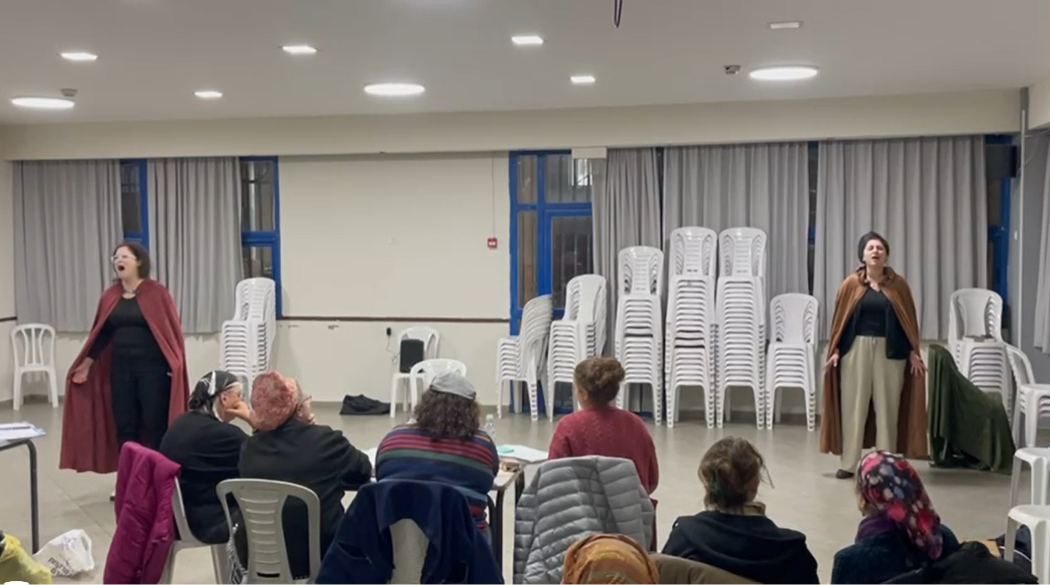
Rivka Deray (playing King Shaul, L) and Michal Lourenco (playing Yonatan, R) rehearse 'I Will Obey' from David The Servant King. (courtesy)
You know you have something good when the entire cast and crew are in tears during a rehearsal. Not tears of frustration (though there can be plenty of those in a production of any scale!), but emotion pouring out on faces as two cast members, Rivka Deray and Michal Lourenco (pictured), playing Shaul and Yonatan, rehearse a haunting song of regret and prayer, on the cusp of their final battle with the Philistines.
(To find out how the story ends, see Shmuel I, chapter 31 – or better yet, ladies, come and see David The Servant King in early 2026!)
That scene, and David’s heartrending eulogy that follows, led another cast member, Malkah Fleisher, who plays Yishai, to comment to me on the degree of tragedy present in the narrative, which follows David from his birth until his ascent to the throne. She seemed surprised to notice this, since the show is well-balanced with many moments of strength and humor that act as a counterweight to the pain experienced by so many of the characters, especially the protagonist, David.
And yet, in learning Tanach in general and Navi (Prophets) in particular, I have always been acutely aware of the pain and tragedy that accompany so much of our history.
Many Tanach teachers remind us that ‘Torah isn’t a fairy tale’; most, if not all, are not written with ‘happy endings’. The stories that form our history and our mandate were recorded by G-d and our prophets with a particular purpose in mind — to help us understand what we are supposed to do and why, as individuals and as a nation, and to allow us to learn from our ancestors’ mistakes.
The last few months have been busy with rehearsals for the show, but as it so beautifully combines my passions for music and Tanach, I felt compelled to take the opportunity to ‘deep dive’* into the Biblical text that inspired Shlomit Koffler Weinreb to write the songs and, together with Avital Macales, the script, that comprise David: The Servant King — a musical production that masterfully balances the emotional weight of its subject matter with witty dialogue, songs and choreography that uplift, entertain and inspire the audience.
As Malkah observed, David’s path to the throne is certainly paved in blood and tears (though in the show, David is also given moments of lightness and humor!).
What struck me most in my study of these stories, however, was not David’s pain, but rather the key moments at which choices were made that shaped the route to his final royal destination.
I subscribe to a worldview of life as a ‘choose-your-own-adventure’ novel with a twist. The destination is predetermined, but the route we take remains the result of our own choices.
I see this play out clearly at many points in David’s story.
Following his own choice to bow to public pressure, Shaul is rejected by G-d as king. However, this does not mean immediate demotion; it simply means that the royal line will stop with him. His son Yonatan will not be king after him.
As it happens, Shaul, almost certainly unknowingly, invites the one who is secretly anointed in his stead — David — to serve him in the palace. David himself eventually marries into the royal family.
All the ingredients were there; it could have been so simple. Instead of fighting the future, Shaul could have shaped it. Rather than handing down the crown to his son, he could have placed it on the head of his son-in-law, David. Yonatan, David’s closest friend, would have stepped aside without hesitation. Shaul could have lived with rejection, as Shmuel foretold, and still seen his royal line live on — entwined with David’s — through his daughter.
What actually happened was far bloodier, and included multiple attempts by Shaul to murder David, David’s flight from the palace in the dead of night, the annihilation of an entire city of Kohanim and a civil war between Shaul’s and David’s followers, until Shaul and his sons’ eventual death in battle.
What went so wrong?
Life may be the sum total of a million tiny choices, but there are still moments that matter more than others.
In this story, there are many key decisions made by the players that could have changed the entire trajectory of the tale.
Shmuel, Shaul’s prophet and mentor, was devastated when Shaul deviated from G-d’s command and chose instead to bow to public pressure. Given his personal stake and disappointment, Shmuel is particularly harsh when delivering G-d’s message of rejection, arguably harsher than the prophecy he actually received from G-d. If Shmuel had been less harsh, would Shaul have been so devastated and angry?
Following David’s victory over Goliath, the public sang a song of triumph that Shaul interpreted (probably erroneously) as a sign of divided loyalty. Had he not already been saddened and angered by the harsh Divine rejection, as expressed by Shmuel, might Shaul have interpreted this song differently?
There is a saying that marrying off a daughter is ‘not losing a daughter, but gaining a son’. Shaul could have chosen to view his new role as father-in-law to David in this way. He could have accepted G-d’s will that his son would not rule after him and officially appointed his son-in-law as heir to the throne. What might the future have looked like had he done so?
Shaul becomes paranoid that David harbors treasonous intent. Michal, Shaul’s daughter and David’s wife, is placed in a position of impossible loyalties. When forced to choose, she aids David’s escape but ultimately remains loyal to her father. If Michal had decided to join David in his flight, would Shaul have continued the chase?
David expresses his concerns to Yonatan, his best friend, as well as Shaul’s son and heir to the throne. In another case of impossible choices, Yonatan helps David escape but remains in the palace with his father. Had Yonatan sided openly with David and stood up to his father, would the war have happened at all, or would the people have sided with Yonatan, as they had done against Shaul previously, avoiding civil war altogether?
One of the reasons I find David’s story so tragic is that so much pain and bloodshed could have been averted had key people made different decisions at critical moments. These choices may not have altered the ultimate outcome — David’s ascent to the throne — but the journey to get there could have been infinitely less painful.
The Talmud in Nedarim 22b quotes Rabbi Adda bar Hanina:
אִלְמָלֵא (לֹא) חָטְאוּ יִשְׂרָאֵל לֹא נִיתַּן לָהֶם אֶלָּא חֲמִשָּׁה חוּמְשֵׁי תוֹרָה וְסֵפֶר יְהוֹשֻׁעַ בִּלְבַד, שֶׁעֶרְכָּהּ שֶׁל אֶרֶץ יִשְׂרָאֵל הוּא.
“Had Israel not sinned, they would have been given only the five books of the Torah and the book of Joshua (because it includes the arrangement of Eretz Yisrael).”
Torah teaches us what we are supposed to do and why. The books of Nevi’im were recorded to help us learn from the mistakes of others, in the hope that we do not repeat them.
We see our leaders today faced with impossible choices. I do not envy their burden. But I do hope they can look back and learn the lessons, so painfully gleaned, from our rich history and tradition. If they do, perhaps the journey towards our own final destination may be a little smoother.
*****
Ladies, if David’s story feels less like ancient history and more like a timeless ‘choose-your-own adventure’ with real consequences, then David The Servant King is a story you should see.
Tickets available for on www.davidservantking.com — with early bird pricing until the end of this week!
Tickets will also be available for a worldwide livestream viewing on 1 February 2026.

* I would like to express my enormous thanks to Rabbi Moshe Shulman of Young Israel of St. Louis for his series of shiurim on the book of Shmuel, which have transformed my understanding of the book and form the basis of the thesis expressed in this post. I highly recommend the series to anyone with the time and interest to study this part of Navi in depth.
Related Topics
Related Posts