The Ecstasy of the Piyyut
After the fall of the Second Temple (70 CE) the Jews were still a majority in the Land of Israel. First, they lived under the authority of the pagan Romans. When the Romans then converted to Christianity, these same Jewish communities found themselves living under the religiously hostile regime of the Byzantine Empire. This corresponds to the period of the finalization of the Talmud during the first five centuries CE.
Ethnomusicologists and historians of liturgy should therefore not be surprised that this period coincided with the creation of a new form of religious poetry and song called Piyyutim in the plural and Piyyut in the singular.
My late mentor, the Israeli ethnomusicologist of the Near East, Amnon Shiloah, might have explained this as radical changes in social structure and authority inevitably produce their artistic correlates, as creative types try to make sense of the world they live in. And so, the Jews of that historical period that scholars now call Late Antiquity, created the Piyyut.
A Piyyut is a Jewish liturgical poem. Most have been written in Mishnaic Hebrew or Jewish Aramaic (the language of the Talmud), and they follow various poetical schemes. Traditionally, they have been chanted as part of a service and much later took on a life of their own being sung, often with near eastern musical instruments on non-Sabbath days.
Here is one example from the traditional Ne’ilah service which is recited at the end of Yom Kippur, the annual Jewish day of fasting and atonement. The piece was recorded in Egypt about a century ago. It was sung by a father and a daughter who were soon to become singing stars in the post WWI rising Egyptian recording and film industry, namely Zaki and Leila Mourad. The Piyyut is called El Nora Alila. The words were written by the Spanish Jewish poet Moses Ibn Ezra, who lived between 1070 and 1138 CE.
Ibn Ezra in his own day was as big a star as Zaki and Leila Mourad. He was a polymath, a friend of the great poet Yehuda ha Levi, author of the Kuzari. He was from a prominent Jewish family and wrote 220 sacred Piyyutim, often mimicking the rhyme schemes of classical Arabic poetry but using Hebrew and in this case, always praising or asking God for something. We call this religious song.
Here is just one verse of El Nora Alila to give you a sample of the mood of these kinds of pieces.
Gather Judah’s scattered flock Unto Zion’s rebuilt site.
Bless this year with grace divine, As Thy are closed this night.
May we all, both old and young, Look for gladness and delight
In the many years to come, As Thy gates are closed this night.
Michael, Prince of Israel, Gabriel Thy angels bright,
With Elijah, come, redeem, As Thy gates are closed this night.
There are no wine, women, and song in these verses nor sex, drugs and rock and roll. It is purely religious, but the music is chock full of emotion and the way it is sung filled with longing and hope.
During the last eight hundred years Piyyutim have been sung by Jewish men living in Islamic societies, during services as well as outside of the Synagogue for entertainment or celebrations of various kinds. They have often adopted the Near Eastern scales with quarter tones (makam) and use instruments like the oud, kemence (violin) and darbuka to accompany them. The melodies are often similar to the music of their Muslim majority hosts, especially in Morocco, as it is well known that Jewish musicians were disproportionately active in the secular music world of their Muslim hosts.
After the expulsion of so many of the Jews of the Arab world in and after 1948, and among so many of those Jews who came to Israel, elderly Jews would congregate in their various synagogues and play and sing Piyyutim.
From 1948 until about the year 2005 the only outsiders interested in recording and studying these traditions were Israeli and Jewish literary scholars and ethnomusicologists who, like so many of their underfunded colleagues around the world, were trying to save as much traditional music for the archives of the world and for the enrichment of the next generation. Israel’s sound archives are full of these recordings and here is just one example of this traditional style maintained by the singing Rabbi Haim Louk from Morocco.
Given the modernizing, secularizing trends in Israel during the 1950s and 60s it was wrongly assumed by ethnomusicologists and the public that the tradition of Piyyut was dying out and it would only survive in the national sound archives, as just one more marvelous aspect of the multicultural past of Israel’s diverse communities who came from the Middle East. Then, just a few years ago that dynamic reversed itself.
Israeli society was changing. The divide between religious and secular has been blurring. The official religious authorities (politically appointed “Chief Rabbis”) were often seen as irrelevant. And so, people along the religious spectrum looked for a better way to express their Jewish faith. They found Piyyutim.
Now all that work done by literary historians and ethnomusicologists started seeping back into the daily life of Israelis. People from all occupations of life, both men and women have found singers of Piyyutim and started informal groups of singers. People now have access to the Singing Communities movement and their web site of Piyyutim which provides similar texts with music from the different ethnic traditions of interpretation. There are many web sites that support this growing, voluntaristic exploration of poetry, music, and spirit. One can be found at http://www.piyut.org.il/
Today, scores of thousands of Israelis either listen to Piyyutim, sing them or join singing groups. There are also new ensembles of Paytannim (performers of Piyyutim) who give concerts, open web sites, and have a growing audience, usually within the age bracket of 20-50.
If you think the revival of Piyyutim is the like Early Music movement or even world music gatherings, think again, as the performance event is something unique and out of the box. I just attended one of these evening events a few days ago. I will try to describe what was on offer and the audience response.
Imagine a beautiful old spacious Ottoman building in the heart of Ein Kerem, with a spacious open courtyard and wall. Against one wall they have set up an enormous, wide stage six feet high (so everyone in the mini amphitheatre like courtyard can see and hear the performers) and wide enough to hold twenty musicians with their lutes, fiddles, flutes, multiple singers, stand up bass, electric guitarist and drums. The stage is littered with stand up and sit-down microphones which are plugged into a state-of-the-art sound system.
The courtyard of the synagogue starts filling up. It is mostly young Israeli men and women from about twenty to fifty. (There are NO tourists here). Some of the couples are married, some are not and there are clearly unmarried men and women sprinkled among the audience, looking about for people they know or then again may not know and want to get to know. It is not a marriage mart but subtly so. Lots of people are being introduced to each other. Lots of hugs and smiles.
Many of the men wear kippahs (head coverings) and many of the women wear graceful and stylish turbans of many colors that are clearly chosen to complement a well thought out, modest but feminine outfit. I call the style of both men and women’s clothing “hippie orthodox,” as it is not linked to any Rabbi or sect. It is as North Americans would say, “spiritual.”
Some of the men wear tzi tzit and there is much hugging, smiling and gossip. (AI tells us that Tzitzit (or tzitzis) are specially knotted ritual fringes or tassels attached to the four corners of garments worn by observant Jewish males, fulfilling a biblical commandment to remember God’s commandments.)
There is lots of smiling as the audience anticipates a beautiful and meaningfully celebration as tonight is Lag Baomer, a Jewish holiday made more meaningful to observant Jews as the ancient sage Rabbi Simon Bar Hai is almost its patron saint. Over the centuries Moroccan Jewish poets and musicians have always held him in high esteem as his grave in the Galilee on Mount Meron is the site of an annual semi ecstatic pilgrimage with commemorative bonfires.
The Chabad site tells me that Lag Ba Omer, the 33rd day of the Omer count—this year, May 5, 2026—is a festive day on the Jewish calendar that honors Rabbi Shimon bar Yochai, author of the Zohar. It is celebrated with outings (on which children traditionally play with bows and arrows), bonfires, parades and other joyous events. Many visit the resting place (in Meron, northern Israel) of Rabbi Shimon, the anniversary of whose passing is on this day. It is now precisely the evening of May 5, and I am ready to be uplifted. (The Zohar is one of the central texts of the Kabbalah, the source of Jewish mysticism and was most likely written by a Rabbi in medieval Spain writing under the name of Bar Yohai. I have read much of it, and it is extremely evocative).
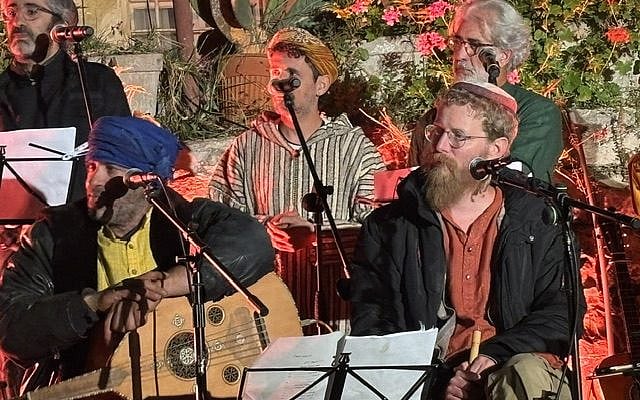
Just before I try to describe, or more modestly, evoke what I heard that evening let me describe the musicians. As they assemble on the stage eighteen men from their twenties to their eighties look out at us. They are dressed in a variety costumes.
Some wear the turbans beloved of the Berbers of highland Morocco and the long woolen djellabas that look like monk’s robes. Others have adopted multicolored Indo Pakistani pantaloons and long shirts to their knees that make them look like characters from a Disney version of Aladdin. Some wear Bokhara caps like the one that Robbie Robertson of the Band whimsically adopted in the 1970s. Others wear vests and scarves of various kinds.
Together they constitute a kaleidoscope of colour. I am reminded of the costuming of the Hollywood musical set in medieval Baghdad, Stranger in Paradise and quite frankly I like the result.
Apart from the stand-up bass player and electric guitarist, all the musicians-drummers, violin, and oud player and a few of the octogenarian singers are seated. Before they even start to play and sing these eighteen men stand poised and proud. Yes, they have that “religious, celebratory” look in their eye, but they are not here to convert anyone, Jew or Gentile.
They are here to celebrate Lag Baomer and the obvious goal of their entire performance is to share the beauty of the Piyyut in honour of this joyful holiday. Meanwhile, as the amphitheatre fills up there is a brisk trade going on for an open bar and bar b q serving up delightful snacks. The drink of choice are small glasses of Arak, an aniseed-based drink beloved of Sephardic and Oriental communities, one more distinction of difference to their former teetotaling Muslim hosts back in the old days.
I am a frequent visitor to this venue when I visit Israel and so I am not surprised to see Gal Amar from the fusion band Silan manning the bar b q, saz player Moriyah Menahem in the audience as well as upcoming Ein Kerem based visual artist Michal Avraham also present. Their mere presence makes me feel at home.
The band begins performing. I usually do not like loud music, but their level of volume is different. It is like listening to a jet plane take off and I am surprised at how powerful and pleasurable it is. They played nonstop for more than two and half hours. Towards the end of the concert, they lit a small, symbolic bonfire in front of the stage in honour of Lag Ba Omer.
By that time, a good quarter of the audience was dancing, yes, ecstatically in front of the stage. Throughout a good-looking middle-aged woman wrapped in a white shawl was belly dancing with her eyes closed. Spiritual, sensual, a combination of both? I will take the latter option.
Yes, all the pieces were Piyyutim of various sorts. The musicians on stage often jumped up and down or raised their hands in supplication. Although the repertoire was linguistically traditional, I was aware that these musicians had open ears. I heard the influence of Berber inspired Moroccan pop musicians like Nass el Ghiwane, the Saharan influence of Tuareg band Tinariwen and the strains of Indian Sufi music.
When they added harmony, I could detect some Zulu strains that they may have picked up from Paul Simon’s work with South Africans. The whole thing was exhilarating. Clearly these musicians have one foot in tradition and one in the world of world music. The audience were not really spectators. They were participants.
I left the event satisfied and elevated and had questions about these musicians for which I needed answers. And so, the next day I had coffee in Ein Kerem with Spanish born Roy Weissglass, a well-known Israeli guitarist and Flamenco aficionado who knows many of the musicians and has performed with them.
He told me that their name is The Piyyut Ensemble. Many of these musicians were born and raised in the Moroccan Jewish community of Ein Kerem and grew up hearing and singing the Piyyutim of their elders. They have now been at it for twenty years and have a wide following among a growing number of Israelis. And then I was told, not to my surprise, that the singing Moroccan Jewish Rabbi Haim Louk himself had helped them get started on their road to national fame.
After coffee I went home and explored their web site. There is a clip of the band performing in Morocco, using a rhythm that the Moroccans call Shabi, and that is so distinct with its accenting pattern that within a few seconds you know you are listening to Moroccan music. The Piyyut ensemble fits right in, and it is to both Morocco and Israel’s credit that they are appreciated in both countries despite the severe political tensions of the region.
That is because in the musical traditions of North Africa and the middle east, there has always been room for mystical ecstasy whether Muslim or Jewish. The Piyyut ensemble is the latest expression of this ancient Mediterranean sentiment.
Listen to this performance that they made during a trip to Morocco. Then decide for yourself: