
Defeating an Idea with Tanks
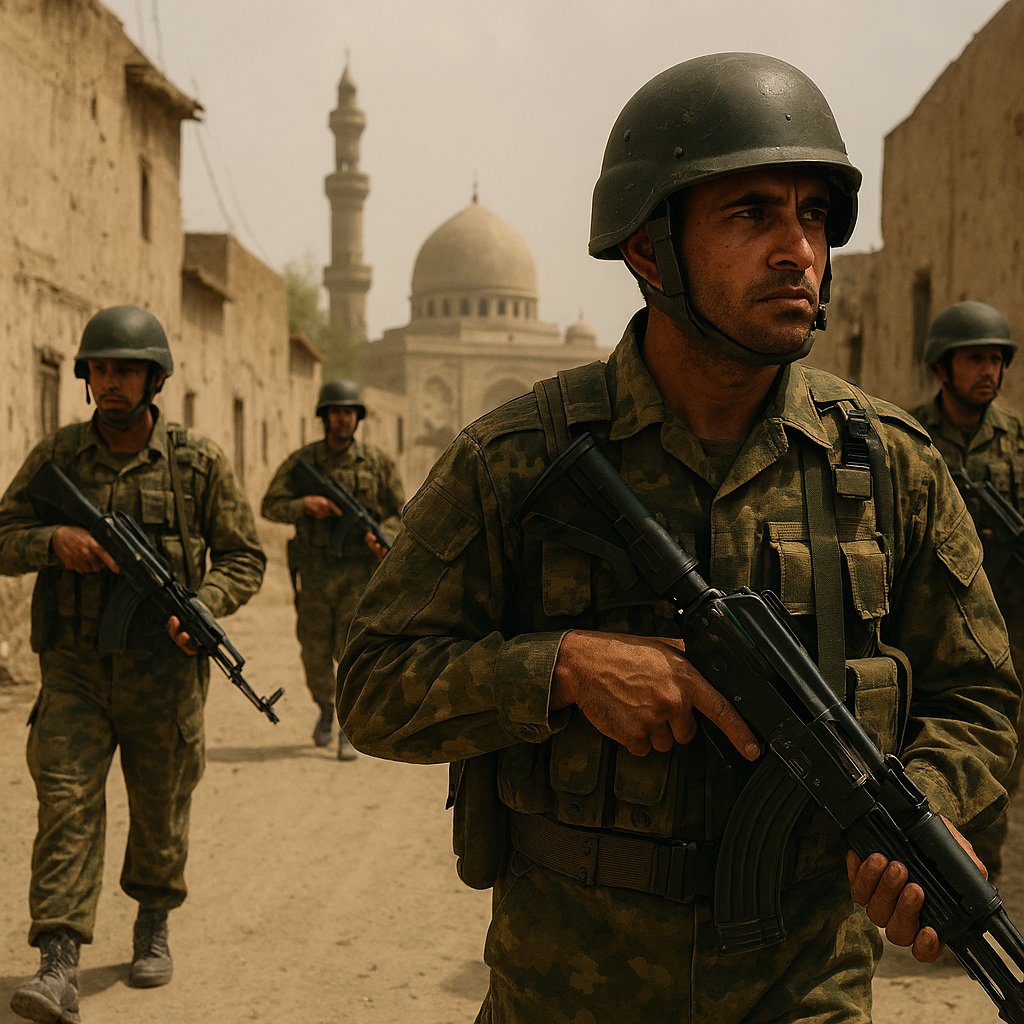
If you listen to Israeli media for any length of time nowadays, you will eventually hear some military expert or former officer make the claim that militaries can’t defeat terrorists or that you can’t destroy an idea with tanks or some other version on the same theme. And the message is clear: Israel needs to make a deal with Hamas and stop the campaign to eliminate it.
As the American actor Bradley Whitford said, “There’s no military solution to terrorism. If there were, Israel would be the safest place in the world.” He claimed to be quoting an unnamed Israeli human rights activist. And Major General (res.) Yair Golan, former Deputy Chief of Staff of the IDF, and head of the newly minted far-left Democrats party, former IDF Chief of Staff and Defense Minister Moshe Ya’alon, and former IDF Chief of Staff and Defense Minister Shaul Mofaz have all formulated versions of that same idea.
In June 2024, IDF Spokesperson Rear Adm. Daniel Hagari said, “Hamas is an idea. Those who think it can be made to disappear are wrong.” He added that anyone promising Hamas’s eradication is “misleading the public.”
Oh really?
We just marked Tisha B’Av, when Jews mourn the crushing defeat of an eight-year-long Jewish insurgency against the Romans under Titus. The Romans methodically subdued rebel strongholds in Galilee and Judea, killing or enslaving tens of thousands, and then besieged Jerusalem. When the dust cleared in 70 CE, the Temple was destroyed and any semblance of Jewish autonomy ended.
Just over 60 years later, as the military pundits would have predicted if cable news had existed back then, the Jews again rose up against their Roman overlords. This time, the insurgency was led by Shimon Bar Kochba and he managed to establish an independent Jewish state for several years. However, Emperor Hadrian deployed at least six full legions and reinforcements against the Jews, using scorched-earth tactics, siege warfare, and systematic destruction of rebel-held towns. By 135 CE, the fortress of Betar fell, Bar Kochba was killed, and the revolt collapsed.
Now, you could say that ultimately the Romans failed to crush the rebels, as we have once again reestablished our nation-state in the Land of Israel. And the Jews of Italy marched through the Arch of Titus in 1948 to drive the point home. But I think it’s not too controversial to suggest that revenant Jews over 1,800 years later, long after the Roman Empire became dust and relics, doesn’t really count as a win for the Bar Kochba insurgency.
“But come now,” our pundit might say, “that was the Second Century. Today, such insurgencies cannot be defeated by force.”
Sri Lanka might disagree. The Tamil Tigers (LTTE), who were fighting for an independent Tamil state, used guerrilla warfare, suicide bombings, assassinations, and even imposed a de facto government on parts of the country. Sri Lanka’s approach to the Tamil Tigers from 1983 until 2006 was a complex mix of military campaigns, ceasefires, and failed peace negotiations, marked by both escalation and strategic restraint. The LTTE used ceasefire periods to rearm and regroup, while the Sri Lankan government faced internal political divisions over how to proceed.
Any of this sound familiar?
The turning point came in 2006, when the Sri Lankan government abandoned negotiations after yet another failed round of peace talks. The military launched a massive offensive against the insurgents, cutting off LTTE supply lines, retaking territory, and targeting their leaders. By mid-year 2009, the Tamil Tigers had been systematically and violently dismantled, tens of thousands of civilians were dead, and the war came to an end.
There has been no armed Tamil insurgency since that decisive three-year military campaign. Of course, that’s only 16 years. Who knows how long it will hold? But it is, in any case, 16 years with zero Tamil ethno-terrorism.
And there are other examples, each with their own flavor.
After World War II, the Democratic Army of Greece, a communist armed insurgency, launched a guerrilla war and eventually controlled large swaths of northern Greece at their peak. Greek government forces (backed by the UK and the US) launched a war to eradicate the enemy, including air strikes and intelligence to isolate and destroy guerrilla units, as well as forced relocations of populations to cut off support for the insurgents. Within three years, the communist rebels were decisively beaten, with surviving fighters fleeing the country.
Another post-World War II communist insurgent movement was crushed by the UK in Malaysia. This time, the terrorists were the Malayan National Liberation Army and they began their rebellion in 1948. Eventually, the British implemented something called the Briggs Plan, which included small-unit patrols, intelligence gathering, and psychological operations, as well as relocating populations to isolate insurgents from local support. By 1960, the communist threat was neutralized.
Interesting that defeat of those “ideas” involved relocating populations within which the insurgents find support and shelter. But I digress.
In 1952, the British faced another anticolonial insurgency known as the Mau Mau Uprising of Kenya. The Mau Mau, primarily Kikuyu, used guerrilla warfare, sabotage, and targeted assassinations of those they considered collaborators. By 1960, the British had crushed the Mau Mau militarily, with tens of thousands of troops, detention camps, mass arrests, psychological warfare, and intelligence operations.
But hey, these are anticolonialists, not Muslim terrorists embedded in a population. That’s got to be what all the experts are really referring to, right?
Algeria eliminated the Armed Islamic Group, which had been responsible for massacres of civilians, bombings, and assassinations. In the late 1990s, the Algerian government infiltrated the group, implemented brutal counterinsurgency measures, mass arrests, and a no-truce doctrine. By the early 2000s, the Armed Islamic Group was no more.
In Egypt, the government cracked down hard, arrested thousands and dismantled networks of the Islamic Jihad group. That jihadist organization had been active in the 1980s and 1990s, carrying out targeted assassinations and bombings (including the assassination of President Anwar Sadat).
And our final example is the most ironic of all.
In 2006, Hamas decisively won elections in the Palestinian Authority. The other terrorist group competing for the throne, Fatah, refused to accept these results. So, in 2007, Hamas launched a military takeover of the Gaza Strip. Fatah men who survived and were not thrown off rooftops were seen running for the borders with Egypt and Israel, or even fleeing into the Mediterranean Sea. Hamas forces ended the reign of Fatah terror and eliminated most of their leadership in less time than it took us to win the Six Day War.
A crucial lesson emerges, in contrast to the accepted punditry: as it turns out, you can destroy an idea with tanks (and a few other military tactics). All that is needed is the will and the capabilities.