
Urban sociologist and geopolitical commentator
Defending the Photocopy: Why Copyright Is Failing Gen Z
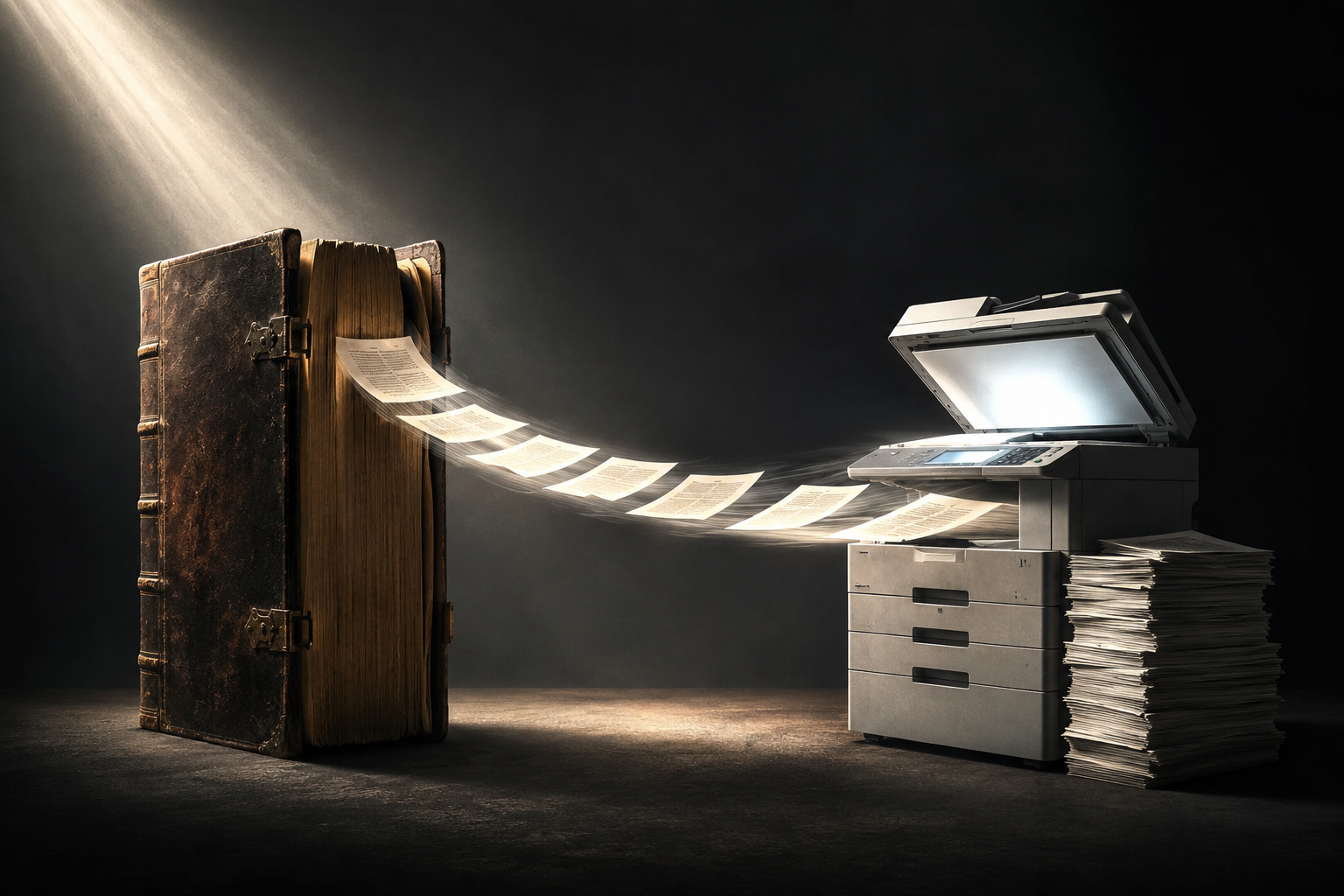
Reading Culture Before Copyright: In Defense of the Photocopy. An AI Illustration. (Credit: ChatGPT)
There is a difference between having information and having knowledge. Information arrives instantly and leaves just as fast. Knowledge is built slowly, through repetition, annotation, argument, and return. It lives in the margins of a well-worn page, in the underlined sentence revisited a dozen times, in the private index a reader builds inside their own head over months of sitting with the same book. This essay is a defense of that slower process, and of the humble photocopy that, for generations of students in the developing world, made it possible.
A Culture Under Quiet Siege
Reading culture rarely collapses all at once. It erodes in small, almost invisible steps: a library budget cut here, a subscription paywall raised there, a lecture slide substituted for a chapter. The last decade has supplied all three at once. Universities across much of the world have been pushed toward privatization, and in that push, knowledge has drifted from being treated as a public good toward being treated as a billable product. The COVID-19 pandemic then normalized habits that might otherwise have stayed marginal: shuttered libraries, remote-only access, and a near-total dependence on digital platforms licensed by a small number of publishing conglomerates. What began as an emergency accommodation has, in many institutions, hardened into permanent policy.
The people most affected by this shift are rarely the ones designing it. A student in a well-funded university with full digital access barely notices a licensing change. A student in an under-resourced college, who could once photocopy the three essential chapters of an expensive monograph, notices immediately, because that photocopy was often the only version of the text they would ever hold.
The Photocopy as an Instrument of Justice
It is worth stating plainly what the photocopy actually did for millions of students, especially across the Global South. It did not compete with scholarship; it delivered scholarship to people scholarship would otherwise never have reached. A library with three copies of a required text and three hundred students enrolled in the course is not really offering access, it is offering a lottery. The photocopy machine was the correction to that lottery. It let a student assemble, chapter by chapter, a personal working library built entirely around their own coursework, income, and pace of study.
This is not a nostalgic point. It is a structural one. Educational exceptions to copyright exist in law precisely because societies have long recognized that the public benefit of learning can outweigh the private commercial interest of a publisher in a narrow set of circumstances, a student photocopying an assigned chapter for personal study being about as narrow and defensible a case as exists. Treating that act as equivalent to piracy collapses a distinction that copyright law itself was built to preserve.
Why the Physical Copy Still Matters
There is also a cognitive argument here, and it deserves to be taken seriously rather than dismissed as sentimentality. A printed page invites a different kind of attention than a screen. It can be annotated in the reader’s own hand, folded, flagged, spread across a desk alongside other texts for comparison. Readers build spatial and physical memory around printed material, recalling not just what an argument said but where on the page it appeared, how many chapters in, next to which of their own scribbled objections. That kind of indexing is not incidental to learning; for many readers it is the mechanism of learning, the scaffolding on which recall and synthesis are built.
Digital reading is not inferior by nature. It is, in principle, capable of the same depth. But the conditions under which most people now encounter digital text – notifications competing for attention, subscription walls that convert reading into a metered transaction, content designed for scrolling rather than dwelling – actively work against the kind of sustained, uninterrupted engagement that deep reading requires. When a generation’s primary encounter with a subject is a slide deck, a summary, or an algorithmically surfaced excerpt, what is lost is not just detail but structure: the sense of how an argument builds, qualifies itself, and arrives somewhere. Confidence built on fragments is brittle. Confidence built on having actually sat with a whole argument is not.
Authors, Access, and the Purpose Copyright Was Meant to Serve
None of this is an argument against paying authors, or against copyright as a principle. Authors deserve recognition and fair compensation, and a healthy scholarly ecosystem depends on their being able to continue writing. But it is worth asking what copyright is actually for. It was conceived as a bargain: limited, temporary rights granted to creators in exchange for the eventual enrichment of public knowledge. It was never meant to be an unconditional license for rights-holders to control every possible use of a text regardless of context or consequence.
When a university enforces licensing terms so strictly that a student cannot photocopy an assigned chapter for personal study, it is not protecting an author’s livelihood in any meaningful sense, that student was never going to buy the book at full price regardless. What is being protected instead is a publisher’s commercial model, and the university, in enforcing it uncritically, has confused two different missions: safeguarding intellectual property and advancing education. These missions overlap often, but not always, and an institution that cannot tell the difference has lost sight of why it exists.
It is also worth noting, if only briefly, that many authors owe their influence to exactly the kind of access this essay is defending. A writer read widely because students could get their work cheaply, through library copies, course packs, or photocopied chapters, tends to build a larger, more devoted readership than one whose work is locked behind a price few can pay. Access does not just serve students; over time, it serves authors too.
Reading Culture Before Copyright – What Is Actually at Stake
The stakes here are larger than examination scores or course completion rates. A society that stops reading books in full does not simply produce students who perform slightly worse on tests. It produces citizens, professionals, and leaders whose relationship to complex arguments is thinner, quicker to accept a summary, slower to construct or defend a sustained position of their own. Doctors, lawyers, civil servants, and teachers across the developing world built the foundations of their thinking on photocopied readings assembled out of necessity. Removing that path does not just inconvenience future students; it narrows who gets to become one of those professionals at all.
A university’s purpose is to expand the public sphere of learning, not to serve as an enforcement arm for licensing regimes designed elsewhere. Public libraries, affordable editions, open educational resources, and reasonable, well-defined exceptions for personal and educational copying all serve that purpose. So did the photocopy machine, for decades, and so it still can.
The measure of an educational system is not how completely it protects texts from readers. It is how effectively it turns readers into thinkers. A society serious about that goal will place reading before revenue, and will defend, without embarrassment, the humble photocopy that made reading possible for those who otherwise would have been left out.
Related Topics
Related Posts