Delfi Chose the Kippah
I direct documentaries. Before a single word of narration is written, decisions have already been made that tell the audience how to feel about the person on screen. The shot. The frame. The costume. The background. The light. By the time dialogue arrives, the audience has been instructed, silently, at the level of the image.
That is not opinion. That is craft. Every working communications professional understands it. And that is why I can read the photograph Delfi published on April 22, 2026 alongside its story on the Lithuanian Radio and Television Commission’s fine of Stanislovas Tomas. I can read that image the way a film editor reads a cut. What I see is not editorial accident. It is professional-grade antisemitic framing.
Grant Gochin has documented the legal and institutional architecture in which Delfi operates in A free-speech architecture that runs in only one direction. Michael Kretzmer, Silvia Foti, and Dillon Hosier have separately mapped Lithuania’s prosecutorial selectivity, its state-institutional laundromat, and its documentary record. This piece addresses the element those analyses identified but did not dissect. The photograph. The image is where the state-aligned press speaks when the regulator cannot afford to.
The photograph Delfi selected
Tomas is not Jewish. He is a Lithuanian lawyer and polemicist, controversial on the merits, with a documented public career across the post-Soviet legal space. None of that is the issue. What matters is what Delfi did with his image.
From the entirety of Tomas’s public Facebook record, Delfi selected one photograph. A white kippah on his head. The Western Wall at his side. Two Orthodox Jewish men visible behind him.
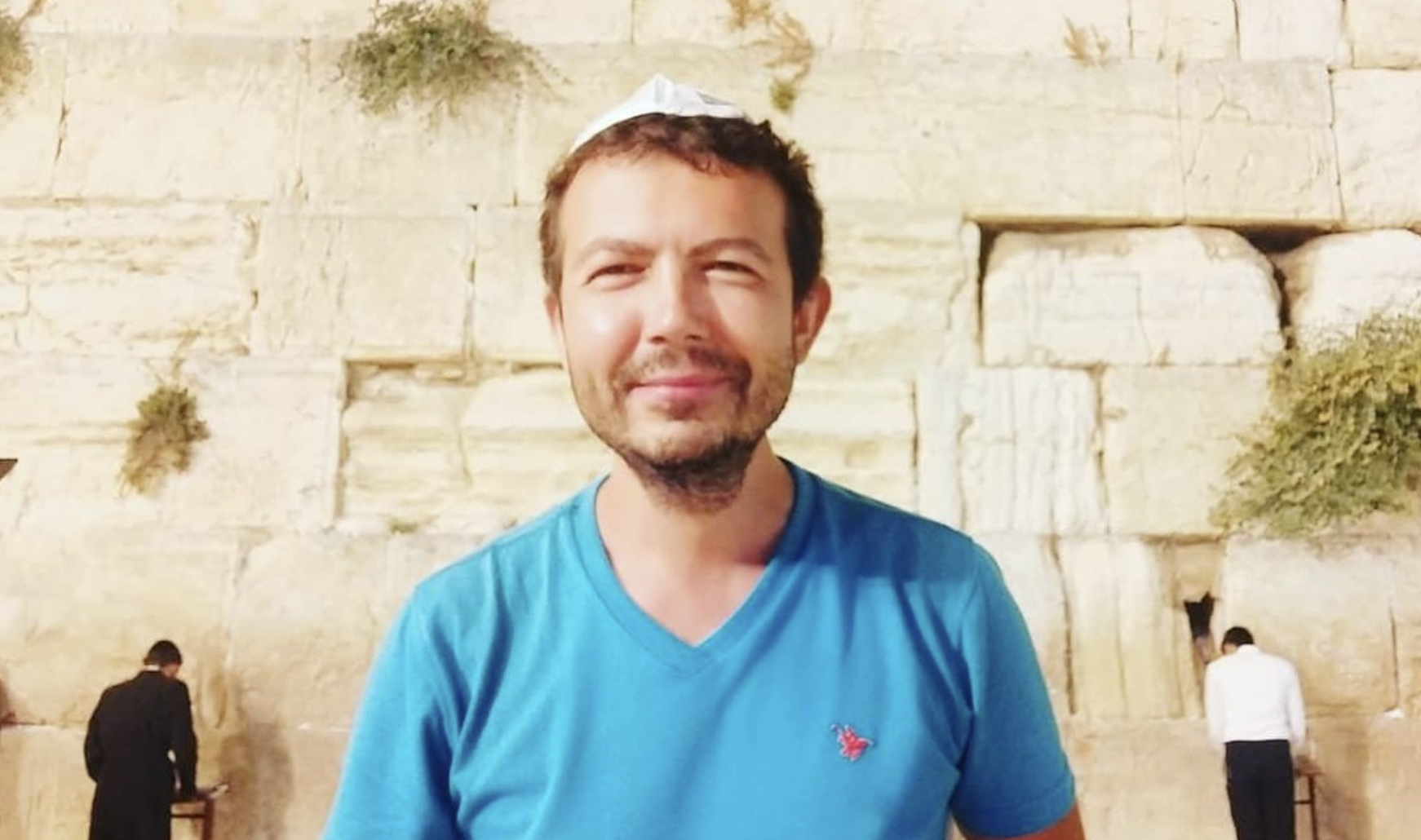
There is no news reason for that image. The story is a Lithuanian regulator’s fine against a YouTube video. The video concerned Lithuanian paramilitary history. Jerusalem is not in the frame of the controversy. The Kotel is not in the frame of the controversy. Jewishness is not in the frame of the controversy.
Until Delfi puts it there.
Selection is meaning
Film has an old rule. Everything inside the frame is intentional. If it was not intentional, it should not be in the frame. The kippah is in the frame. The Kotel is in the frame. The Orthodox men are in the frame. That is an editorial statement, whether the editor acknowledges it or not.
Tomas’s public Facebook contains images of him in courtrooms across post-Soviet jurisdictions. In classrooms. At professional events. At home. None of those alternatives would have communicated what the Kotel image communicates. That is why the Kotel image was chosen.
An editor selecting between plausible photographs is making an argument. When the selection foregrounds the single visual element that has nothing to do with the reported story, the argument is not neutral. The argument is the selection.
Mise-en-scène as antisemitism
In film the totality of the visual frame is called mise-en-scène. It is what the viewer receives at once, before language catches up. The kippah is a visual tag. The Kotel is a symbolic location. The Orthodox figures behind Tomas are iconographic fill. None of these alone carries the load. Together they compose a Jewish reading environment into which the subject is placed.
The reader does not need to say to himself, “This man is Jewish.” The image has done that work. The reader does not need to say to himself, “I distrust Jews.” A visual culture in which that reflex still lives does not need to be told. It needs only to be cued.
Professional propaganda, when it is fluent, does not shout. It cues.
The old antisemitism and the new
Old antisemitism was crude. It announced itself. It caricatured the nose. It drew the horns. It was built for an audience that wanted to be told what to feel. Modern antisemitism is media-literate. It has learned discipline. It has learned economy. It has learned to speak in pictures.
I grew up in the Soviet system. I know how a regime trained in visual propaganda marks its targets. The Soviet press did not need to call a man a Zionist saboteur in the text. It placed his photograph next to an Israeli flag, an American dollar, or a yarmulke. The article wrote itself from there. That apparatus did not vanish when the Soviet Union collapsed. It was absorbed. By successor states. By state-aligned outlets. By editors trained in those newsrooms.
Delfi did not invent the technique. Delfi inherited it. In 2026 a Lithuanian outlet applied it to a Lithuanian man, to mark him as a Jew, because the mark remains useful in the political environment Lithuania has constructed. My documentary Baltic Truth traced the lineage from wartime Latvia and Lithuania to the institutional denial in which these countries now operate. The grammar of image-as-weapon is part of that lineage. Silvia Foti’s Storm in the Land of Rain walked the same lineage from the inside of a Lithuanian family.
The ambient environment
This is not an isolated choice. The ADL’s Global 100 survey, released in 2025, reported that 46 percent of adults worldwide now hold significant antisemitic attitudes, the highest level the organization has ever recorded. Tel Aviv University’s Kantor Center reported that antisemitic incidents in 2025 across countries with major Jewish populations remained tens of percentage points above pre-war 2022 levels, and that 20 people were murdered in four antisemitic attacks in 2025, the highest such casualty figure in decades. The UK’s Community Security Trust recorded 1,521 antisemitic incidents in the first half of 2025 alone, the second-highest January-to-June total on record. London Antisemitism tracks the British pattern in detail. The Hudson Institute has placed antisemitism where it belongs in American policy debate, as a national-security threat. The record is public and consistent.
In that environment a European editor does not need to manufacture antisemitism. The antisemitism is ambient. The editor only has to harmonize with it. A chosen image activates a reflex the reader already carries. The editor publishes a real photograph. The audience finishes the sentence.
That is how respectable antisemitism operates once it has acquired media discipline. It does not foam. It curates.
Asked and unasked
Gochin notes that Delfi did not contact Tomas to seek permission to publish the photograph. The image was lifted from a personal Facebook account. Gochin, before reproducing the same image in his own piece, contacted Tomas directly and secured express written consent. A Jewish-American advocate who criticizes Lithuania’s state institutions asked a non-Jewish Lithuanian subject for permission. Lithuania’s leading news outlet did not.
That asymmetry is itself a communication. A press culture that treats its subjects as property, when the subjects are convenient to frame, is not operating under the standards of a free press.
Why the defense collapses
The predictable defense is that the photograph is authentic, that Delfi published what existed, that no slur was used, that no claim about the subject’s religion was made in the text.
Each of those statements is true. Each is beside the point. The question is not whether the published photograph is authentic. The question is why this authentic photograph, from many authentic alternatives, was the one used. That question cannot be answered on innocent grounds when every other available image would have communicated something less ethnically specific. Authenticity is not the defense. Selection is the charge. Selection is what editors do.
The message
A regulator’s fine is a legal story. A press outlet illustrates the legal story. The illustration is chosen in a newsroom. The newsroom is inside a country whose state institutions prosecute a Jewish citizen for accurate historical speech, dismiss Jewish witnesses in citizenship cases, withhold an internal perpetrator list of more than two thousand names, label a Jewish-American advocate an enemy of the state, and govern in coalition with a convicted antisemite. That newsroom chose the one visual frame that would communicate to the Lithuanian reader, before the reader reached the text: see this man first as a Jew. Read him as a Jew. Judge him as a Jew.
That is antisemitic intent.
Not because the editor published a photograph of a Jew. Tomas is not Jewish. That is not an inconvenience for this analysis. It is the clearest evidence of it. The photograph was not chosen because the subject was Jewish. The photograph was chosen to make the subject appear Jewish. Delfi manufactured a Jew out of an image of a non-Jew in order to activate an antisemitic reception against a Lithuanian critic of the Lithuanian state.
That is the entire technique. That is the entire argument. That is why the photograph was selected and published, and why no other photograph was.
Delfi did what Tomas was fined for
The LRTK ruled that Tomas’s YouTube comparison was “disinformation, war propaganda and incitement to hatred” lacking “any factual basis.” Hold that formulation against Delfi’s photograph.
The photograph is disinformation. It communicates a false claim, that Tomas’s Jewishness is a relevant fact in a story about a Lithuanian regulator fining a Lithuanian citizen over a YouTube video concerning a Lithuanian paramilitary organization. Tomas is not Jewish. The image is untrue in its implication.
The photograph is incitement to hatred. It invites the Lithuanian reader to receive a Lithuanian critic of the Lithuanian state through an antisemitic frame calibrated to discredit him before the reader reaches the regulator’s reasoning. The frame does not criticize. It taints.
The photograph has no factual basis for its placement in the story. No element of the LRTK proceeding turned on Tomas’s religion, ethnicity, or proximity to the Western Wall. The image earns its place in the article only through the prejudice it activates. That is the definition of no factual basis.
The LRTK wrote the standard. Delfi violates the standard. The state regulator will not apply its own standard to the state-aligned outlet. That asymmetry is the regime.
The body that exists to fail here
Lithuania has an institution whose formal statutory function is to adjudicate exactly this question. The Office of the Inspector of Journalist Ethics, Žurnalistų etikos inspektoriaus tarnyba, is empowered under the Law on the Provision of Information to the Public to determine whether information released in the media encourages hatred on grounds of nationality, origin, religion, social status, or belief. The statute is written. The mandate is specific. The test is met.
The Inspector has acted on comparable fact patterns before. In 2017 the Office ruled against an outlet that had republished a subject’s photograph without permission in a publication using the antisemitic slur košerinės fizionomijos, “kosher-faced.” The Office found the publication libelous and degrading to the subject’s honor and dignity. The jurisdictional logic is identical to the Tomas case. A photograph taken from a personal account without consent, deployed in an ethnically coded frame, in a publication calibrated to degrade. The Office has adjudicated it before. The Office knows how.
The Office will not adjudicate it here.
There is no reason to file the complaint. There is no reason to ask. We know. The architecture Grant Gochin has documented over 30 years, the dismissal of sworn Jewish witnesses, the withholding of a two-thousand-name perpetrator list, the “no factual basis” ruling against Western Holocaust scholarship, the prosecution of a Jew for quoting the state’s own letter, does not malfunction when it arrives at Delfi’s photograph. The architecture functions. The silence of the Inspector is not oversight. The silence is the policy. The institution was built to produce this silence.
To request adjudication from the Inspector would be to lend the apparatus a legitimacy it does not possess. Lithuania does not run a Jewish-accountability system that occasionally fails. Lithuania runs a Jewish-accountability system that performs exactly as designed. The designers are not redeemable. The functionaries are not mistaken. The Office of the Inspector of Journalist Ethics is part of the frame Delfi published. It is not outside the frame looking in.
The photograph was the editorial
The image was never ornamental. The image was the editorial. The Lithuanian audience was not invited to read the LRTK’s reasoning. The Lithuanian audience was shown, before reading anything, that the fined man belonged to a group the audience had been trained to discount. The text did the formal work. The image did the prejudicial work. The combination produced the result Delfi needed.
Delfi knew exactly what it was doing. Every working communications professional does. The prosecution of Artur Fridman was intended to silence the conversation about Lithuania’s role in the Holocaust. Instead it put Lithuania on trial. The Delfi photograph was intended to discredit Tomas in advance. Instead it has documented, in a single frame, that respectable European antisemitism in 2026 works through curation rather than words. The newsroom selected the Jew. The newsroom published the Jew. The Jew the newsroom selected was invented.