
Russian-American-Israeli Palestinian. Palestine is Israel.
Demystifying Gender
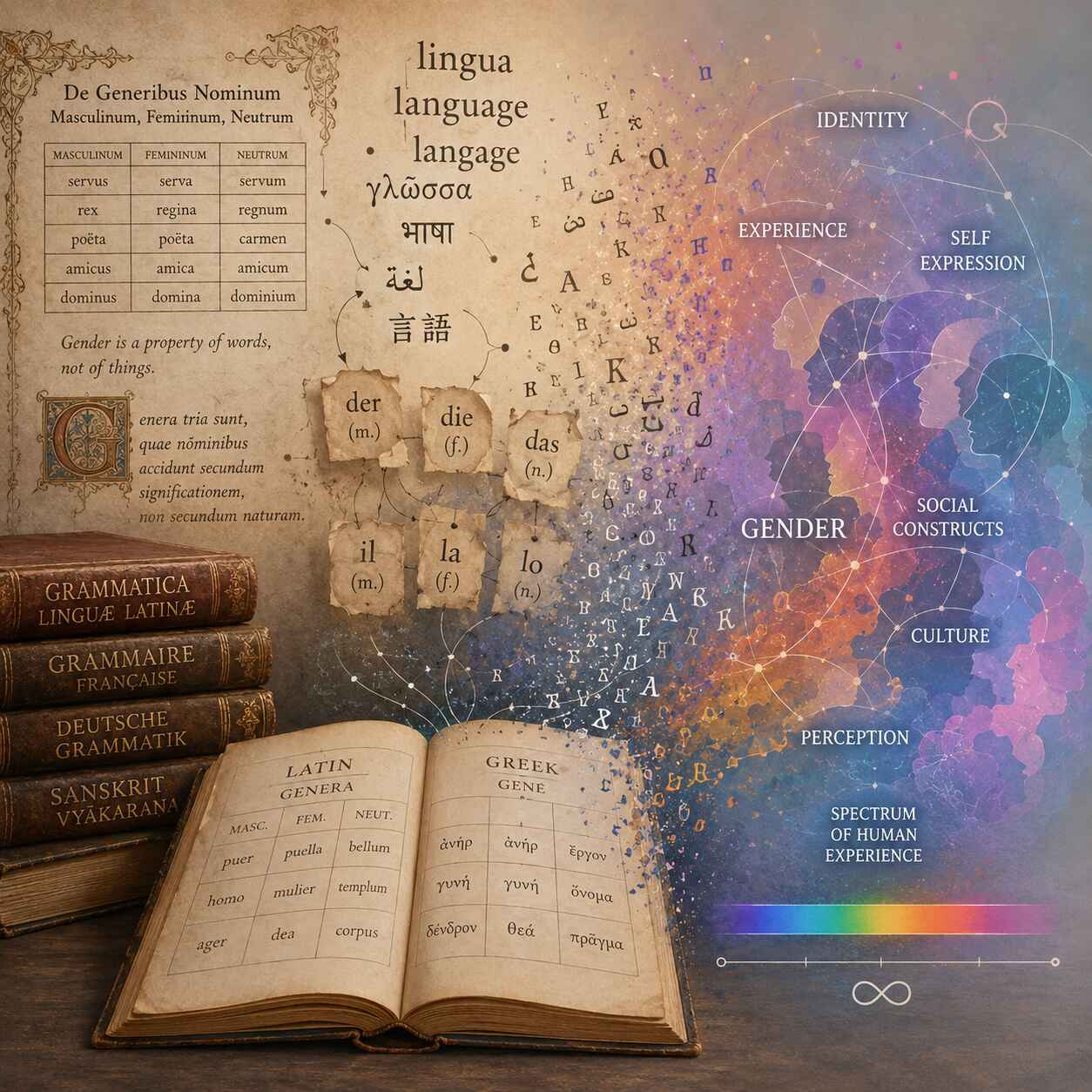
What began as grammatical classification slowly expanded into a system for interpreting human identity, perception, and meaning. Image © Ivan Bassov, 2026. Licensed under CC BY 4.0.
How a Grammatical Word Became a Metaphysical System
Many people struggle to grasp the concept of gender — myself included.
There are countless forums where people sincerely ask others to explain what “gender” means. Long threads follow. Articles are linked. Videos are recommended. Workshops are held. Entire academic departments exist for this purpose. People write dissertations about it, publish manuscripts, create presentations, teach seminars, conduct corporate trainings, and develop institutional policies around it.
And yet, after all that effort, many people still quietly admit:
“I still don’t get it.”
Most people understand two genders. Some can comfortably imagine three. But contemporary discussions often describe gender as a broad spectrum of identities. Depending on the source, the number of listed genders may be 20, 50, 72, or effectively unlimited.
At some point, one begins to wonder whether gender is less like biology and more like alchemy, astrology, or tarot cards — a symbolic system understandable only to the initiated. Or perhaps it is like music. Some people are tone deaf; perhaps others are simply gender deaf.
And if some lucky individuals finally manage to understand all 72 flavors of gender, the next question naturally appears:
Why stop there?
Why not apply the same framework to race, ethnicity, citizenship, education, profession, or religion? Why is gender uniquely fluid while other categories remain stubbornly objective?
As an analytical person, I tried to think through this logically. I am not trying to mock anyone who identifies with one of these genders. I am simply attempting to explain the concept to myself — and perhaps to others who share the same confusion.
My conclusion is surprisingly simple:
The word gender itself became detached from objective meaning and transformed into a subjective qualifier. Once you realize that, the entire system suddenly becomes easier to understand.
The History of the Word
Historically, the word gender had nothing to do with sex at all.
It comes from the Latin genus, meaning:
- type,
- kind,
- category.
Originally, it was mostly used in grammar. Many languages — including French language, German language, Russian language, and Hebrew language — assign grammatical gender to nouns.
The same object may be masculine in one language, feminine in another, and neuter in a third — suggesting that grammatical gender historically functioned as a linguistic convention rather than a statement about the object’s essence.
A book might be masculine in Hebrew language, feminine in Russian language, yet neuter in German language. Nobody imagined the objects themselves possessed some deep internal gender identity. Grammatical gender was simply a linguistic classification system.
A personal anecdote comes to mind. In ulpan — an intensive Hebrew language course — a student once asked the teacher how to remember which nouns are masculine and which are feminine.
The teacher answered:
It’s very simple. Just say the noun together with an adjective. If the adjective is masculine, then the noun is masculine. If the adjective is feminine, then the noun is feminine.
Which, for confused students, clarified absolutely nothing.
In other words, grammatical gender was largely a matter of linguistic convention, agreement, and usage — not metaphysics.
Meanwhile, the word sex referred to biological classification:
- male,
- female,
- reproductive distinction.
Later, “gender” began to be used as a polite synonym for “sex.” Instead of asking “What is your sex?” forms began asking “What is your gender?”
Then, in the 20th century, the terms split apart.
Sex remained primarily a biological classification grounded in reproductive function, anatomy, chromosomes, and hormonal development — even though biology occasionally produces atypical or intermediate cases.
Gender evolved into something psychological and subjective:
- how one internally experiences oneself,
- how one identifies socially,
- how one feels.
One modern definition states:
Gender refers to a person’s internal sense of self and their social identity, which may or may not align with the sex they were assigned at birth.
And here, I think, lies the source of much confusion.
A Note on Biological Complexity
None of this means biology is always perfectly binary in every individual case. Nature contains variation:
- intersex conditions,
- chromosomal anomalies,
- hormonal differences,
- and many forms of sexual development.
Likewise, sexual orientation is itself a complex biological and psychological phenomenon rather than a simple mechanical switch.
But acknowledging edge cases and biological variation is not necessarily the same as saying all categories become entirely subjective. Categories in biology often remain meaningful even when nature produces exceptions and gradients.
The Missing Qualifier
The problem is that gender stopped being treated as a descriptive qualifier and began to be treated as a standalone mystical-sounding essence.
A clearer formulation would be:
Sex-gender
In other words:
Sex-gender refers to a person’s subjective psychological relationship to biological sex categories.
Suddenly the idea becomes much easier to understand.
Biological sex remains objective.
Sex-gender becomes subjective.
Once viewed this way, the framework can logically be generalized.
Race-Gender
Race is generally treated as something objective:
- ancestry,
- inherited traits,
- population history.
But race-gender could describe how a person internally identifies racially.
A White person could feel Black.
A Black person could feel Asian.
An Asian person could feel Native American.
Why not?
After all, subjective identity has already been separated from biological classification in the case of sex-gender.
Education-Gender
Education is usually formal:
- diplomas,
- degrees,
- accreditation.
But education-gender would be subjective.
A person without a university degree may:
- read extensively,
- watch lectures,
- study independently,
- and genuinely feel like a PhD.
That becomes their education-gender.
Why should institutions decide who people truly are?
Profession-Gender
A CEO may internally identify as a tractor driver.
A tractor driver may feel like a CEO trapped in the wrong profession.
Why privilege externally assigned profession over internally experienced profession?
Religion-Gender and Ethnicity-Gender
A gentile may feel Jewish.
A Jew may feel Japanese.
A Japanese person may internally identify as Druze.
Who determines authenticity:
- ancestry,
- institutions,
- communities,
- or internal experience?
Citizenship-Gender
A non-citizen may deeply identify as American.
That becomes their citizenship-gender.
Whether the government recognizes it becomes secondary to personal identity.
After all, society increasingly accepts that biological classification and subjective identity may diverge in the case of sex-gender.
So why should citizenship remain uniquely objective?
This parallels an idea explored in Soulmateland. Bashertland (“Homeland is not where you were born, and not where you chose to live — but where you belong”), where belonging is not defined by formal recognition, but by an underlying sense of identity—much like the emerging logic behind “citizenship-gender.”
The Great Multiplication
Now imagine if we detached these concepts from their original domains and gave them entirely new standalone mystical names.
For example:
- Race-gender → Folk
- Education-gender → Enlightenment
- Profession-gender → Calling
- Ethnicity-gender → House
- Religion-gender → Denomination
- Citizenship-gender → Nationhood
Then we could say things like:
- “My folk is White.”
- “My enlightenment is PhD.”
- “My calling is CEO.”
- “My house is Japanese.”
- “My denomination is Jew.”
- “My nationhood is American.”
Soon universities would create departments devoted to these concepts.
Experts would lecture about them.
Consultants would certify organizations.
Public policies would emerge.
Dissertations would multiply.
And ordinary people would once again stare at the discussion and quietly ask:
“What exactly are they talking about?”
The Real Point
My point is not that people are dishonest.
Nor is it that subjective experience is meaningless.
Humans clearly possess internal identities, aspirations, affinities, and psychological self-concepts.
The real questions are philosophical:
- Which categories are objective, and which are subjective?
- Which categories are externally verifiable, and which are internally experienced?
- Why are some categories permitted to detach from objective grounding while others are not?
Perhaps there are good answers to these questions.
Or perhaps modern society is still improvising them in real time.
Either way, many analytically minded people remain unconvinced not because they are hateful, but because the conceptual boundaries remain blurry.
As for me, perhaps I am simply gender deaf.
Which is admittedly ironic for someone with a logical mindset, a PhD in computer science, and a lifelong career in software engineering.
One of my commenters suggested that software engineers, trained to think in binaries, may naturally struggle with concepts presented as spectra. As a software engineer myself, I find this hypothesis… computationally interesting.
Of course, this is not a law of nature. There are many software engineers who are perfectly fluent in spectra — including those who identify as non-binary. Reality, as usual, refuses to compile cleanly into binaries.
Possible Objections
At this point, defenders of modern gender theory may object that the analogy between gender and categories such as race, education, profession, ethnicity, religion, or citizenship is incomplete.
They may argue that:
- gender identity reflects a deep and persistent psychological structure,
- whereas race is heavily tied to ancestry and historical lineage,
- education is primarily institutional,
- profession is merely occupational,
- ethnicity is tied to ancestry and cultural continuity,
- religion comes from belief, tradition, and communal recognition,
- and citizenship comes from law.
In other words, not all categories function the same way socially, psychologically, or biologically.
That is a fair point.
But the philosophical question still remains:
- By what principle do we decide which categories may be self-defined and which remain externally grounded?
Modern society increasingly accepts subjective identity in some domains while rejecting it in others. My purpose here is not to deny anyone’s personal experience, but to explore where those boundaries are drawn — and whether the underlying rules are fully coherent.
Perhaps the Real Issue
Perhaps the real problem is not gender itself, but language.
The word “gender” gradually evolved from:
- a grammatical classification,
- into a polite synonym for sex,
- and finally into an independent psychological and social category.
As a result, people are often speaking about entirely different things while using the same word.
Some hear:
- biology.
Others hear:
- identity.
Others hear:
- social role.
Others hear:
- personal self-expression.
Perhaps that is why discussions about gender so often resemble parallel monologues rather than conversations.
And perhaps that is why some of us remain, despite sincere effort, somewhat gender deaf — far from maestros in this symphony of genders.
—
See Also
Related Topics
Related Posts