The Prisoner
A tip of the kippah this week to Gazan writer Ahmed Fouad Alkhatib for the evocative title of his new book, Hamas and Its Two Million Hostages. Whatever readers ultimately think of the book itself, the title captures an uncomfortable reality about life under authoritarian rule: sometimes a regime’s first victims are its own people.
The title also transported me back nearly fifty years to another story about captivity. Not a war. Not the Middle East. But a quirky British television series that posed a question I would spend the next fifty years trying to answer.
During my years at UMass Amherst in the late 1970s, a small group of us had a ritual. After we had finished studying, or at least convinced ourselves we had, we would gather around a television late at night to watch reruns of a strange British series called The Prisoner.
When the show ended, the television station would sign off for the night. Younger readers may not remember that TV stations once literally went off the air. Before the screen dissolved into a test pattern, an announcer would recite John Gillespie Magee Jr.’s famous poem High Flight over scenes of soaring aircraft, while my friends and I recited along.
The Prisoner debuted in 1967, but it never really belonged to 1967. Patrick McGoohan borrowed the anxieties of the Cold War to tell a much older story about conformity, conscience, belonging, and freedom.
McGoohan plays a British intelligence agent who abruptly resigns. Before he can leave, he is kidnapped and awakens in an idyllic seaside community known only as the Village. No one has a name. Everyone is identified by a number. McGoohan is Number Six.
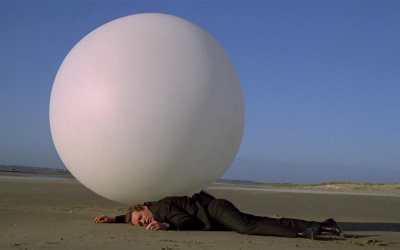
The Village is weirdly quaint, almost beautiful. There are cafés, shops, gardens, music, even democratic elections. Beneath its postcard charm lies something deeply unsettling. Every conversation feels manipulated. Every explanation raises more questions than it answers. Escape is impossible. Rover, a giant white balloon, always makes sure of it.
Each episode follows the same pattern. A new Number Two arrives to run the Village and devises another strategy to break Number Six’s will, discover why he resigned, and convince him to accept the identity the Village has assigned him.
He refuses. Every time.
His defiant declaration became one of television’s most memorable lines:
“I am not a number. I am a free man.”
Curiously, McGoohan never tells us why Number Six resigned. The Village is obsessed with discovering his reasons. He never provides an answer. That omission matters far more than the answer ever could.
Like millions of viewers, I became captivated by the mystery. Who was Number One? What exactly was the Village? Would Number Six ever escape? My friends and I debated theories long after each episode ended.
At nineteen, I thought The Prisoner was simply an ingenious television mystery. It took me nearly fifty years to realize I had been asking the wrong question.
Not, Who is Number One?
But, What does it take to remain free?
What I didn’t realize then was that another part of the university was quietly asking the same question.
I was a journalism student. Our professors drilled us relentlessly: the Five W’s, the Inverted Pyramid. Verify, corroborate, distinguish reporting from opinion, question authority, and—just as importantly—question your own assumptions. At the time, I thought I was learning how to become a reporter. Looking back, I was learning something much more enduring.
The fundamentals of journalism aren’t really about newspapers. They’re about habits of mind: following evidence wherever it leads, being willing to change your mind, and never confusing confidence with certainty.
Oddly enough, those lessons weren’t entirely new. Long before I arrived at UMass, Judaism had already begun teaching me many of the same habits.
We are heirs to a tradition that asks questions before it offers answers. The Passover Seder begins with questions. The Talmud records not just what the rabbis decided, but how they argued, questioned, and reasoned their way there. Even minority opinions are recorded, because the process of wrestling with ideas matters almost as much as the conclusions we reach.
Perhaps that’s one reason Jews have always seemed more comfortable with ambiguity than certainty. We have been arguing with one another for thousands of years. It’s practically a sacrament. As the old saying goes, two Jews, three opinions.
Today, I’m less interested in Number One than I am in another question.
Where is Number Six?
Not the fictional spy. The person. The citizen. The neighbor. The journalist. The professor. The elected official. The student. The one who refuses to surrender independent judgment simply because everyone around him seems certain.
Because that’s what I eventually came to understand about The Prisoner. The Village wasn’t merely a place. It was a system designed to persuade people that independent thought was no longer necessary. The goal wasn’t simply obedience. It was consent.
Because once I began looking for the Village, I started seeing it everywhere. Every generation builds its own version. The architecture changes. The design doesn’t. Each promises certainty. Each discourages inconvenient questions.
Some Villages are brutally obvious.
Hamas has spent nearly two decades constructing its own Village in Gaza. Dissent carries enormous personal risk, yet people like Ahmed Fouad Alkhatib continue to criticize Hamas while advocating for the Palestinian people. Whether one agrees with all of his conclusions is almost beside the point. He has refused to surrender his independent judgment to the demands of his own tribe.
Our Villages tend to be more subtle.
Democracies face a different danger than dictatorships. The coercion is usually quieter. It can appear as loyalty tests, public shaming, performative investigations, or demands that disagreement itself be treated as disloyalty. Institutions of accountability are essential. But they, too, can become instruments of intimidation when the goal shifts from discovering truth to punishing enemies.
The pressure rarely arrives with a prison guard. More often it arrives with applause. Or silence. Or the realization that asking one more question may cost you friendships, professional opportunities, or acceptance within your own community.
And then there is the Village we all carry around in our pockets.
Social media promised to democratize ideas. In many ways it has. It has also become astonishingly effective at rewarding certainty over curiosity. Algorithms learn what confirms our existing beliefs and feed us more of it. Outrage spreads faster than nuance. Identity begins to replace inquiry. Before long, we find ourselves surrounded by people who think exactly as we do, convinced that anyone outside the Village must either be ignorant or malicious.
The technology is new. The temptation is ancient.
I’ve watched this happen in some of our most emotionally charged public debates. Slogans replace history, certainty replaces curiosity, and complex questions are flattened into moral cartoons of heroes and villains.
Difficult questions should be asked. Democracies depend on scrutiny. Journalism demands it. Judaism practically insists upon it. But scrutiny is not certainty, and asking questions is not the same as choosing sides.
I’ve come to believe that one of the first signs you’ve entered a Village is when certain questions become socially unacceptable, disagreement is treated as betrayal, and curiosity itself begins to look like disloyalty.
The pressure isn’t always to believe something new. Sometimes it’s simply to stop asking the next question. It only has to convince enough people that independent thought carries a social cost. Once that happens, the prison becomes largely self-governing.
That may be why The Prisoner still resonates nearly sixty years after Patrick McGoohan first walked through the Village. His greatest act of courage wasn’t escaping the Village. It was refusing to surrender his own mind.
When I was nineteen, I thought The Prisoner was asking one question.
Who is Number One?
For years, I wanted to solve the mystery. I wanted to know who was pulling the strings, who was really in charge, and whether Number Six would finally escape. I don’t wonder about those things anymore. I’ve learned that the more important question was never who ran the Village.
Looking back, I no longer see an eccentric British television series. I see a young journalism student who had no idea he was learning from three very different teachers.
One was a fictional spy who refused to become Number Six in anything but name. Another was a group of journalism professors who insisted that evidence mattered more than certainty. The third was an ancient Jewish tradition that has always understood that questions are not a weakness of faith, but one of its greatest strengths.
Freedom is not simply the absence of chains. It is the willingness to keep asking the next question. To follow the evidence. To resist the comfort of easy certainty. To refuse to surrender your own judgment, even when doing so is lonely.
Patrick McGoohan never really answered the question that fascinated me as a college student. He left us with a better one.
Where is Number Six?
Sometimes I think back to those nights in the Brown House dormitory lounge. The debates about Number One. The strange little British television series. The station signing off for the night. The test pattern filling the screen. And my friends and I reciting High Flight one last time before heading off.
“Oh! I have slipped the surly bonds of Earth…”
At nineteen, I thought those words were about flying.
Today, I hear them differently.
And for those who have never met Number Six……