Deni Avdija, Latkes, and a Menorah: Portland’s Latest Zionist Complicity Crises
 This fall I have been writing a series for Oregon Roundup (listed at the end) on how to keep the Trail Blazers in Portland for the next twenty years. Five articles so far, on a deal that should have been a layup. Instead, part of the City Council has treated it as a referendum on the billionaire class. When the council approved its term sheet in August, people in the chamber held signs reading “No bailouts for billionaires,” and one of the four no votes warned that the city would cut parks and homeless services “because we gave away $400 million to a billionaire.”
I had assumed the billionaire test was the only one the Blazers had to pass. I was wrong.
Before this season started, I heard that some season ticket holders had cancelled over Deni Avdija, the team’s Israeli star.
I did what any objective journalist would do. I found out how many, then bought that number plus one, and donated the seats to the team’s programs that bring kids to games. Most reporters ask for a comment. I asked for an invoice. I still have the cancelled check and the thank-you note from the team.
My reasoning was simple. If people were going to vote with their seats on who belonged in the Moda Center, the count should come out in Portland’s favor.
The timing of the cancellations takes a special kind of conviction. Avdija is the first Israeli-born NBA All-Star, coming off a breakout season in which he averaged more than 25 points a game. These fans didn’t leave a bad team. They left the best player the franchise has had in years, right after the best season of his career. That is not a basketball decision.
I bring this up because the Blazers are about to do something that, under the rules now circulating in Portland politics, may require an investigation.
The incident
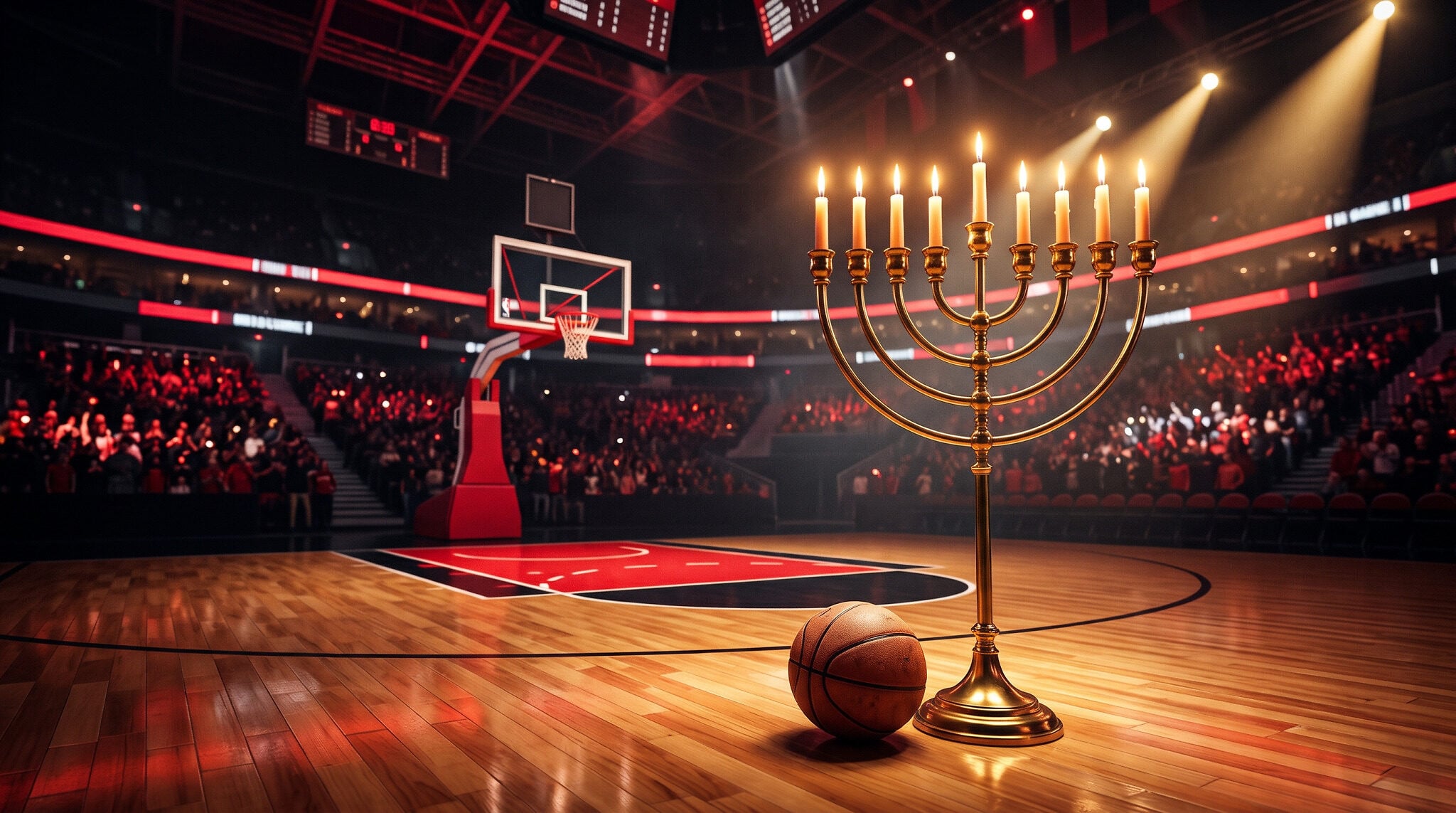
On Thursday, December 3, the Blazers will host a Celebration of Lights against the Utah Jazz. It falls the night before Chanukah, because the team is on the road for the entire holiday. Participants get a pregame social hour at Veterans Memorial Coliseum with latkes, and after the game, an exclusive experience with Avdija. Partners include the Jewish Federation of Greater Portland, the Mittleman Jewish Community Center, Chabad Young Professionals, and the Oregon Jewish Community Foundation. Season ticket holders are welcome.
Latkes. Candles. An Israeli forward. A federation. Cases have been built on less.
The rules
In October 2025, six of Portland’s twelve city councilors signed a pledge, written by the Portland chapter of the Democratic Socialists of America, to investigate the city’s complicity with Israel. The pledge targets weapons manufacturing, port shipments, city investments, contracts, and sister-city ties. Councilor Mitch Green told Willamette Week, “There’s nothing here about Jewish people and Judaism.”
I take him at his word. That is exactly why I don’t know what to do about the latkes.
Nationally, DSA adopted Resolution 22, “For a Fighting Anti-Zionist DSA,” at its 2025 convention. It lists expellable offenses, including opposing BDS, equating anti-Zionism with antisemitism, and affiliation with “Zionist lobby group(s) such as, but not limited to, AIPAC, J Street, or Democratic Majority for Israel.”
“Such as, but not limited to” is the most powerful phrase in the English language. Ask any contracts lawyer. Ask any investigator.
A modest questionnaire
Nobody has explained how complicity will be detected at a basketball game, so I have taken the liberty of drafting the screening form. To be clear, this part is invented.
City of Portland Complicity Screening, Form CL-1 (Celebration of Lights)
-
Did you buy your ticket through the Celebration of Lights link? If so, did you know the link was Zionist when you clicked it?
-
Did you eat a latke? Was it fried in oil? Describe the oil’s position on the occupation.
-
When the Israeli scored, did you (a) clap, (b) clap loudly, or (c) stand up in a manner suggesting normalization?
-
Have you, your father, or any male relative ever belonged to a fraternity whose initials stand for a Zionist motto?
I pass the first three on technicalities. Question 4 is where I fail.
The family file
My father played football for Bear Bryant and basketball for Adolph Rupp at the University of Kentucky after World War II. Bryant was building his teams then with returning veterans, and my father was one of them. He was good.
He was also Jewish, which at Kentucky in those years meant Zeta Beta Tau, Alpha Iota chapter, chartered in 1942. ZBT existed because other fraternities would not take Jews. It began in New York in 1898 as a Zionist youth society organized by Columbia professor Richard Gottheil, then president of the Federation of American Zionists. The initials came from Isaiah 1:27: Zion Bemishpat Tipadeh. Zion shall be redeemed with justice.
A generation later, I joined the same chapter. So the file on my family is two generations deep, and the founding document is in Hebrew.
When my father went home to New York, he could not get hired by the big accounting firms. Nobody told him why. Nobody had to. B’nai B’rith surveyed 2,120 accounting graduates from the classes of 1946 and 1947 and found that 95 percent of the employed Jewish graduates worked for firms with all-Jewish or partly Jewish management. Five percent worked for non-Jewish firms. It was called a gentleman’s agreement because gentlemen did not write things down.
This is why the Avdija cancellations landed on me the way they did. My father was a Jewish basketball player whom Kentucky was glad to have on the court on game night. The trouble started when he took off the uniform and tried to join a fraternity or get a job. Seventy-some years later, Portland has a Jewish basketball player from Israel, and some fans couldn’t stand him even in uniform. They gave up their seats rather than watch him play. The circumstances have changed. The impulse to decide which Jew is acceptable, and where, has not.
Here is the irony. My father’s generation faced an unwritten test. My generation gets one in writing, with signature lines and expulsion criteria. Progress, of a kind. At least now we know where the rules are kept.
In fairness, the analogy has limits. The accounting firms controlled jobs and incomes. A political organization controls its own membership and endorsements, and the city pledge has so far produced investigations and an investment-policy debate, not a blacklist. But the instinct is familiar: one loyalty question, applied to one group, by people who insist the question has nothing to do with the group.
Options memo to ownership
The timing matters. The Blazers and the city are negotiating a Moda Center lease, and the state’s $365 million share depends on a final deal by the end of December, including the twenty-year lease the Legislature required. The council had hoped to vote before its mid-December recess. Council President Jamie Dunphy now says, “That timeline is simply not going to happen at this point.” Whenever the vote comes, it will be the same council, with the same six signatures.
So, as a public service, here are the team’s options.
Option A: Cut the lights. Rename the event “A Celebration of Ambient Dimness.” Unplug the menorah. Serve “potato rounds of unspecified heritage.” Have Avdija sign autographs in the parking lot, which is technically off the playing surface. Risk: someone notices.
Option B: Trade the player. Swap an All-Star for someone whose politics have been pre-cleared. Risk: the team gets worse, and the people who cancelled their season tickets still don’t come back, because the tickets were never really the point.
Option C: Move to Mexico City. The NBA has floated it as a possible market. Risk: it sits more than 7,300 feet above sea level, and nobody has tested whether latkes fry evenly at that altitude.
Option D (recommended): Light the menorah. Win the game. Then let the council explain, whenever it finally votes, why it wants a twenty-year lease with a franchise that serves latkes to Zionists.
The seats
On December 3, the seats I bought will be filled by kids who don’t know any of this. They will watch the lights go on, eat a latke if they get to the Coliseum early, and see the best player in Portland play basketball. He happens to be an Israeli Jew, the way my father happened to be a Jewish kid from New York playing for Adolph Rupp. Neither fact should have anything to do with who gets a seat, a job, or a lease.
That is the whole conspiracy. If it counts as complicity, I plead guilty. So did my father. And the check cleared.
The screening form and the options memo are satire. The pledge, the resolution, the survey, the fraternity, and the check are real. I paid for the seats myself and have no financial relationship with the team.
The series
My Oregon Roundup series on keeping the Trail Blazers in Portland:
-
Put Portland and the Blazers on the Same Side of the Dollar (October 6, 2026)
-
Portland’s $586 Million Blazers Offer Ranks Last in NBA Arena Comparison
-
The Moda Lockbox: From last in the league to the middle without a new dollar (October 27, 2026)
-
How to Keep the Blazers: Settle the Two Words Worth a Billion Dollars
The working papers, including The Lockbox Amendment, are at The Center Held