
Denying settler violence does not make us better allies to Israel
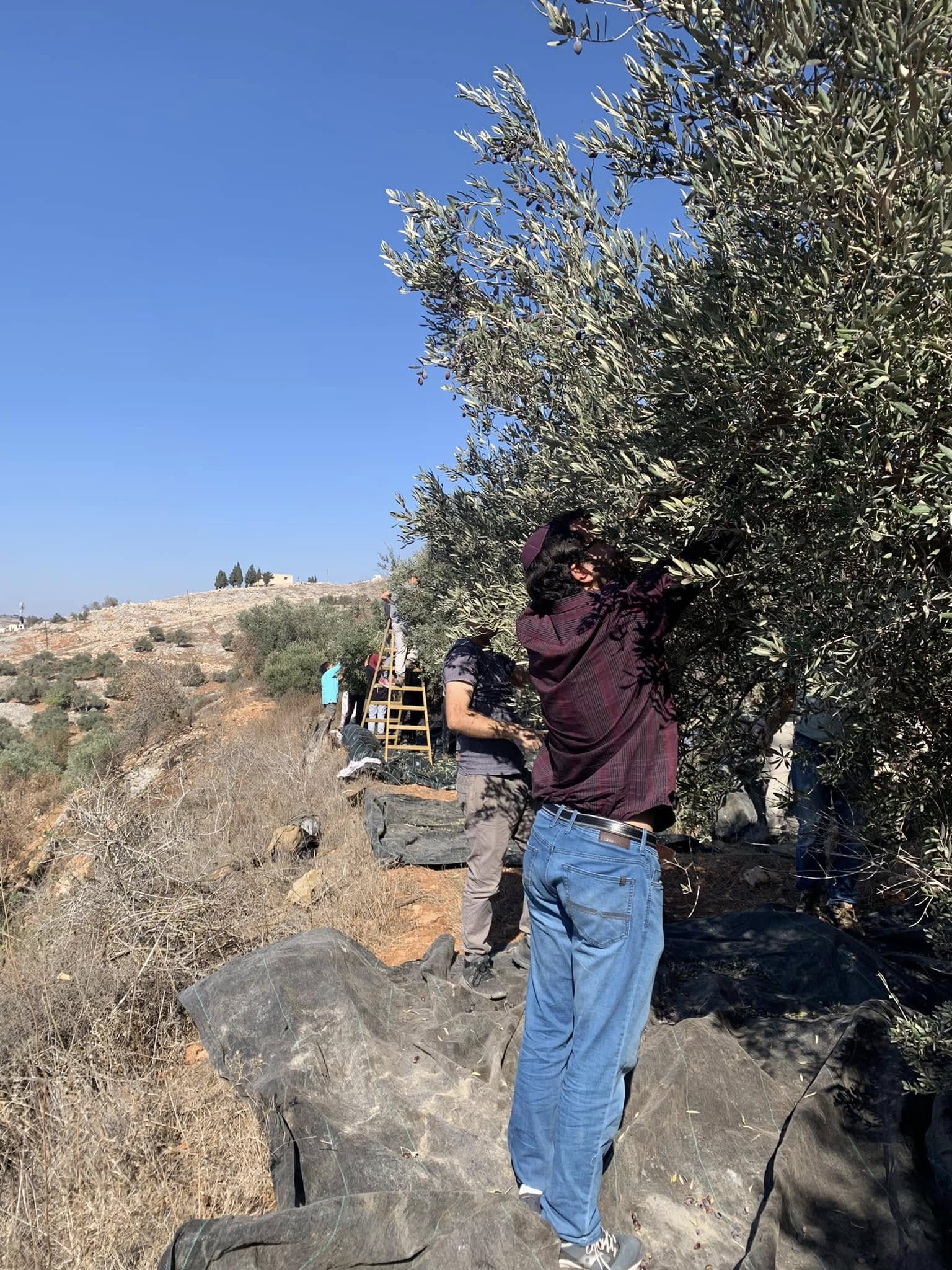
In 2022 I visited Burin, a small village just south of Nablus and below a Jewish settlement called Yitzhar. I went as part of the weekly solidarity visits organized by Rabbis for Human Rights who accompany Palestinian farmers to their fields during the olive harvest. The Israelis join the harvest both as part of protective presence – to help deter attacks, harassment and theft of olives by extremist settlers—and to lend a hand during the short time window that the IDF allows the farmers to access their lands near settlements.
The locals I met shared stories of burned olive groves, ongoing threats of violence and the fear of losing their livelihood. Their accounts resonated deeply on a personal level. My grandmother’s family lived through the pogroms in Uman eventually fleeing to Southern Ukraine for safety and my paternal great-grandfather was killed in a random act of violence in Eastern Ukraine, leaving behind my great-grandmother to care for their 10 children. The history of fear, flight and dispossession is part of my Jewish identity, just like it is for many Jews with roots in Eastern Europe.
Our painful past makes us particularly adept at recognizing danger and at naming violence perpetrated by an angry mob against a community for what it is—a pogrom. Including when the perpetrators are Jewish.
But in a recent article for the Tablet Magazine, Adam Louis-Klein tries to persuade us that what we see as indefensible and incompatible with Jewish values could simply be dismissed by branding it as the new “antizionist libel.” According to him, the reporting on settler violence in the West Bank is an information operation, a politically motivated media “hysteria” campaign seeking to “categorize Jews in Judea and Samaria as terrorists.” He warns that it “will surely license further attacks on Jews across the globe.”
I understand why some people may identify with this last statement. There are real concerns about the safety of Jews in the diaspora, and for some, acknowledging wrongdoing may feel like handing ammunition to the very people that wish us harm. But there has to be a better way to reconcile our desire for safety with our core values grounded in truth, integrity, and pursuit of justice.
What’s striking about Louis-Klein’s piece is just how little evidence it offers to the reader in support of its sweeping claims and how much evidence to the contrary it consequently leaves out. He narrowly focuses on two incidents in the Palestinian villages of Qusra and Jalud. According to reports in the mainstream Israeli media, settlers entered the Palestinian villages and besieged homes in an attempt to make their residents leave. Louis-Klein’s challenge to the prevailing account relies primarily on claims made by extremist Hilltop settlers and on reporting from Channel 18, an obscure and explicitly pro-settler online outlet. His readers never learn that the IDF supported the mainstream account in their official statement, describing settlers “entering and taking control of Palestinian homes and land in the areas of Qusra and Jalud” and denouncing their activities as “illegal, reprehensible and unacceptable.” In fact, since the events described in the article, Israeli authorities have arrested at least three suspects in connection with the Qusra attack, including an IDF soldier.
More broadly, to credibly argue that reporting about settler violence is an antizionist libel, one would have to confront an extensive body of reporting and evidence. The UN Office for the Coordination of Humanitarian Affairs (OCHA) and multiple Israeli human rights organizations have collected testimonies and videos documenting thousands of settler attacks in recent years, alongside forcible displacement of dozens of Palestinian communities, with a sharp increase in violence and displacement in 2025-2026.
Some readers may want to dismiss these sources as biased or unreliable. Yet this information is consistently backed up by the Israeli security establishment, which only recently reported a 63% increase in Jewish nationalist crime in the West Bank during the first half of 2026. According to a report published by the INSS, an Israeli think tank with close ties to the security establishment, this violence is “not limited to a handful of extremists; it also involves armed settlers, territorial defense soldiers […] and members of local first response teams.” According to the report, the violence serves as a complementary mechanism for other institutional tools promoting the current government’s policies of settlement expansion and annexation of the West Bank.
And if you are still unpersuaded by these sources, consider the reports issued by the violent settlers themselves in their dedicated WhatsApp and Telegram groups. The latest summary of their activity during the last Jewish year—an annual report, if you will—lists hundreds of “attacks” and dozens of “villages attacked” – including 15 attacks on Qusra and 10 on Jalud. The message adds: “Number of vehicles burned: 436. Number of structures set on fire: 201. Mosques set on fire: 15. Number of Arabs injured: 409. In addition, tens of thousands of windows were smashed, thousands of olive trees were cut down, hundreds of tires were punctured, and tens of thousands of dunams of fields and orchards were set on fire.”
In a recent interview, one of the leaders of the Hilltop Youth, Elisha Yered confirmed that they initiate violence as part of a strategic vision to expand Jewish settlements in the West Bank. “We unequivocally initiate friction and we are proud of it,” he said. Another Tablet columnist, Gadi Taub, recently called Yered “a man of vision.” Yered is sanctioned by the EU, UK, Canada, Australia and other governments for his role in settler violence.
Taken together, the evidence is difficult to dismiss as just another anti-Zionist information campaign. Yet Louis-Klein’s selective treatment of uncomfortable facts leads him to give disproportionate weight to the narrative of extremist settlers at the cost of dismissing concerns widely shared within mainstream Israeli society. The alarm over settler violence that he derides as international-media “hysteria” has also been expressed – albeit in different terms – by mainstream Israeli news outlets, Israel’s president and prime minister, its security establishment, Religious Zionist rabbis and leaders, and numerous Israeli citizens who have signed petitions demanding action against the violence.
Perhaps most striking has been the warning issued by Maj. Gen. Avi Bluth, commander of the IDF’s Central Command and the officer responsible for security in the West Bank. In a public letter, Bluth wrote that “a violent group of lawbreakers is operating in the territory of Judea and Samaria without restraint, contrary to the law, to IDF values, and to the values of the Jewish people.” He continued: “Their actions are harming people in a population that is not involved in terrorism. This population has no connection to terrorism. The violent activity, carried out in an organized and systematic manner, threatens the rule of law and order in the region, harms the IDF’s mission, and undermines Israel’s security.” According to Louis-Klein’s logic, this stark warning makes Bluth, his predecessor Yehuda Fuchs, and others in the IDF leadership speaking out against Jewish extremist violence, key participants in the broader anti-Zionist smear campaign.
There is a certain irony here. Israel’s most uncompromising defenders abroad often condemn Western pro-Palestinian activists for disregarding Palestinians when their views complicate the preferred narrative. Yet the same blind spot can appear on the other side. Some hardline pro-Palestinian activists romanticize “resistance” even as some Palestinians question what armed struggle has achieved. Likewise, some hardline pro-Israel advocates dismiss settler violence as an “antizionist libel” even as Israelis—from the IDF leadership to political leaders and civil society—repeatedly warn that it is a real and growing danger. In both cases, the people whose cause is being defended become secondary to defending the narrative itself.
Despite what Adam Louis-Klein and those who agree with him would like us to believe, invoking “libel” whenever Israeli wrongdoing is credibly alleged does not make Israel safer. It also doesn’t make us better allies. To support Israel requires of us, first and foremost, an honest relationship with the truth, however uncomfortable or painful it may be.
If nothing else, our history requires it.