Destroying Pickaxe Mountain Will Take Far More Than Fordow Did.
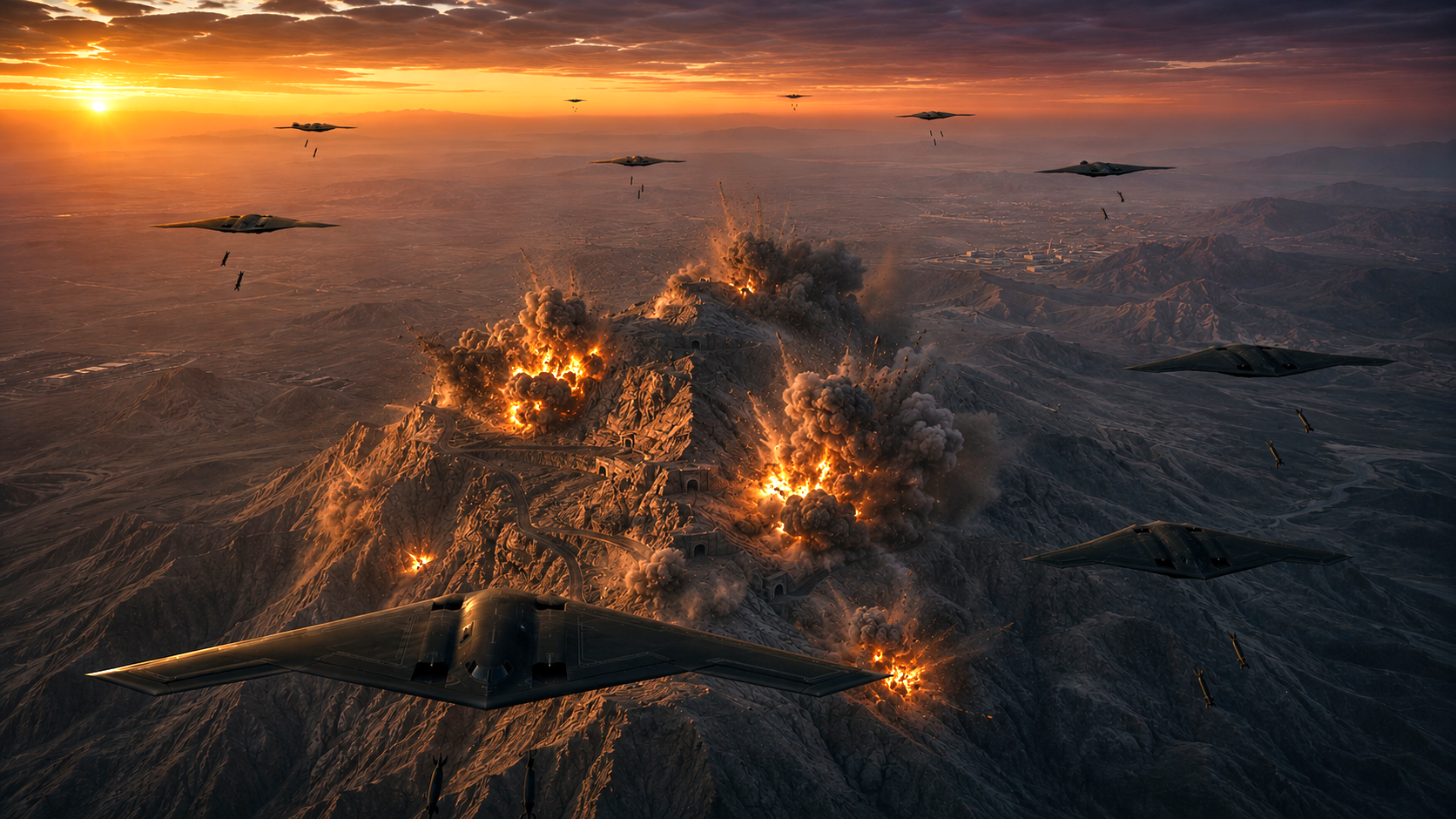
On Monday afternoon, speaking with Hugh Hewitt, President Trump was asked whether he would insist on inspectors reaching the deep tunnels of a mountain south of Natanz before signing any new agreement with Iran. He said he would. Then he went further than the question. Pickaxe, he said, was a possible target for a nice, big, fat shot right in the front door. Before the interview closed he made it a commitment. “We’re going to take out Pickaxe Mountain. Tell the Iranians to be ready.”
Somewhere between those two moments he said something quieter. Washington would probably give Pickaxe a shot relatively soon.
Take out a mountain. Then give it a shot. The promise shrank inside a single conversation, and the shrinking is worth noticing. It raises the only question worth asking this week. What would taking out that mountain actually require?
What Fordow cost
The cost is known. The United States carried out the easier version of this a year ago.
On the night of June 22, 2025, six B-2 bombers put twelve GBU-57 bombs into the ridge above Fordow. A seventh dropped two more on Natanz.
The GBU-57 weighs fourteen thousand kilos. Six meters of hardened steel, guided by satellite, carrying more than two thousand kilos of explosive. It does not explode on contact. It survives the impact, bores down through rock and concrete, and detonates once it is deep enough to matter. It is the largest non-nuclear bomb the United States owns. One aircraft carries it. Two at a time.
How far down it gets depends entirely on what it hits, and the published figures are worth reading in order. The Air Force says up to sixty meters, without naming the material. Analysts at Janes put it at roughly sixty meters of earth, or eighteen meters of concrete. The original 2004 proposal claimed forty meters of moderately hard rock. Against high-strength reinforced concrete, that same document claimed eight meters.
Watch the numbers as the material hardens. Sixty meters of dirt. Eighteen meters of concrete. Eight meters of the hard stuff.
Fordow’s halls sit eighty to ninety meters under limestone. No published figure for this bomb reaches them.
Those seven bombers were the visible part. Thirteen B-2s left Missouri that night. Six flew west over the Pacific to be seen doing it. The force that turned east was more than a third of the entire fleet, and it flew eighteen hours to get there. Around it moved roughly125 aircraft. Fighters clearing the way. Tankers. Electronic warfare. Reconnaissance. A submarine firing cruise missiles at Isfahan.
That was the price of the target Washington understood better than any other.
How the bombs actually got in
Almost every account written this week assumes the bombs beat the rock. Harder rock, then, means more bombs. That is not what happened at Fordow.
The bombs were not aimed at the mountain.
General Dan Caine, chairman of the Joint Chiefs, told reporters at the Pentagon what the aimpoints were. Two ventilation shafts. Six bombs down each. The first tore off the concrete cap the Iranians had poured over the opening days earlier. The next four went into the shaft and traveled down into the complex at more than three hundred meters per second. They detonated inside. The sixth was held back in case one of the others failed. What destroyed the equipment, Caine said, was overpressure and blast moving through the open tunnels.
Maxar’s imagery shows the same thing from above. The numbers being repeated this week are getting confused with one another, so it is worth being exact. There are six entry holes on that ridge, not two. They sit in two clusters. Analysts who examined them read the twelve bombs as six openings struck twice each, a second bomb sent down the hole the first one made.
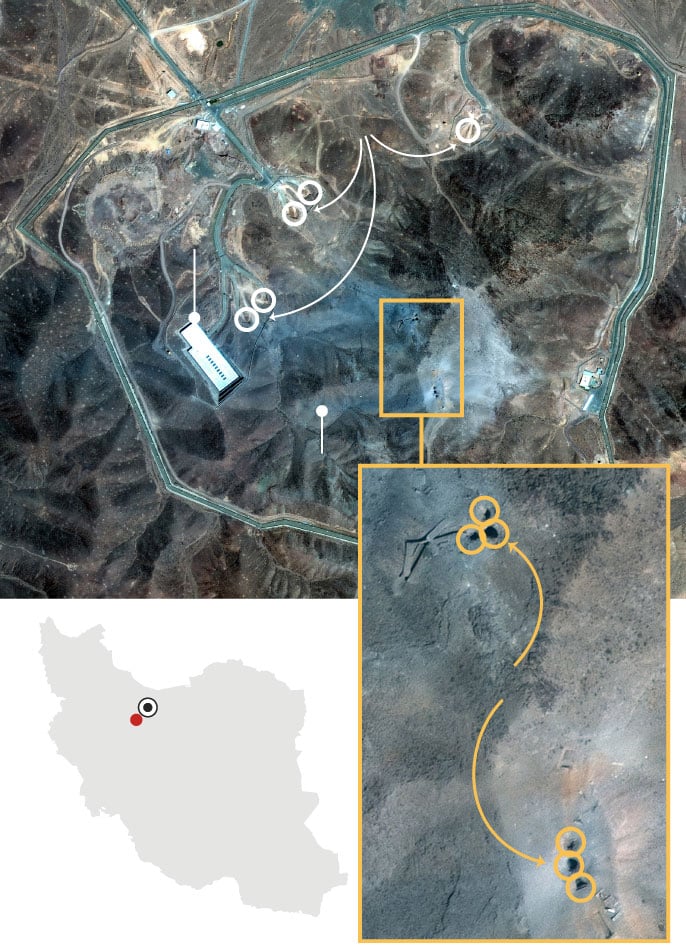
The rock was never defeated. The bombs went around it, through openings Iranian engineers had cut themselves.
That worked because someone knew where the openings were.
In 2009 an officer at the Defense Threat Reduction Agency was handed photographs of a construction site in the Iranian mountains and told to understand it. He and one teammate spent more than fifteen years on that single target. They watched the digging. They followed the spoil, the weather, the construction materials, the question of who had sold them. They mapped the vent shaft, the exhaust shaft, the electrical systems, the environmental controls. Neither man ever walked into the building.
Fordow was defeated by fifteen years of intelligence work. The bomb only carried out the plan.
Why Pickaxe is a different problem
The mountain south of Natanz exists because of that same pressure.
On July 2, 2020, an explosion tore apart a workshop at the Natanz complex. Iran never confirmed the cause. An unknown group calling itself the Cheetahs of the Homeland claimed it. But a Middle Eastern intelligence official told the New York Times that Israel was responsible and that a powerful bomb had been used, and outside analysts reached the same conclusion. Early speculation pointed to a cyberattack, like the Stuxnet worm that wrecked centrifuges at the same site a decade earlier. The simpler explanation held. Someone placed an explosive inside the building.
The building mattered. The Institute for Science and International Security judged it the only place in Iran capable of assembling advanced centrifuges in quantity, several thousand a year. Replacing it would take at least a year, probably longer. Three quarters of the above-ground plant was gone. Estimates of the delay ran from months to two years.
Iran answered within weeks. Ali Akbar Salehi, then running the country’s atomic energy organization, told a parliamentary committee that the replacement would be built in the heart of the mountain nearby. Work had already begun.
The warning came almost immediately. Writing that same month, analysts at the Bulletin of the Atomic Scientists said that destroying a workshop at a declared and inspected site might push Iran to harden its facilities or move the work out of sight.
That was six years ago. What they predicted is now a granite ridge no inspector has entered. A president is promising to destroy it.
Iran was not simply digging. It was replying.
Harder rock, and no more depth than before
Fordow sits under limestone and dolostone. Sedimentary carbonate rock, dense and folded. Nobody who has studied it calls it weak. Pickaxe is granite. Granite has a considerably higher compressive strength than the rock above Fordow, which means it absorbs and spreads the shock of a conventional bomb more effectively.
Depth is where most of the coverage has gone wrong. The mistake happens to support the argument made here, which is reason enough to correct it rather than use it.
Set the two mountains side by side. Fordow’s enrichment halls sit eighty to ninety meters below the summit. Pickaxe’s halls are estimated at somewhere between seventy eight and one hundred forty five meters below its crest, depending on which tunnel entrance the diggers followed. Most assessments settle near a hundred.
That is the entire difference. Perhaps ten meters. Perhaps fifty. At the shallow end, perhaps nothing at all.
The number carrying the headlines is a different one. Pickaxe stands 1,608 meters. That figure is being printed as though it were the thickness of stone over the halls. It is not. It is the mountain’s height above sea level, measured from an ocean hundreds of kilometers away. It says nothing about how much rock lies between a bomb and a centrifuge.
Pickaxe is not dramatically deeper than Fordow. It is harder. And no one outside Iran has ever seen inside it.
That second point matters more than the rock. Fordow was declared to the International Atomic Energy Agency in 2009 and placed under safeguards. Inspectors walked its halls. No inspector has been inside Pickaxe, not once since the first shovel went in. Nor has anyone bombed it. It was left alone in the twelve day war of June 2025. It has been left alone in the fighting since February, while the United States struck almost everything else Iran owns.
The shafts that would have to be found first
This is where the Fordow method becomes unavailable.
It depended on knowing which holes to use. Against Pickaxe, nobody outside Iran knows whether such shafts exist, or where. The Institute, listing what a strike on the mountain could aim at, includes the location of the ventilation shafts as one of the things still to be determined.
Read that again. The most important aimpoint on the target is not a coordinate. It is an open question.
Finding it is not a bombing problem. It is an intelligence problem. The last time the United States solved one of these it took fifteen years, two analysts, and a facility that had been declared, inspected, and photographed from the inside.
What the mountain itself would demand
Without shafts to aim at, only the granite is left. The numbers stop working.
The GBU-57 is carried by one aircraft in the American inventory and no other, two at a time. Its replacement is still in development. Six aircraft delivered twelve bombs into two known openings at Fordow. Striking blind into hard rock means more bombs per aimpoint. More aimpoints. More sorties. Each sortie is a B-2 exposed again over the most sensitive airspace in Iran, and each one needs the tankers, the suppression, the escort that made the first night possible.
It also means going back. The ridge does not keep the shape it had when the first bomb arrived. Each impact leaves rubble and deformed rock where the next bomb is supposed to travel. Returning to the same point days later is not the same as returning to it seconds later.
This is not Fordow with a bigger number attached. It is a different problem. Counting bombs no longer answers the question.
The option that is not there
When conventional weapons run out of answers, the next suggestion is usually a tactical nuclear warhead. That option fails, and not only for political reasons.
Driving a shockwave into a hall a hundred meters under granite requires a detonation that breaks the surface. A detonation that breaks the surface is not contained. It is fallout, carried on whatever the wind is doing that night. Over a county of some forty thousand people. Over the plain that grows most of the world’s saffron. Toward Kashan, forty kilometers away, and toward a metropolitan area of more than two million at Isfahan.
Iran probably did not place its program among civilians as a shield. Enrichment needs grid power, water, roads, and thousands of trained technicians. Infrastructure follows infrastructure. The sites sit where the country already lives.
But intent does not change the result. The granite rules out a conventional attack that works. The civilians rule out a nuclear one. Tehran did not need to plan the second protection to benefit from it.
And nobody would know if it worked
There is one more problem, and it is the one least discussed.
Battle damage assessment needs a baseline. Fordow was declared, inspected, and studied for fifteen years, and the United States still spent months arguing with itself about what those twelve bombs accomplished. The argument is not settled now.
Pickaxe has no interior to compare against. Nobody has seen it. A strike would be launched into a rock whose contents are unknown and judged afterward by photographs of a hillside.
The United States would be striking blind and assessing blind. That is not a plan. That is guesswork with bombers.
None of this proves the mountain cannot be broken. It shows that the honest answer to how many bombs is not a number at all.
Fordow took six bombers, twelve bombs, and fifteen years of knowing exactly which two holes to aim at. Washington can build more bombers. It can build more bombs. It cannot build the fifteen years, and against Pickaxe it does not have them.
Iran spent six years and a great deal of concrete arranging exactly this.
Destroying Pickaxe Mountain will take far more than Fordow did. Perhaps the mountain has an Achilles heel, a shaft or a cable or a door, and the work is to find it, patiently, before anyone tries to break it. Or perhaps it has none. Perhaps its Achilles heel is the other thing entirely. The most brutal air attack ever concentrated on a single point of ground in the history of military aviation. One that would be studied for as long as men study war.