Devarim – Calev: The Man Who “Wholly Followed” G-d
On many levels it would be interesting to write about provocative and controversial characters every week. Figures who did things which were truly inspiring but who had complexities and clear weaknesses.
This week I’ve really done the opposite. I’ve written and given space and honour to someone who did some amazing things but who was to some extent has slipped under the cracks. Calev. And as I think you will read, it was well worth the effort – a real role model.
When I think about the people who have really shaped me, the famous names are rarely the ones that come first. The people I keep returning to are quieter. They did the right thing when it would have been far easier to look the other way, and they never seemed to need anyone to notice. The Torah has a role model built on exactly that quality, and he barely makes the list of its great leaders.
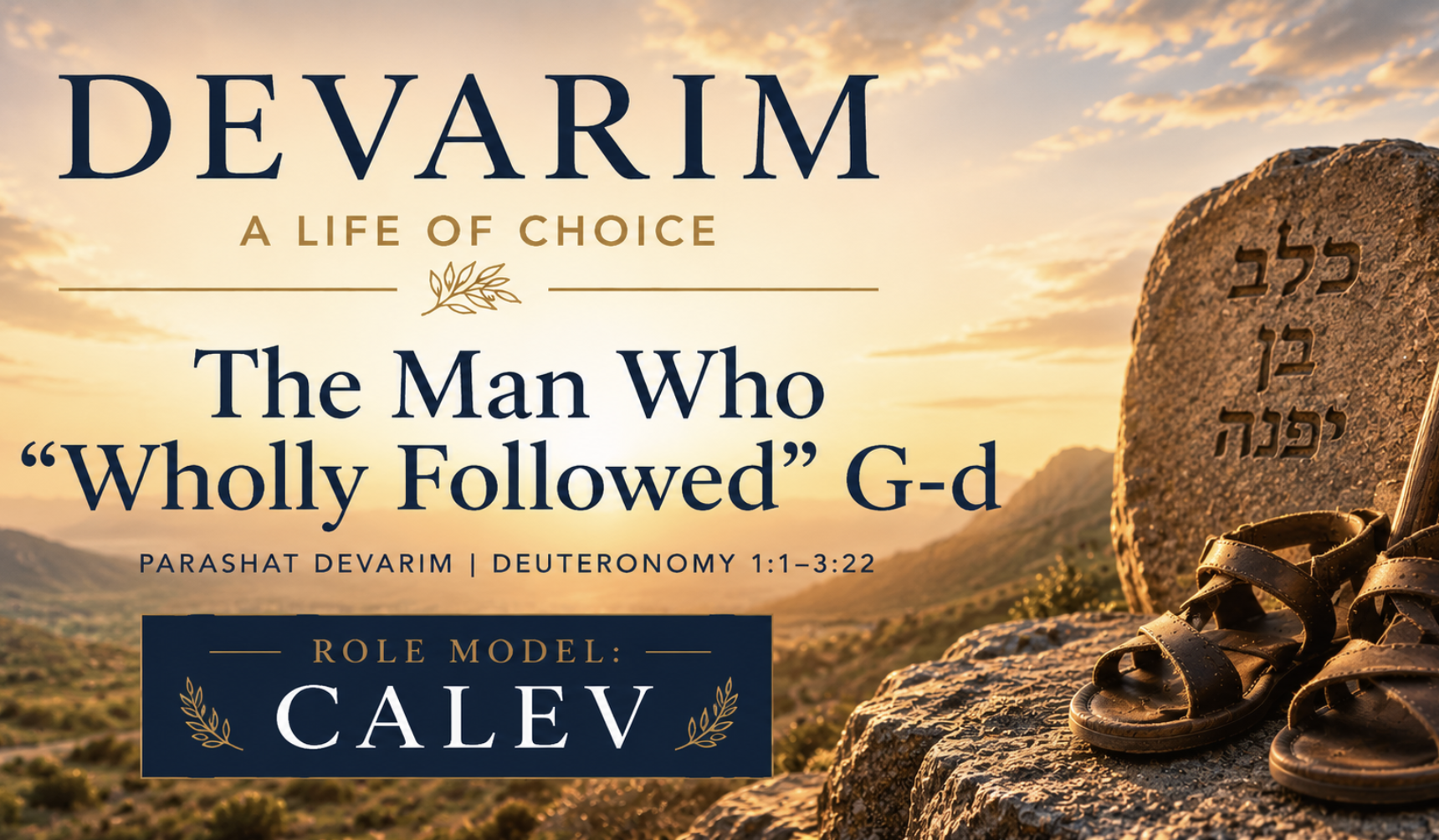
If I asked you to name the great figures of the Torah, you would probably reach for Moshe, Aharon, Miriam, Yehoshua, or David. Calev rarely takes centre stage. He never held the highest office, never sought greatness, and never seems remotely interested in being recognised. Yet that may be precisely why he belongs among our finest role models. Calev turns up at the defining moments of the wilderness years, and each time he does the same unglamorous thing. He quietly does what is right in G-d’s eyes, whatever it costs him. As the text says, twice: he “wholly followed G-d.”
The mission of the spies. This is the first of those moments. Twelve leaders were sent to scout the land. Ten came back overwhelmed by fear and talked an entire nation out of its future. Calev, with Yehoshua, stood almost completely alone. In this week’s parasha, Moshe reaches back forty years and retells the whole painful episode.
אם יראה איש באנשים האלה הדור הרע הזה את הארץ הטובה אשר נשבעתי לתת לאבתיכם. זולתי כלב בן יפנה הוא יראנה ולו אתן את הארץ אשר דרך בה ולבניו יען אשר מלא אחרי יהוה
Surely not one of these men, this evil generation, shall see the good land that I swore to give your fathers, except Calev son of Yefuneh. He shall see it, and to him and his children I will give the land he set foot on, because he wholly followed the LORD. (Devarim 1:35 to 36)
Those closing words deserve attention: because he wholly followed the LORD. They sound at first like a simple note of loyalty. The commentators hear something far more deliberate. Rashi, commenting back on the original account, notices that when the spies reached Chevron the Torah suddenly slips into the singular: and he came to Chevron (Bamidbar 13:22). One man broke away. Drawing on the Gemara in Sotah 34b, Rashi explains that Calev slipped off alone to prostrate himself at the graves of the patriarchs and beg for the strength not to be swept along by his colleagues. He understood something about himself: that staying faithful sometimes means deliberately placing yourself among those who steady you rather than those who frighten you. Rashi ties that solitary detour straight to our verse, the land he set foot on, and to the city Calev is later given.
The pull he fought. The original account is even more honest about what this cost him. There, G-d calls Calev a man who had רוח אחרת, a different spirit, within him (Bamidbar 14:24). The Or HaChaim reads that phrase against the grain. The other spirit was not only his courage. It was also the pull in the opposite direction, the ordinary human temptation to fall in line with ten respected men who all agreed. Calev felt that pull as strongly as anyone in that camp. What made him Calev is that he wrestled it down. His faith was not the absence of doubt. It was doubt defeated, quietly, again and again.
And he kept doing it. He was the one who silenced the panicking people and insisted, we can surely go up and take the land (Bamidbar 13:30). Decades later, tradition places him once more among the spies Yehoshua sent into Yericho, volunteering for exactly the kind of mission that had broken the nerve of a whole generation the first time around. Most people who had lived through that failure would have avoided anything resembling it for the rest of their lives. Calev walked back in. He simply would not let one catastrophe decide who he was going to be.
The claim at Chevron. Here the series reaches the moment it has been circling toward. Forty-five years after the spies, Calev, now an old man, stands before Yehoshua. He is eighty-five, and he says so himself. He recounts the promise Moshe made him, and then he asks for what he was owed.
ועתה תנה לי את ההר הזה
Now then, give me this mountain. (Yehoshua 14:12)
Read one way, it is magnificent. An old soldier pointing at the most dangerous high ground in the country, the very place still full of the giants that terrified the other spies, and asking for it by name. But listen again and there is an edge in it. This is a man who has waited forty-five years in a wilderness, watching an entire generation die around him for a failure he had no part in, and he has counted every one of those years. Give me this mountain. He is not asking a favour. The verse itself has him invoke a promise, the mountain of which the LORD spoke that day. There is something owed here, he knows it, and he wants it now. That is not a stain on Calev. It is what makes him real. Nobody holds the right position alone for that long and comes through untouched. Faithfulness has a cost, and if you want to hear the cost, it is right there in the sharpness of an eighty-five-year-old asking for his mountain. The Torah does not hide it. It lets us watch a good man collect a debt.
And he receives it. Yehoshua blesses him and gives him Chevron, and the text closes the circle with the very words Moshe used in our parasha: because he wholly followed the LORD, the God of Israel (Yehoshua 14:14). The same phrase, forty-five years apart. The Torah is telling us that the quality was never a single brave sentence in the desert. It was a lifetime of the same choice, made when it was thrilling and made when it was merely long.
There is a quiet tradition that Calev married Miriam (Sotah 11b to 12a). It is a fitting match. She too did the right thing early and without applause, often years before anyone thought to call her great. Neither of them chased status. Both simply did what was needed, and kept doing it.
That is why Calev is such a compelling role model. Our world often celebrates the loudest voice and the largest audience. The Torah celebrates something harder to see and harder to sustain: character held steady across a whole life, most of it unwatched. Very few of us will ever lead a nation or be remembered for millennia. But every one of us meets the smaller version of Calev’s test, the moment where following the crowd is easy and following your conscience is not, and where nobody would ever know if you quietly gave in. Those moments rarely make headlines. They are exactly where character is decided.
Last week, in Matot-Masei, we sat with Yirmiyahu, the prophet who could not stop speaking a truth nobody wanted to hear, and who taught us that winning was never the point. Calev is his quiet counterpart in the wilderness. He too held to a conviction almost no one would share and said the unpopular thing when silence would have been so much easier. Unlike Yirmiyahu, Calev lived to collect what he was promised. And yet the parasha is careful with its words: what it praises is not the mountain he won but the fact that he wholly followed. The reward was never the point. The following was, and Calev did it for a lifetime.