
Did Muhammad Fast on Yom Kippur?
Before Muslims had to fast during Ramadan, there was Ashura.
Ashura falls on the tenth day of Muharram, the first month of the Islamic year. Muhammad is said to have explained that fasting on Ashura atones for the sins of the preceding year.
Yom Kippur, of course, is also a fast day devoted to atonement for the prior year’s sins. It too falls on the tenth day of the first month of the year, albeit the Jewish civil year. Could it be that Ashura derives from Yom Kippur?
Islamic tradition gives some tantalizing hints.
One Islamic tradition describes Muhammad arriving in Medina and finding “the Jews observing the fast on the day of Ashura.” When he asks why, they tell him that God rescued Moses and the Israelites from Pharaoh on that day. Muhammad reportedly responds by ordering his followers to fast too, on the theory that Muslims have a closer claim to Moses.
That might sound like a confusion of Passover and Yom Kippur, but it’s not the only complication. Yet another Islamic tradition on Ashura’s origins omits any reference to Jews. It reports that Muhammad was already fasting Ashura even before leaving Mecca, because his tribe, the Quraysh, did so.
No contemporary non-Muslim source has much to say about this issue, and the surviving Islamic traditions do not definitively answer the question.
Perhaps Muhammad encountered Jews observing Yom Kippur and adopted or adapted their fast. Maybe an existing Arabian fast acquired Jewish associations. It could even be that both Yom Kippur and Ashura derive from the same ancient tenth-day atonement fast that is now lost to history.
We simply do not know.
That said, it is interesting that I don’t ever remember learning about this at all, notwithstanding my K-12 education at Solomon Schechter Day School, now Golda Och Academy. Indeed, the centuries between Jewish “exile” after Bar Kokhba’s rebellion in the second century and the Arab Conquest in the seventh century seem like a black box. And not all of the events in those centuries lack sources, significance, or drama.
Consider the Jewish-assisted Persian conquest of Jerusalem in 614 CE. I almost fell off my chair when I learned about this forgotten chapter of Jewish history. Multiple Jewish (and Christian) texts describe the dramatic details, including a fascinating cast of characters.
For starters, there is Benjamin of Tiberias, a wealthy Jewish leader who recruits and arms fighters from Tiberias, Nazareth, and other Galilean communities. Jews elsewhere in the land that now makes up the modern state of Israel join them. These communities, it turns out, had never left the holy soil.
The apocalyptic Hebrew text Sefer Zerubavel casts a Jewish warrior named Nehemiah ben Hushiel as one of the leaders of the Jewish forces. More spectacularly, the book introduces Hephzibah, a female warrior wielding a miraculous staff. Not only does it say that she is destined to kill two enemy kings; she is also the mother of the messiah.
Enter a Sassanian Persian army under General Shahrbaraz, whose menacing title means “boar of the empire.” After hundreds of years of on-and-off fighting, the Sassanians are gaining the upper hand over the Byzantines. Shahrbaraz’s forces sweep across Anatolia and down through Syria where the Jewish forces join them.
The combined armies besiege Jerusalem and force the Byzantine Christians to surrender the city. A near-contemporary piyyut attributed to Eleazar ha-Qallir and preserved in the Cairo Geniza describes the Persians permitting Jews to build an altar and resume sacrifices in Jerusalem, although the sanctuary itself is never completed. For a brief moment, Jewish hopes of restoration flare.
Then everything goes horribly wrong.
About 617 CE, Persian policy reverses. The Sassanians restore a Christian administration in Jerusalem, and the brief window of Jewish restoration slams shut. A decade later, Persia loses the wider war and Byzantine rule returns under the Emperor Heraclius.
In Sefer Zerubavel, Nehemiah ultimately suffers a gruesome death. According to later Christian accounts, Benjamin of Tiberias is forced to convert to Christianity. We never learn what happened to Hephzibah.
These stories deserve more prominence. Regardless of the moral and strategic lessons the Jewish community might learn, the events are an important check on the traditional assumption that Jews were exiled and powerless between Bar Kokhba and Theodore Herzl. And there is more.
A history attributed to Sebeos, a seventh-century Armenian bishop, includes a startling sequel. It tells of Jewish refugees caught up in the Byzantine-Persian wars who had sought refuge in Edessa (what is today the city of Urfa in southeastern Turkey). After renewed conflict with Byzantine authorities, Jews head into the desert and encounter the “children of Ishmael.”
That, Sebeos tells us, is when an Ishmaelite merchant named “Mahmet” appears.
Teaching the Arabs about the God of Abraham and the story of Moses, Mahmet reportedly tells the Arabs that they, like the Jews, are entitled to the inheritance promised to Abraham. Sebeos says the Jews and Arabs then form a “mighty army” together. By 638 CE, Byzantium has relinquished control of Jerusalem to Mahmet’s followers.
Of course, the Jewish-Arab partnership doesn’t last.
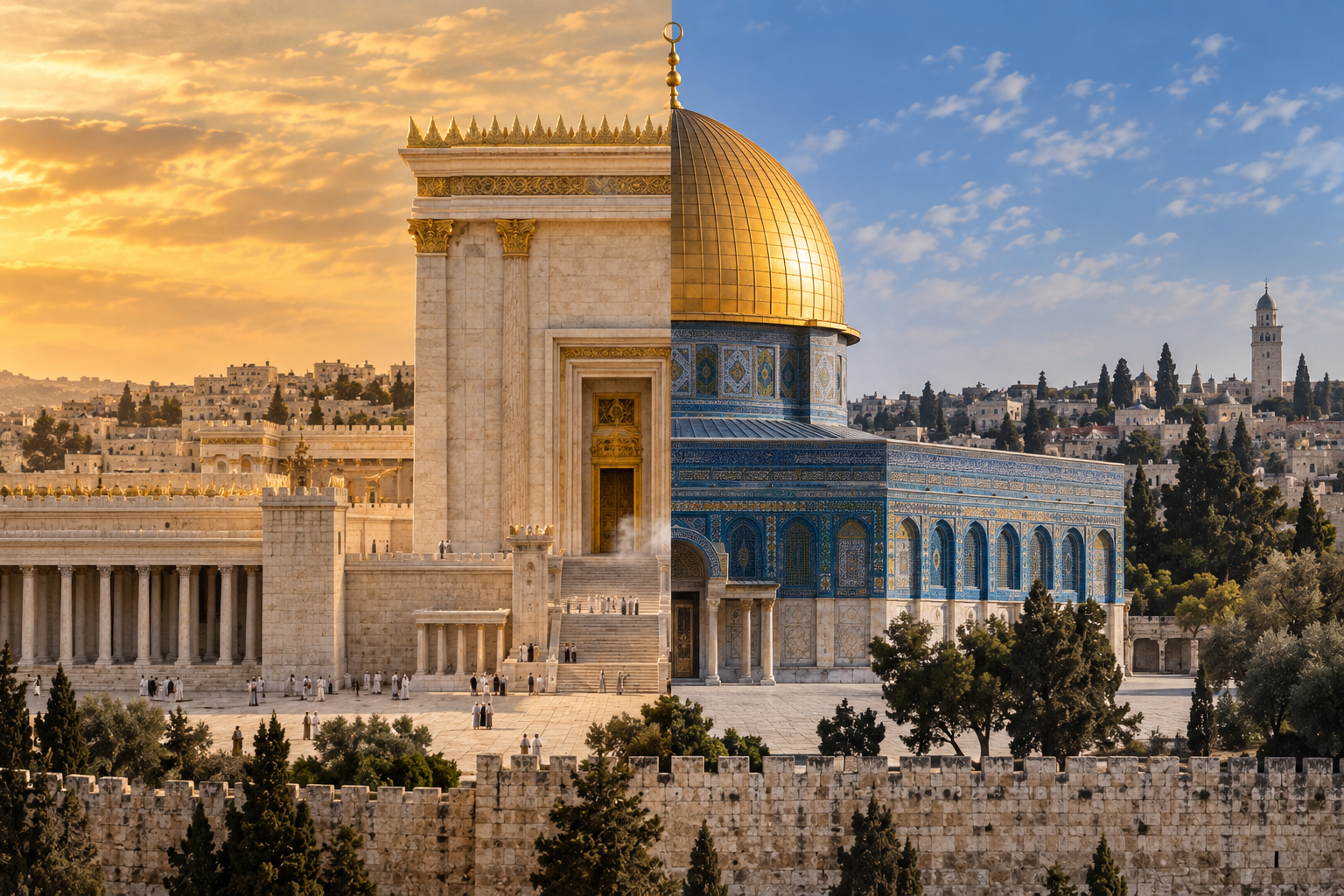
Sebeos reports that, after the conquest, Jews locate the Holy of Holies and begin constructing a place of prayer on the Temple Mount. But their former Arab allies soon expel them and claim the area. Today, that site, which Muslims call Haram al-Sharif, is where the Dome of the Rock and the Al-Aqsa Mosque stand.
Absent future discoveries, we might never know exactly what role Jews played at this historical fulcrum that severed Jerusalem from Antiquity and tipped it into the Islamic Middle Ages. But does this lack of certainty explain its absence from the curriculum? After all, the Biblical stories often lack outside confirmation, but Jewish education relies on many of them.
Another factor might well be at work. If so, it could explain the lack of attention to the possible connection between Ashura and Yom Kippur as well as both seventh-century conquests of Jerusalem. We are all vaguely aware of the general resemblances between Judaism and Islam, including veneration of Abraham (Ibrahim), Moses (Musa), and David (Dawud).
Both religions involve circumcision, dietary laws, and daily prayers. Both also give a sacred role to a Semitic language.
But we are not as comfortable with the origins and details of those entangled traditions. Maybe that is for the better, or at least inevitable. That said, I can’t help thinking that the journey that led me from the eerie similarity of two tenth-day atonement fasts to the boundary-shattering history presented by Sebeos should not stay buried.
Studying ancient history will not, of course, resolve the present. History rarely works that neatly. But it can remind us that Jews and Arabs might be “cousins” in more than metaphor.
Above all, it teaches us to have an open mind. History cannot give us a peace plan. But it might give us a better place from which to imagine one.