London based entrepreneur, cybersecurity analyst doing a PhD in AI
One Idea Tafsir No. 13 – Harvard Business School.
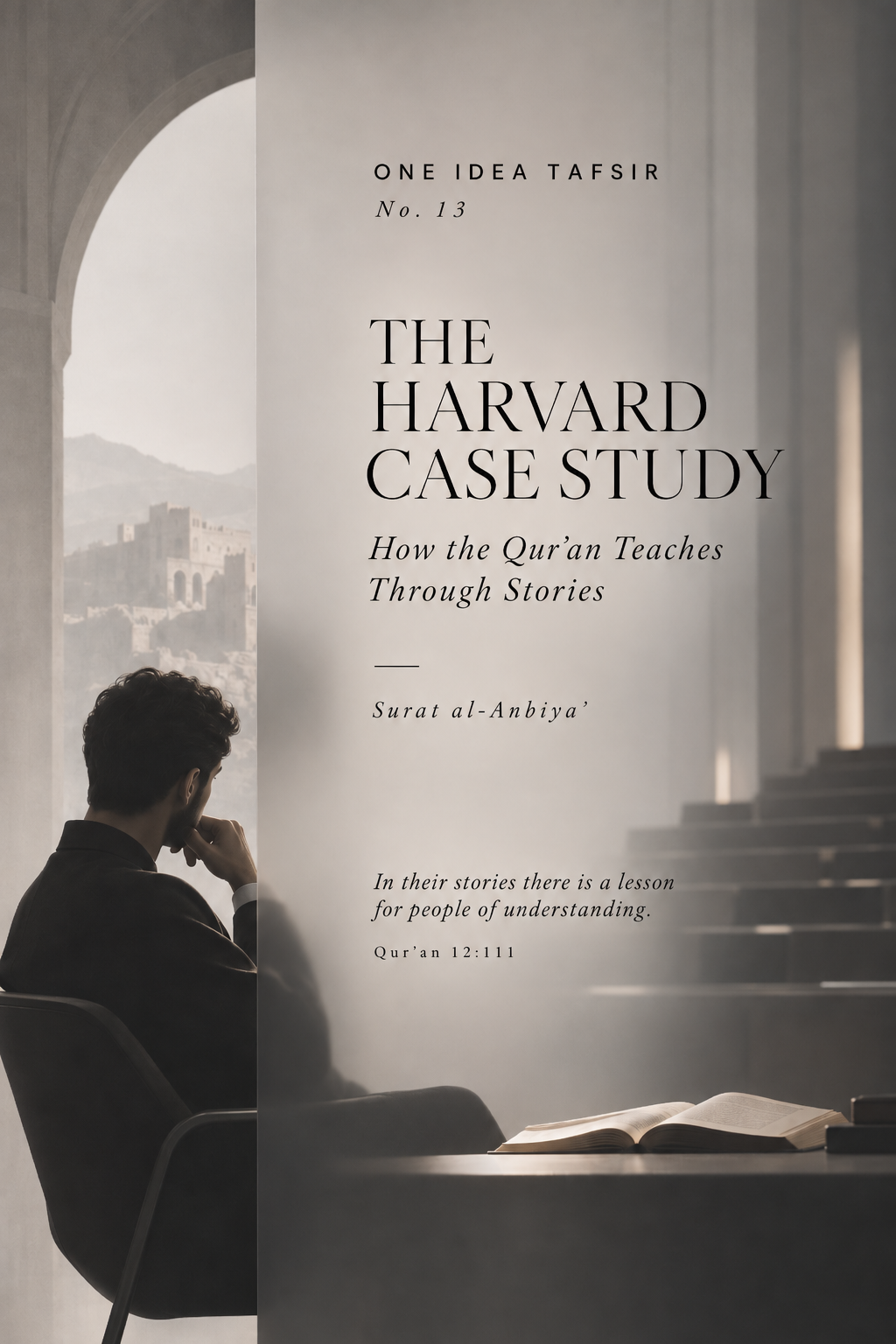
Excerpt of Surah Yusuf (verse 111). Harvard teaches using a case study method of over 500 cases in 2 years to sharpen reasoning in business situations.
One Idea Tafsīr — No. 13
The Harvard Case Study: Why the Qur’an Teaches Through Stories
From Sūrat al-Anbiyāʾ to Harvard Business School’s case study method: how revelation turns the lives of the prophets (عَلَيْهِ السَّلَامُ) into lessons for our own.
A classroom, a dilemma
Walk into a Harvard Business School classroom and you might find no conventional lecture. Instead, students have read a case study: a leader must make a consequential decision with limited information.
The professor asks, “What would you do?”
Different answers are examined, assumptions challenged, consequences explored. The purpose is not merely to acquire facts about a company. It is to practise judgment before life demands it. In many cases, you are “training” your reasoning without having to be in a real life “high pressure” scenario.
The approach has a history. Harvard published its first standalone business case in 1921, formally named the “case system” in 1922, and today says its MBA students read about 500 cases over two years.
A case connects a principle to a particular human situation. Knowing that honesty matters is easy; telling the truth when it costs you something is harder. [1]
The Qur’an explains why it narrates
The comparison becomes remarkable when we turn to revelation.
Allah says in Sūrat Yūsuf (12:3):
نَحْنُ نَقُصُّ عَلَيْكَ أَحْسَنَ ٱلْقَصَصِ بِمَآ أَوْحَيْنَآ إِلَيْكَ هَـٰذَا ٱلْقُرْءَانَ وَإِن كُنتَ مِن قَبْلِهِۦ لَمِنَ ٱلْغَـٰفِلِينَ ٣
We relate to you ˹O Prophet˺ the best of stories through Our revelation of this Quran, though before this you were totally unaware ˹of them˺. (Quran 12:3)
Elsewhere, Allah introduces the story of Moses and Pharaoh as an account recited “in truth” (28:3).
نَتْلُوا۟ عَلَيْكَ مِن نَّبَإِ مُوسَىٰ وَفِرْعَوْنَ بِٱلْحَقِّ لِقَوْمٍ يُؤْمِنُونَ ٣
We narrate to you ˹O Prophet˺ part of the story of Moses and Pharaoh in truth for people who believe. (Quran 28:3)
The youths of the Cave are similarly introduced:
نَّحْنُ نَقُصُّ عَلَيْكَ نَبَأَهُم بِٱلْحَقِّ ۚ إِنَّهُمْ فِتْيَةٌ ءَامَنُوا۟ بِرَبِّهِمْ وَزِدْنَـٰهُمْ هُدًى ١٣
We relate to you ˹O Prophet˺ their story in truth. They were youths who truly believed in their Lord, and We increased them in guidance. (Quran 18:13)
And in Sūrat Hūd (11:120), Allah states that the accounts of the messengers are related to strengthen the Prophet Muhammad’s ﷺ heart.
وَكُلًّا نَّقُصُّ عَلَيْكَ مِنْ أَنۢبَآءِ ٱلرُّسُلِ مَا نُثَبِّتُ بِهِۦ فُؤَادَكَ ۚ وَجَآءَكَ فِى هَـٰذِهِ ٱلْحَقُّ وَمَوْعِظَةٌ وَذِكْرَىٰ لِلْمُؤْمِنِينَ ١٢٠
And We relate to you ˹O Prophet˺ the stories of the messengers to reassure your heart. And there has come to you in this ˹sûrah˺ the truth, a warning ˹to the disbelievers˺, and a reminder to the believers. (Quran 11:120).
Finally, Sūrat Yūsuf explains that the stories contain a lesson for people of understanding (12:111). [3]
لَقَدْ كَانَ فِى قَصَصِهِمْ عِبْرَةٌ لِّأُو۟لِى ٱلْأَلْبَـٰبِ ۗ مَا كَانَ حَدِيثًا يُفْتَرَىٰ وَلَـٰكِن تَصْدِيقَ ٱلَّذِى بَيْنَ يَدَيْهِ وَتَفْصِيلَ كُلِّ شَىْءٍ وَهُدًى وَرَحْمَةً لِّقَوْمٍ يُؤْمِنُونَ ١١١
In their stories there is truly a lesson for people of reason. This message cannot be a fabrication, rather ˹it is˺ a confirmation of previous revelation, a detailed explanation of all things, a guide, and a mercy for people of faith. (Quran 12:111)
Those verses tell us what the stories are for: truth, guidance, remembrance, reassurance and moral understanding.
The analogy with Harvard is educational, not theological. Harvard cases invite debate about human judgments in business contexts; the Qur’an, in Islamic belief, is Allah’s word.
Sūrat al-Anbiyāʾ: one chapter, many trials
Sūrat al-Anbiyāʾ — “The Prophets,” Chapter 21 — offers a concentrated sequence of prophetic examples. [ Arabic Honorific for prophets: عَلَيْهِ ٱلسَّلَامُ, meaning “peace be upon him“, shortened to p.b.u.h for the rest of the article]
Verse 35 supplies the organising principle: human beings are tested through both hardship and good fortune.
كُلُّ نَفْسٍ ذَآئِقَةُ ٱلْمَوْتِ ۗ وَنَبْلُوكُم بِٱلشَّرِّ وَٱلْخَيْرِ فِتْنَةً ۖ وَإِلَيْنَا تُرْجَعُونَ ٣٥
Every soul will taste death. And We test you ˹O humanity˺ with good and evil as a trial, then to Us you will ˹all˺ be returned. (Quran 21:35)
Success is a test of gratitude; authority, of justice; suffering, of patience.
The accounts are not all presented chronologically, and some of the familiar examples below appear elsewhere in the Qur’an. [4]
Adam [p.b.u.h] faces the consequences of disobedience, acknowledges wrongdoing and seeks forgiveness. The lesson is not that mistakes do not matter, but that repentance matters more than proud self-justification. [5]
Noah [p.b.u.h] continues calling his people despite rejection. He teaches perseverance without treating public approval as the measure of obedience to Allah. [6]
Abraham [p.b.u.h] , prominently featured in al-Anbiyāʾ, questions his community’s inherited idol worship. He refuses to confuse a widely accepted custom with truth, even when that challenge attracts persecution. Lot likewise faces a community whose wrongdoing he cannot endorse. [7]
Moses [p.b.u.h] and Aaron [p.b.u.h] are charged with confronting Pharaoh, yet are instructed elsewhere to speak gently. Courage and disciplined conduct belong together.
Joseph [p.b.u.h] , whose account appears in another chapter, eventually obtains power over brothers who betrayed him, but responds with forgiveness. [8]
Then comes perhaps the chapter’s clearest judicial case.
Sheep damage a cultivated field at night. David [p.b.u.h] and Solomon [p.b.u.h] consider the dispute; Allah gives Solomon understanding of the matter while affirming that both have wisdom and knowledge (21:78–79).
Think about this in these terms. Two CEOs or presidents are brought the same problem, both reason through it, one comes up with a better understanding. The arena of Islam is justice, moral reasoning, piety or god consciousness.
The Harvard Case study approach is similar. Students sit around and discuss a problem, and try to get to an understanding of it.
Judgment requires attention to rights, consequences and restoration — not simply the desire to punish. [9]
Job [Ayyub (Arabic: أيوب)] [p.b.u.h] calls upon Allah amid affliction; patience does not prohibit acknowledging pain.
Ishmael [p.b.u.h] , Idris [p.b.u.h] and Dhul-Kifl [p.b.u.h] are commended for steadfastness, even though this passage offers little biographical detail.
Jonah [Yunus or يونس] [p.b.u.h] recognises his error and calls on Allah from darkness.
Zechariah [p.b.u.h] continues to pray despite apparent impossibility.
Mary [p.b.u.h] is honoured for chastity and becomes, with Jesus, a sign for the worlds. [10–12]
What unites these stories?
They are not interchangeable management lessons. The prophets’ primary mission is to call people to worship Allah.
Indeed, after recounting their diverse experiences, al-Anbiyāʾ declares:
إِنَّ هَـٰذِهِۦٓ أُمَّتُكُمْ أُمَّةً وَٰحِدَةً وَأَنَا۠ رَبُّكُمْ فَٱعْبُدُونِ ٩٢
˹O prophets!˺ Indeed, this religion of yours is ˹only˺ one, and I am your Lord, so worship Me ˹alone˺. (Quran 21:92)
Classical commentators understand this as the unity of the prophets’ essential religion, notwithstanding differences in their revealed laws. [13]
Another account expands the method beyond the prophets. The young believers of the Cave (18:13–16) face pressure from their society and choose fidelity to Allah.
Their youth and apparent powerlessness do not prevent moral courage.
Meanwhile, the Qur’an does not manufacture a happy ending for every earthly trial: Noah’s message is rejected by many; Joseph suffers years of separation; Job experiences real affliction.
The lesson is not that righteous choices always produce immediate worldly comfort. [14]
There is also a subtle difference in how we approach the protagonists.
In a business class, we may challenge an executive’s errors. With the prophets, the believer seeks guidance from Allah’s account, honours their prophetic rank and does not casually imagine being morally equal to them. You have more of a chance of bettering Steve Jobs or Elon Musk, than of bettering a prophet in any way. Allah chose them for a reason, and didn’t choose us for a reason. The lesson is, similar to Harvard, to see how we can apply the reasoning in our lives, and train ourselves in moral reasoning as believers, as Harvard trains in business reasoning for executives.
In both settings we examine circumstances; in the Qur’an, however, the revealed standard judges us.
The right question is not “Could I have done better than a prophet?” but “What must I change in myself or how do I react to an immediate situation in my life?”
The reader can nevertheless ask four disciplined questions:
- What was the test?
- What did Allah teach?
- What did the prophet do — or what does the account warn against?
- How should that guidance affect my conduct, in light of the Qur’an, authentic Sunnah and sound tafsīr?
At Harvard, the student studies someone else’s decision before entering a real boardroom.
In the Qur’an, the believer studies the prophets before facing the next real test of honesty, power, loss, patience or mercy in real life. It’s training to navigate life itself.
The ultimate purpose is greater than improved decision-making: it is worship, character and accountability before Allah.
An examination at Harvard may be marked by a professor. The Qur’an’s horizon is more serious: the scales of justice on the Day of Resurrection (21:47).
No flattering presentation, elegant argument or worldly title can substitute for sincerity and righteous deeds. [15]
No powerpoint slide deck will save you or me that day, because the one controlling the event knows everything – what you and I hide and what we reveal. We can’t just “smooth” things over.
The story has been read. The question is whether its lesson has entered our lives.
And whether we are ready to navigate life and answer for ourselves on the Day of Judgement.
Explanatory Footnotes and References
[1] What Harvard’s case method actually is
Harvard’s first standalone case, General Shoe Company (1921), used a hypothetical shoe factory and a labour-management problem; therefore it would be inaccurate to say that every case is a literal transcript of events at a real company.
Harvard faculty voted to name their teaching approach the “case system” on 10 May 1922.
Sources: Harvard Business School, The Case Method; Baker Library, Case Method 100 Years and The General Shoe Company, 1921.
[2] “The best of stories” and “the best manner”
The Arabic of 12:3 begins Naḥnu naquṣṣu ʿalayka aḥsana al-qaṣaṣ.
For interpretation, Revelation has priority over a metaphor used here to explain.
[3] Four verses explaining the storytelling method
Each passage speaks of divine truth, not merely persuasive storytelling.
[4] Adam: repentance rather than self-exoneration
Read Qur’an 2:30–39 and 7:19–23 alongside the passages on Iblīs (7:11–18).
Adam and his wife transgress a prohibition and turn toward Allah, saying Rabbanā ẓalamnā anfusanā — “Our Lord, we have wronged ourselves” — and asking for forgiveness and mercy (7:23).
The contrast with Iblīs (Shaytaan, the Devil) is not that one mistake is acceptable and another intrinsically unforgivable: it concerns repentance versus pride and persistence in rebellion.
Sunni doctrine also recognises the honoured status of Adam as a prophet.
The practical question is whether a person acknowledges wrongdoing promptly, seeks Allah’s forgiveness and repairs what can be repaired, without treating the prophet as a fallible corporate executive whose status may be freely judged by modern managerial criteria.
[6] Noah: endurance and the limits of outcome-based evaluation
Qur’an 71:5–9 describes his calling them by night and day, publicly and privately.
The lesson is not passive refusal to reassess methods.
Rather, the prophet (p.b.u.h) fulfilled a divine obligation despite sustained resistance.
A person today should seek effective, ethical means while recognising that effectiveness cannot be reduced to popularity, revenue or a numerical success target.
[7] Abraham and Lot: conviction without reckless analogy
Abraham challenges inherited idol worship in 21:52–67, and Allah commands the fire to be cool and safe for him in 21:69.
This is a divine miracle, not a promise that every believer who confronts wrongdoing will escape harm.
His reasoning is directed toward tawḥīd — worship of Allah alone — not a blanket rejection of ancestral knowledge.
Lot’s deliverance is mentioned in 21:74–75, while the fuller account of his people occurs elsewhere, including 7:80–84.
The modern educational application is to distinguish truth from social pressure.
It is not permission for vigilantism, cruelty, or declaring every disagreement equivalent to a prophet’s confrontation with unbelief.
[8] Moses, Aaron and Joseph: strength restrained by ethics
Moses and Aaron receive a criterion and reminder in 21:48–50.
The instruction to address Pharaoh gently is in 20:43–44, not Sūrat al-Anbiyāʾ.
Gentleness does not mean conceding the truth to oppression; it governs how the truth is delivered.
Joseph’s trajectory is recounted principally in Sūrat Yūsuf.
He resists temptation (12:23–24), experiences imprisonment, assumes responsibility for Egypt’s stores (12:55) and finally tells his brothers that there is no reproach upon them that day (12:92).
His father’s grief and continued hope are described in 12:83–87.
These are not interchangeable leadership techniques: each response follows its own moral and revealed context.
Forgiveness is virtuous, but an injured person must not be pressured to overlook continuing harm.
[9] David and Solomon: a genuine dispute, with an important sourcing distinction
Qur’an 21:78–79 explicitly states that sheep damaged a cultivated field at night, that David and Solomon adjudicated the matter, and that Allah gave Solomon particular understanding while giving both judgment and knowledge.
Ibn Kathīr reports an account attributed to Ibn Masʿūd: David awarded the sheep to the owner of the damaged crop, while Solomon proposed that the owner of the sheep restore the crop and the injured party benefit from the sheep in the interim, after which both properties would return to their owners.
Those detailed remedies belong to the exegetical report; they are not specified word-for-word in the Qur’an.
Ibn Kathīr also transmits al-Ḥasan al-Baṣrī’s observation that Solomon was praised without David being condemned.
Thus the strongest established lesson is the value of wise, fair judgment, not a simplistic claim that one prophet was incompetent.
[10] Job and the shorter accounts: what patience does — and does not — mean
Al-Anbiyāʾ 21:83–84 presents Job’s appeal to Allah in adversity and Allah’s response.
It does not provide a complete clinical history of his suffering; dramatic medical details sometimes repeated in popular retellings should not be treated as established by these verses.
A patient believer can acknowledge pain, pray for relief and seek treatment.
Verses 21:85–86 then commend Ishmael, Idris and Dhul-Kifl for patience and admit them into divine mercy.
Their grouping does not give us a detailed chronology or an individual case with an explicit dilemma for each one.
Scholars also differed over whether Dhul-Kifl was a prophet or a righteous servant; the Qur’an’s explicit praise of his patience is secure regardless.
[11] Jonah: the meaning of the supplication and the disputed phrase
Jonah’s prayer in 21:87 is:
Lā ilāha illā Anta, subḥānaka, innī kuntu minaẓ-ẓālimīn.
“There is no deity worthy of worship but You; glory be to You; I have been among the wrongdoers.”
Verse 88 describes his deliverance and extends the lesson to believers.
The preceding expression fa-ẓanna an lan naqdira ʿalayhi must not be translated or understood as if Jonah disbelieved in Allah’s omnipotence.
Classical tafsīr explains it in relation to Allah’s decree or constraining him.
The account is a lesson in turning to Allah, not licence to diminish a prophet’s faith.
Its modern application is to admit mistakes without despair; deliverance, however, remains subject to Allah’s wisdom and is not a formula guaranteeing an immediate worldly outcome.
[12] Zechariah, Mary and Jesus: hope, modesty and divine signs
Zechariah’s prayer is in 21:89–90, with further background in 19:2–11.
He petitions Allah for an heir despite old age and circumstances that seem prohibitive; Allah grants him John.
The verses also praise his household’s eagerness for good deeds, hope, reverence and humility.
Mary’s chastity and the miraculous creation of Jesus are invoked in 21:91 and expanded in 19:16–36.
The Qur’an calls Mary and her son a sign for the worlds.
The lesson is not that faith supplies a predictable procedure for receiving every specific request.
Rather, supplication remains meaningful when human forecasts are bleak, and the believer acts with modesty, courage and trust without demanding a miracle as proof of personal virtue.
[13] The single foundation beneath different lives
In Qur’an 21:92, Inna hādhihi ummatukum ummatan wāḥidatan wa-anā rabbukum faʿbudūn, the unity of the prophetic community is explained by Ibn Kathīr through reports from Ibn ʿAbbās, Mujāhid and others: their fundamental religion is one.
Islamic teaching holds that the prophets all called people to worship Allah alone, although their specific revealed laws could differ; compare Qur’an 5:48.
The Prophet Muhammad ﷺ is described as mercy to the worlds in 21:107 and as an excellent example in 33:21.
The final standard is not commercial success but accountability before Allah: 21:47 describes just scales on the Day of Resurrection.
Therefore a case-study approach is only a reflective aid. It must remain subordinate to revelation, authentic Sunnah, established tafsīr and the dignity due to the prophets.
[14] The People of the Cave and the wider scope of Qur’anic narratives
In 18:13, Allah declares that the youths’ story is related in truth and that their faith is increased in guidance.
In 18:14 they declare the lordship of Allah despite a surrounding society committed to other worship.
In 18:16 they separate from that practice and seek refuge.
Ibn Kathīr interprets these youths as having embraced guidance rather than following entrenched falsehood.
Their story is not presented as a prophetic biography; it demonstrates that Qur’anic exemplars include righteous non-prophets.
The Qur’an also tells cautionary stories, such as the arrogance of Pharaoh, so an instructive narrative need not feature a protagonist whose conduct one should imitate.
This is a reason to identify the text’s praise or condemnation before deriving a modern application.
[15] Interpretation before application
A responsible “case-study” reading asks first what the Arabic says, then what the narrative’s immediate context establishes, and then how the authentic Sunnah and classical commentators interpret it.
Only after that should one offer a personal analogy.
This order prevents turning a miracle into a management tactic, a specific divine decree into a promise of automatic results or a prophet’s test into an excuse to judge other people.
It also makes room for the full purpose of the Qur’an: belief, worship, moral formation, warning and hope, not merely worldly efficacy.
Where the text is silent about details, silence is often more faithful than an invented explanation.
Related Topics