
Did the Carousel Turn While the Warsaw Ghetto Burned?
I went looking for a photograph to help me describe what “indifference” means, and I found a thirty-year argument instead.
I had been writing about my mother-in-law, who was born at Miła 18, became a child smuggler in the Warsaw Ghetto, and escaped to the Aryan side before the uprising. I wanted an image for the essay. I knew the one I wanted: the carousel by the ghetto wall in the spring of 1943. Everyone knows it, or thinks they do.
Here is the story as most of us carry it. Holy Week in 1943 ran from April 19 to April 25. The Warsaw Ghetto Uprising began on Monday, the first day of that week. On the Aryan side, a small amusement ground stood near the wall. On Easter Sunday, Czesław Miłosz was traveling with his wife, Janina, from Mokotów to Bielany to visit the writer Jerzy Andrzejewski. Their tram stopped at Długa Street because nothing was being let through to plac Krasińskich. Miłosz saw something there that he could not put down. He wrote “Campo di Fiori,” and the image of Poles riding a carousel while Jews burned behind a wall entered the world and never left it.
What I did not know is that in Warsaw, the question of whether that actually happened has been fought over in newspapers and essays for more than thirty years, and it is still not settled.
The historian Tomasz Szarota gathered the dispute into an essay whose title is a question rather than a verdict: “Did the Merry Crowds Really Laugh?” Reading it, you understand why he declined to rule.
In 1993, Zbigniew Wójcik wrote to Życie Warszawy to say he had seen with his own eyes that the carousel on plac Krasińskich was running on April 21, two days into the uprising. In 2003, the literary critic Ryszard Matuszewski published a piece called “The Motionless Carousel on plac Krasińskich.” He had ridden the tram along Bonifraterska and through the square twice a day, every day, from 1940 to 1944. He remembered the carousel operating very rarely and, when it did turn, being empty or nearly empty. He was not attacking Miłosz. He called “Campo di Fiori” one of the greatest poems Miłosz ever wrote. He simply thought it was a metaphor, and that people had begun mistaking it for a deposition.
A third account moves the carousel off the square altogether, into the courtyard of a house that had burned in 1939, and insists nobody used it while the fighting was underway.
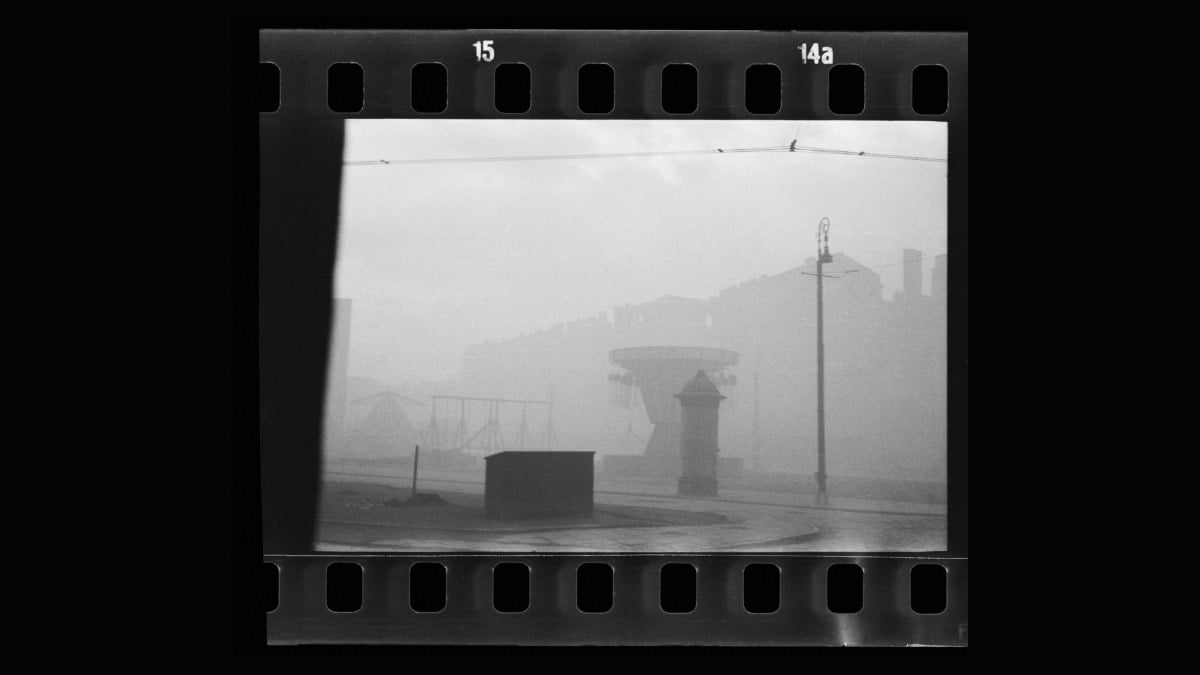
The photographs do not settle it either. The best-documented images were taken from the Aryan side by Rudolf Damec, a Warsaw warehouse worker. They were discovered decades later by his granddaughter, Aleksandra, who said her first thought on seeing the negatives was of Miłosz. In the frames, the amusement ground stands in smoke. Nobody is on it. On the same rolls of film, interleaved with the smoke, are Damec’s family snapshots: his wife with a braid wound around her head, his small son in a forest clearing, a boy handing him a pine cone. Ordinary life and the burning ghetto were exposed on the same strip of celluloid. That may be the most honest document anyone produced that spring.
Even the object is uncertain. Some photographs show a chair-swing, while witnesses remember horses. In one, a German gun stands nearby, pointed at the ghetto. It is not clear that everyone has been arguing about the same carousel.
So I sat with the question of why the argument is so ferocious, and I do not think it is really about a fairground ride.
Indifference is almost impossible to photograph. You can photograph a murder and you can photograph a wall, but you cannot photograph the decision to look away because it does not look like anything. It looks like a Tuesday. The carousel became the exception, the one image that made a moral abstraction visible. Once it was visible, it became evidence, and once it became evidence, there had to be a trial. Polish historians, witnesses, and commentators have been conducting that trial ever since, without agreeing on a verdict.
Indifference is almost impossible to photograph. It looks like a Tuesday.
I understand the defensive impulse. Poles were being murdered too. The German occupiers controlled the city, while ordinary Warsaw life continued under the conditions they imposed. The Underground warned that “only pigs sit in the cinema.” There were Poles willing to risk their lives to rescue Jewish children, and my mother-in-law is alive in my book because of exactly that kind of person.
But I noticed something while I was reading all of it, and it is the reason I am writing this instead of merely publishing a picture.
Almost all the energy goes to the ride. Was it turning? Was it full? Was it here or fifty meters away? Were people laughing, and if so, how many? Thirty years of letters and rebuttals about the carousel.
Nobody argues about the wall.
Nobody argues about the wall.
No serious historian disputes what was happening on its other side that week. Between April 19 and May 16, 1943, German forces burned the ghetto block by block with its people inside it. That is the one fact in this story that has never required a witness to be cross-examined.
My mother-in-law was born less than a kilometer from where the carousel stood. By the time of the uprising, Edna was eight years old and passing as a Polish Catholic orphan on the Aryan side. From a balcony, she watched the ghetto where she had been born burn. She witnessed executions. She saw people on fire. She saw people jumping from burning buildings to their deaths.
At eight years old, Edna should have been at the amusement ground. She should have been sitting on one of those swings, rising into the spring air. Instead, she watched people leap into that same air to escape the flames.
At eight years old, Edna should have been on the swing.
So I have stopped asking whether the carousel turned. Whether people outside the wall were laughing has been argued for more than thirty years.
I keep thinking about the Jewish child who stood outside the wall and watched what was being done to everyone still trapped inside it.
Edna should have been on the swing.
Janet Bond Brill, PhD, is the author of Little Edna’s War, based on her mother-in-law’s Holocaust testimony, published on January 27, 2026, on International Holocaust Remembrance Day. Order Now.