Eyes everywhere
Did Trump just betray the Iranian people massacred by the regime?
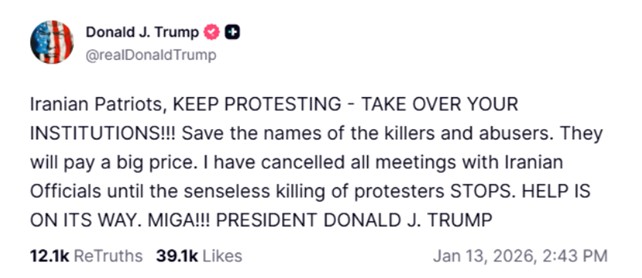
Trump's social media post inciting the Iranians to protest and promising help ((Picture from X; used in accordance with clause 27a of the copyright law).
On January 9, 2026, US President Donald Trump said that Washington would “hit Iran very, very hard where it hurts” if the Islamic Republic killed people protesting against the regime. Since then, at least 12000 demonstrators were murdered by the Islamist regime, many of them young people who took to the streets to overthrow a bloody regime that has been repressing the Iranians and masterminding terrorism worldwide for 47 years.
On January 13, Trump once again incited the demonstrators to keep protesting and remember the names of those abusing them, saying help was on the way. On his Truth Social account, Trump posted the following message: “Iranian Patriots, KEEP PROTESTING – TAKE OVER YOUR INSTITUTIONS!!!… HELP IS ON ITS WAY”.
However, that help never came, the demonstrators were slaughtered, the protests have faded while the regime, although weakened, is still standing and more ferocious than ever because it is in survival mode. When a regime is on the brink of collapse, it is willing to do anything to maintain control, and indeed, the results are visible.
Trump, on the other hand, suddenly changed his mind and informed Iran that he would not order a strike on the country over the massacre of demonstrators after the leaders of four Arab countries convinced him to hold off.
This is an interesting point that raises one obvious question: who runs the US Presidency? Trump? Or the “four Arab countries”?
On January 16, Trump denied it, saying that “nobody convinced him except himself.”
However, one of them, Qatar, which has a strong influence over Trump, as already seen with the situation in Gaza, is terrified of a fall of the Iranian regime and has most likely lobbied, along with other countries including Saudi Arabia to once again spare the regime. This had already happened during the Twelve-Day War, when Trump ordered Israel to halt its offensive.
As if it wasn’t enough, US special envoy Steve Witkoff, suggested on Thursday that the Trump administration prefers a diplomatic resolution, rather than a military one: “I hope there’s a diplomatic resolution. I really do.”
Witkoff and his son, Alex, are known to have business ties with Doha to the extent that the US and Israeli media have repeatedly raised concerns of a potential conflict of interest. It is yet unclear why Witkoff is hoping for a “diplomatic resolution” with a ferocious Islamist regime that slaughtered thousands of people.
The US President exposed himself by inciting the demonstrators, threatening the regime and promising that “help was on its way”. But it did not come. Trump never allowed the strikes and changed his mind. He said that “Iran told him that killings had stopped”. And if the regime says so, why shouldn’t we believe it?
Incredibly, on January 16, Trump even thanked the Iranian regime for cancelling over 800 executions scheduled for Thursday in a post on Truth Social: “I greatly respect the fact that all scheduled hangings which were to take place yesterday (over 800 of them) have been cancelled by the leadership of Iran. Thank you!”
All this, while the Iranian regime has repeatedly mocked and threatened Trump with statements and media images.
The outcome of the Iranian affair is so far disastrous for the Trump administration, as he will most likely be remembered as the President who first incited and then betrayed the Iranian demonstrators massacred by the regime against which they bravely rebelled. This could be an unprecedented betrayal of the Iranian people and a devastating blow to Trump’s reputation and his administration.
Moreover, it is ethically aberrant, and it’s important to highlight this point. In relation to this, it is necessary to refer to an article published in early December by Prof. David Weinberg on the Israeli media and entitled “Trump’s Truancy” where the expert says:
“…the fact that Donald Trump does not do ideology is problematic. His exceptionally transactional approach to political and foreign affairs – thinking that money, dealmaking, and the force of his personality can fix everything and lead to swift peace everywhere – is refreshing but also dangerous. It leads him to ignore the villainous nature of people…”
This is a huge problem that has recently manifested itself with Venezuela, as Trump ordered Maduro’s arrest and then attempted to cut deals with the regime, with great disappointment from the Venezuelan dissidents who were hoping for the restoration of democracy.
On January 15, an Iranian journalist in exile, Masih Alinejad, speaking at the emergency meeting of the United Nations Security Council, said: “The Iranian people are asking the world to help through action, not back-to-back meetings and empty condemnations. We don’t need empty words.” She is right, the Iranians don’t need posts on Truth Social, they don’t need futile threats, they need actions.
As if it were not enough, the contradicting voices coming from within the US administration, with Senator Lindsey Graham promising help to the Iranian demonstrators, while Witkoff pushes for a “diplomatic solution” (whatever that may mean,) further damage the credibility of the Trump administration.
Will a potential military intervention come later? Was it a bluff to confuse the regime, as some wish to believe? Or has the Iranian regime once again been saved by those who don’t want to see its collapse? All these are secondary considerations when there are thousands of dead protesters on the ground. This is probably the biggest fiasco ever accomplished by an American administration, perhaps worse than the Bay of Pigs disaster.
Related Topics
Related Posts