
Digital Trust: The Invisible Infrastructure
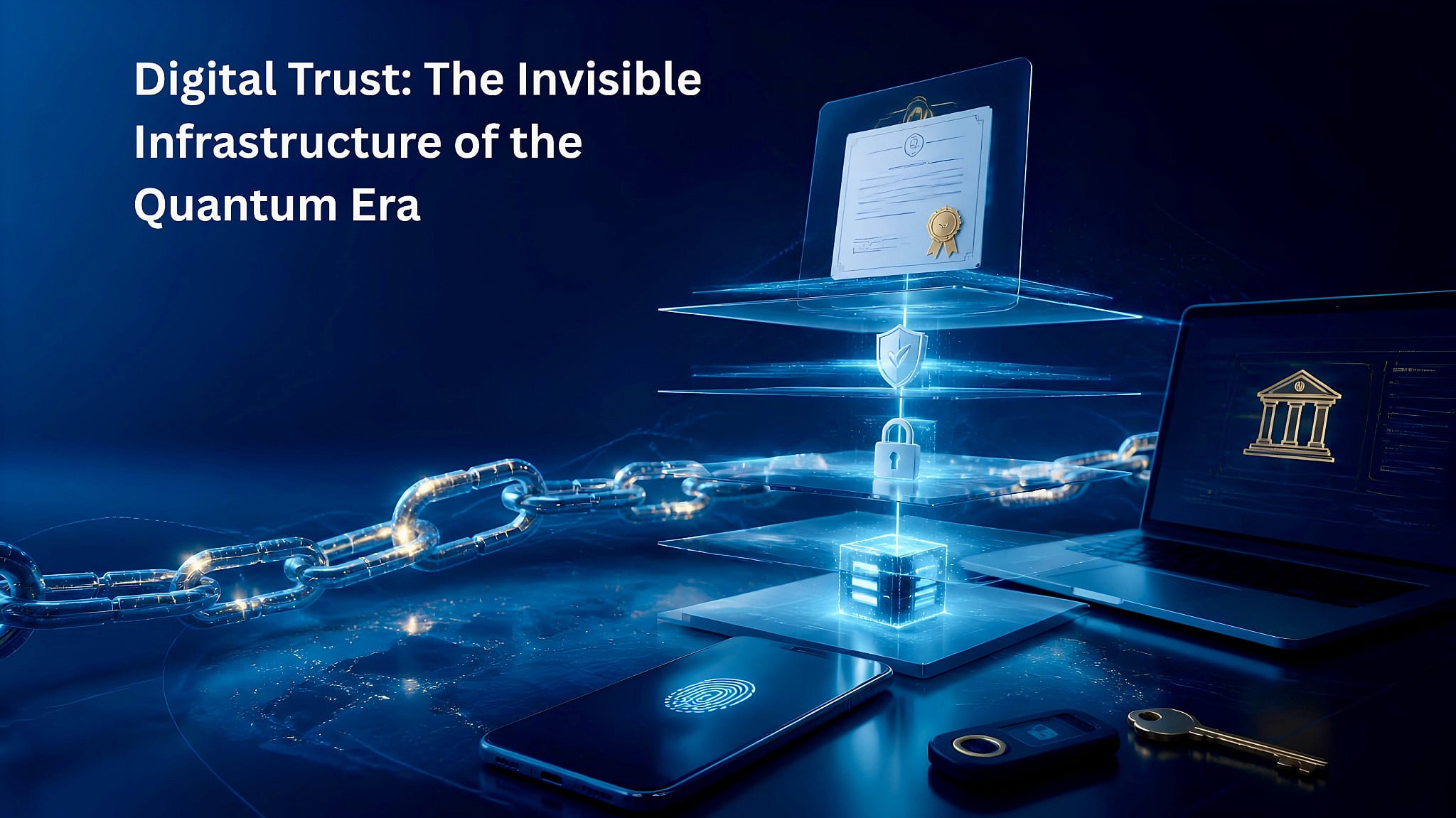
Most of us rarely think about digital trust. We open a banking app and assume we are communicating with our bank. We install a software update and assume it came from the company that created the software. We connect a device to a network and assume the device is what it claims to be. These interactions happen billions of times every day, usually without us giving them a second thought. That is digital trust at work.
People can assume trust. Digital systems have to establish it. Behind that process is a complex technological infrastructure designed to establish identity, authenticate devices and systems, verify information, and protect the integrity of digital interactions. Cryptography, digital signatures, certificates, authentication protocols, and cryptographic keys all help make that trust possible.
So what happens when some of the technologies we rely on to establish that trust begin to change?
In my previous article, I argued that quantum security is about more than replacing encryption. Post-quantum cryptography is essential, but protecting the digital world also requires us to trust the identities, devices, keys, platforms, and infrastructure on which cryptography depends.
That raises a larger question: what does it actually mean to trust something in the digital world?
To answer that, it helps to think about how trust works in the physical world.
In the physical world, trust is often based on things we can see or experience. We recognize a person. We know a building. We see a signature. We hold a physical document. The digital world works differently. In the digital world, trust is largely invisible. Yet it is part of the infrastructure that makes almost every digital interaction possible.
A bank server does not recognize your face when you log in. A device joining a network cannot look around the room to determine whether it belongs there. A computer receiving a software update cannot simply ask whether the software feels authentic. Instead, digital systems need ways to establish trust mathematically and technologically. At its simplest, digital trust comes down to a few fundamental questions:
Is this person who they claim to be?
Is this device what it claims to be?
Did this data come from the source we expected?
Has it been altered?
Can we trust the system connecting them?
Cryptography plays a central role in answering these questions, allowing people, devices, and systems that may never have interacted before to establish trusted relationships.
We rarely notice any of this when it works.
We notice very quickly when it does not.
What quantum changes about digital trust
The Quantum Era introduces a new challenge because a sufficiently capable quantum computer could threaten widely used forms of public-key cryptography that support today’s digital trust. This is why governments and industries are already beginning the transition toward post-quantum cryptography. But the implications go beyond keeping information secret.
Public-key cryptography also helps us verify identity, authenticate systems, validate software, protect transactions, and establish that information has not been altered. If those mechanisms become vulnerable, the question is no longer simply whether someone can read information they should not be able to read. The question becomes whether we can continue to prove that the people, machines, software, and information participating in a digital interaction are authentic.
That is a digital trust problem.
Trust is a chain
There is another reason this matters. Trust in a digital system rarely depends on a single technology. Consider something as ordinary as installing a software update. You trust that the update came from the legitimate software provider. You trust the digital signature used to verify it. You trust the certificate and cryptographic keys behind that signature. You trust the infrastructure that manages those keys. You trust the device receiving the update. And you trust that none of those elements has been compromised along the way.
Each layer depends on another. This is why I think of digital trust as a chain. Strengthening one link is important, but it does not automatically strengthen every other link. This is also why the transition to post-quantum security cannot be treated purely as an algorithm replacement exercise.
New cryptographic algorithms may protect critical parts of the chain, but organizations still need to understand how identities are established, how keys are protected, how devices are authenticated, and whether the platforms performing those operations can themselves be trusted. The real objective is not simply stronger encryption. It is preserving trust as the technologies underneath it change.
From cybersecurity to strategic infrastructure
This distinction matters because digital trust is no longer confined to traditional information technology.
Banks depend on digital trust to move money. Governments depend on it to deliver services. Hospitals rely on it to connect systems and protect sensitive information, while critical infrastructure and defense systems depend on it to authenticate machines, communications, people, platforms, and sensors.
And as more decisions are made by connected and increasingly autonomous systems, the number of interactions requiring trust will continue to grow. The rise of AI agents makes this challenge even more important. As software agents begin acting on behalf of people and organizations, we will increasingly need to establish not only who a human user is, but which machine or agent is acting, what authority it has, and whether the information it produces can be trusted.
Quantum computing does not create all of these challenges. But it arrives at a moment when our dependence on digital trust is expanding rapidly. That combination matters.
Trust must be designed, not assumed
For much of the digital era, trust has often been treated as something that exists quietly underneath our systems.
If the certificate works, the connection is trusted. If the signature validates, the software is authentic. If the credentials match, the user is allowed in.
The Quantum Era should force us to look more carefully at those assumptions. Organizations will need to understand not only which cryptographic algorithms they use, but how trust is established throughout their infrastructure. They will need visibility into identities, keys, devices, certificates, software, and the relationships between them. They will also need the ability to adapt those mechanisms as standards and threats evolve. This is not simply a cybersecurity project. It is an architectural challenge, and increasingly, a strategic one.
In the Quantum Era, the strategic question will not simply be whether our data is encrypted. It will be whether we can still prove what, and whom, we can trust.
That is why digital trust deserves to be treated as infrastructure. We depend on it every time money moves, software runs, machines communicate, identities are verified, or information crosses a network. Most of the time, we never see it, but much of the digital world stops working without it. The Quantum Era gives us an opportunity to strengthen that foundation before we are forced to discover where it was weak.
In my next article, I will turn to Israel. Israel has built global strengths in cybersecurity, defense technology, research, and entrepreneurship. But leadership in the Quantum Era will require more than technological excellence. The question is whether Israel can turn those strengths into a coherent national advantage.