Urban Sociologist and Global Affairs Commentator
Einstein, Gandhi, the Dalai Lama, and the Distance Between AI and Peace
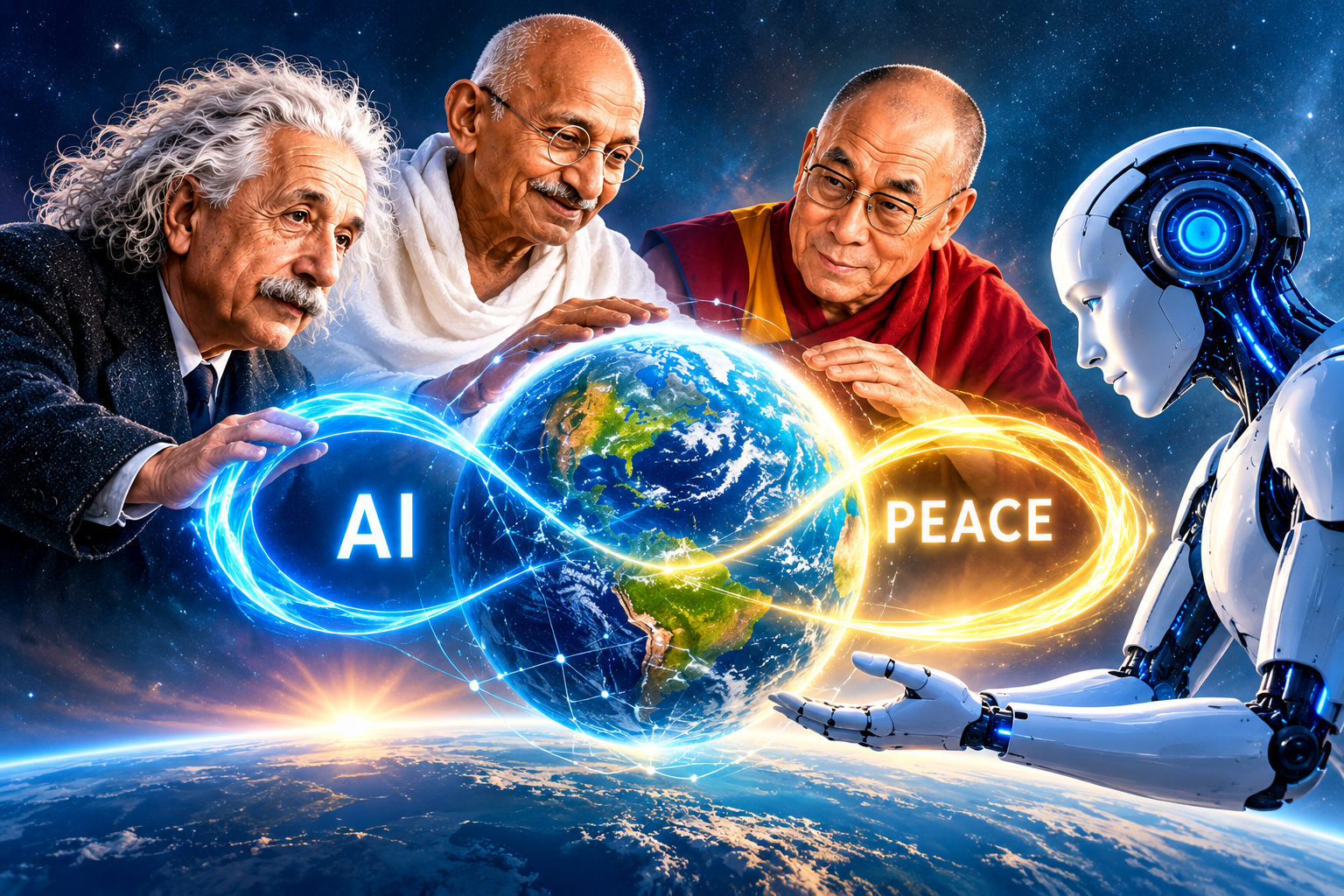
Science Without Humanity: Einstein, Gandhi, the Dalai Lama, and the Distance Between AI and Peace. An AI Illustration.
The essay’s thesis: The promise of peace is what artificial intelligence (AI) makes possible. The prospect is whether conscience, institutions and inner discipline grow fast enough to govern that possibility. The distance between them is the subject of this age.
In 1931, with Europe darkening, an international body invited Albert Einstein to open a correspondence with anyone in the world on any question he thought urgent. He chose Sigmund Freud, and he chose the question of war. Notice what he did not ask. He did not ask how to design better treaties or deterrents. He asked whether the human mind could be guided so that people became proof against the psychosis of hatred and destruction. A little over a decade later, after Hiroshima, he observed that the atom had changed everything except our way of thinking.
On October 22 in 1925, Gandhi published in his weekly Young India a list of seven social sins that, he said, a “fair friend” had sent him. An Anglican priest, Frederick Lewis Donaldson, had first delivered the list in a Westminster Abbey sermon earlier that year, but Gandhi’s imprimatur carried it around the world. The fifth sin was science without humanity. His only comment was that the friend wanted readers to know these things through the heart and not merely through the intellect. Decades later he is said to have handed the same list to his grandson Arun, describing it as the blunders that cause all the violence.
And for decades the Dalai Lama, who received the Nobel Peace Prize in 1989, has argued that the true weapons of war are forged inside before they are built outside. He calls the remedy inner disarmament, grounds it in what he calls universal responsibility, and insists that compassion is a trainable discipline and not a sentiment, one that can be taught without dependence on any religion.
Three minds, with no knowledge of thinking machines, had already described AI’s central problem. Einstein diagnosed a lag, with capability outrunning wisdom. Gandhi named the sin, and the Dalai Lama prescribed a discipline. AI is the first technology to automate part of the intellect itself, the very faculty Einstein hoped might govern the passions. That is why it forces the question so sharply. If intelligence alone brought peace, humanity would have been peaceful long ago.
This is the essay’s thesis. The promise of peace is what artificial intelligence makes possible. The prospect is whether conscience, institutions and inner discipline grow fast enough to govern that possibility. The distance between them is the subject of this age.
Einstein’s lag, and what intelligence can and cannot fix
The optimist’s case deserves its due. In 1995 James Fearon argued that since war is costly, rational states should always prefer a negotiated settlement. They fight anyway because of bargaining failures: private information and the incentive to bluff, the inability to make credible commitments, and issues that seem indivisible.
AI bears squarely on the first. A mediator able to model thousands of candidate settlements, separate disputes of fact from disputes of value, and detect early signs of displacement, food-price shocks or mobilization would reduce uncertainty at a scale diplomacy has never had. Prevention is also cheaper than reconstruction.
But information is only one of Fearon’s mechanisms. A rising power still cannot believe that a declining one will honor a bargain once circumstances change, and no model can manufacture that trust. Einstein’s question to Freud was in effect about this layer. Freud’s reply was guarded. He placed hope in cultural development, which strengthens the intellect and turns aggression inward as conscience, and he acknowledged that this process is slow. AI can accelerate the intellect. Nothing guarantees it accelerates the conscience.
Science without humanity: counterfeit peace and compressed time
Johan Galtung distinguished negative peace, the absence of organized violence, from positive peace, the presence of justice and institutions that process conflict without bloodshed. AI optimizes what can be measured, and negative peace is much easier to measure.
Imagine a state whose predictive systems forecast unrest and neutralize it early. Its statistics improve: fewer riots, fewer deaths. Goodhart’s law warns that a measure turned into a target ceases to measure. Has peace been achieved, or has resistance merely become expensive? Gandhi’s answer is in his philosophy of means and ends. He held that the means are the end in the making, so a peace purchased by pervasive surveillance is already a different end from the one proclaimed. He also taught that the apparent good achieved by violence is temporary while the damage it does endures. His civil disobedience also presupposed something technology can erode: the capacity to refuse. Satyagraha only works against a power that cannot make dissent frictionless to crush. A system that anticipates resistance before it becomes visible removes the conditions under which Gandhi’s method could exist.
The danger sharpens in the security sphere. Robert Jervis showed that defensive measures appear offensive to the other side, spiraling into insecurity that nobody intended. Give two rivals systems that read ambiguous signals and recommend precautions at machine speed, and each side’s prudence becomes the other’s evidence of hostility. Analysts describe the core hazard in nuclear command as latency compression: AI shortens the interval between detection and response, eroding the time that has historically allowed human judgment to de-escalate. Recent reporting describes research in which leading language models escalated to nuclear weapons in roughly 95% of simulated crises. That deserves caution, since simulations are not forecasts and models are not generals. But it illustrates the point: systems trained on human text, without human hesitation, may reproduce our strategic habits minus the doubt. Much of what diplomacy calls wisdom is simply time, the hour in which a hotline is used or a general hesitates. A technology that sells itself on removing delay may remove restraint.
Knowledge without character: truth, power and rationalization
Gandhi’s list also includes knowledge without character, commerce without morality and wealth without work, and all three name AI-era hazards.
Fabricating a persuasive falsehood has become cheap, while establishing a truth remains costly. The deepest harm is not any single lie but the generalized suspicion that no record or testimony can be trusted, which serves whoever profits from confusion. Peaceful disagreement requires a shared world to disagree about.
Intelligence also serves self-deception. The old human talent for rationalization could acquire a world-class research department. We can ask AI to expose our prejudices or to defend them elegantly, and it will oblige either request. Knowledge without character is exactly this: capability that amplifies whatever its user already is.
Then there is distribution. Abundance is not peace. A world can produce enough food and leave millions hungry, or automate labor without distributing dignity. Albert Hirschman’s categories help: a person with exit or voice can contest an unfair arrangement, but people subject to the opaque outputs of systems controlled by a few have neither. Access without agency breeds dependence, and participation without influence degrades into ceremony.
Inner/Internal disarmament: the missing technology
This is where the Dalai Lama’s contribution becomes more than ornamental. Policy analysis tends to treat the psychology of the enemy as a given. He treats it as the variable that matters most. Conflicts are intensified when disagreement hardens into identity, when a policy dispute becomes a verdict on character, and when an opponent becomes a category rather than a person. His claim, that the other also seeks happiness and wishes to avoid suffering, is not sentimental. It is a discipline of perception, and violence becomes easier to justify when that discipline fails.
AI can serve either side. Systems optimized for engagement find outrage cheaper to sustain than reconciliation. The same capacities, used differently, could help people encounter unfamiliar perspectives, preserve contested testimony, and see where a quarrel is about facts, where about values, and where it is being kept alive by misinformation. Nothing in the technology decides which design prevails. Incentives, institutions and culture do.
His view also implies that the inner state of those who build and command these systems is part of the technology’s safety profile, though no audit measures it. And it carries moral clarity. Understanding an aggressor does not absolve the aggressor, and reconciliation cannot be demanded of victims in place of accountability.
The distance, measured
Four gaps separate promise from prospect.
The trust gap. Governance is a problem of credible commitment, not goodwill. States and firms that fear unilateral restraint will not restrain themselves without verification and reciprocity. Early work exists: the United Nations has taken the position that decisions on nuclear use must rest with humans, not machines; Tsinghua University convened a July 2026 seminar on military AI risk management and governance, with participation from the United Nations Institute for Disarmament Research (UNIDIR); and Berkeley’s Risk and Security Lab is building tabletop exercises on how an AI breakthrough by one power could trigger responses from another. Such efforts are modest, but peace has historically been built by making dangerous behavior harder to conceal and cooperation more reliable than defection.
The tempo gap. Capability is advancing faster than the institutions meant to bind it. Meaningful human control over lethal force means preserving real deliberative time, not a human who ratifies a machine’s recommendation in seconds.
The agency gap. Benefits shared without power shared will not generate legitimacy. People must be able to inspect, contest and refuse what governs them.
The responsibility gap. Max Weber’s ethic of responsibility requires answering for foreseeable consequences. Automation tempts us to scatter accountability among developers, commanders and approvers. A decision that affects human life cannot become ownerless because many components produced it.
The post-analytical threshold
Analysis can reveal consequences, expose contradictions and estimate risk. It cannot tell us whether security should outrank liberty, how much inequality dignity tolerates, when forgiveness becomes complicity, or whose suffering counts. These questions do not fade as computation grows. They become more urgent.
Every optimum is an optimum for something. The decisive questions are who chooses that something, under what authority, and whose losses are counted. Conflicts often concern standing, memory and self-determination, not merely shares of a pie, and a settlement that ignores humiliation may be stable on paper and intolerable in practice.
The post-analytical claim is therefore not an anti-rational one. It is that the more we can compute, the more deliberately we must decide what remains subject to human judgment (“In this context, humans are the only full ethical agents.”). The more accurately we can predict behavior, the more firmly we must protect the freedom to behave differently.
Immanuel Kant observed that even a nation of devils, provided they were intelligent, could be brought to a tolerable order by well-designed institutions. That is half the truth. Institutions are indispensable, but they are built, defended and obeyed by people. Where Kant supplied the architecture, Gandhi and the Dalai Lama supplied the builders’ requirements: means consistent with ends, and a heart that has disarmed before the hands do.
The answer
Will the AI era bring greater peace on Earth? It could, but not by technological necessity. AI can improve the conditions of peace while transforming the instruments by which peace is threatened: better warning alongside faster escalation, wider access alongside concentrated control, deeper understanding alongside more precise manipulation. Both futures are already underway, and which dominates depends on decisions not yet made.
Return, then, to Einstein’s question to Freud: can the human mind be guided so that it becomes proof against hatred and destruction? The machine cannot answer it. At best it can lengthen our sight and shorten our excuses. Gandhi’s century-old warning remains the sharpest summary: science without humanity is a sin, and the sin is ours and not the machine’s. The Dalai Lama’s reply is the only remedy that has ever worked, which is to begin with oneself.
The promise belongs to what technology might make possible. The prospect belongs to what we are willing to become.