London based entrepreneur, cybersecurity analyst doing a PhD in AI
Discernment – Reason in the age of AI
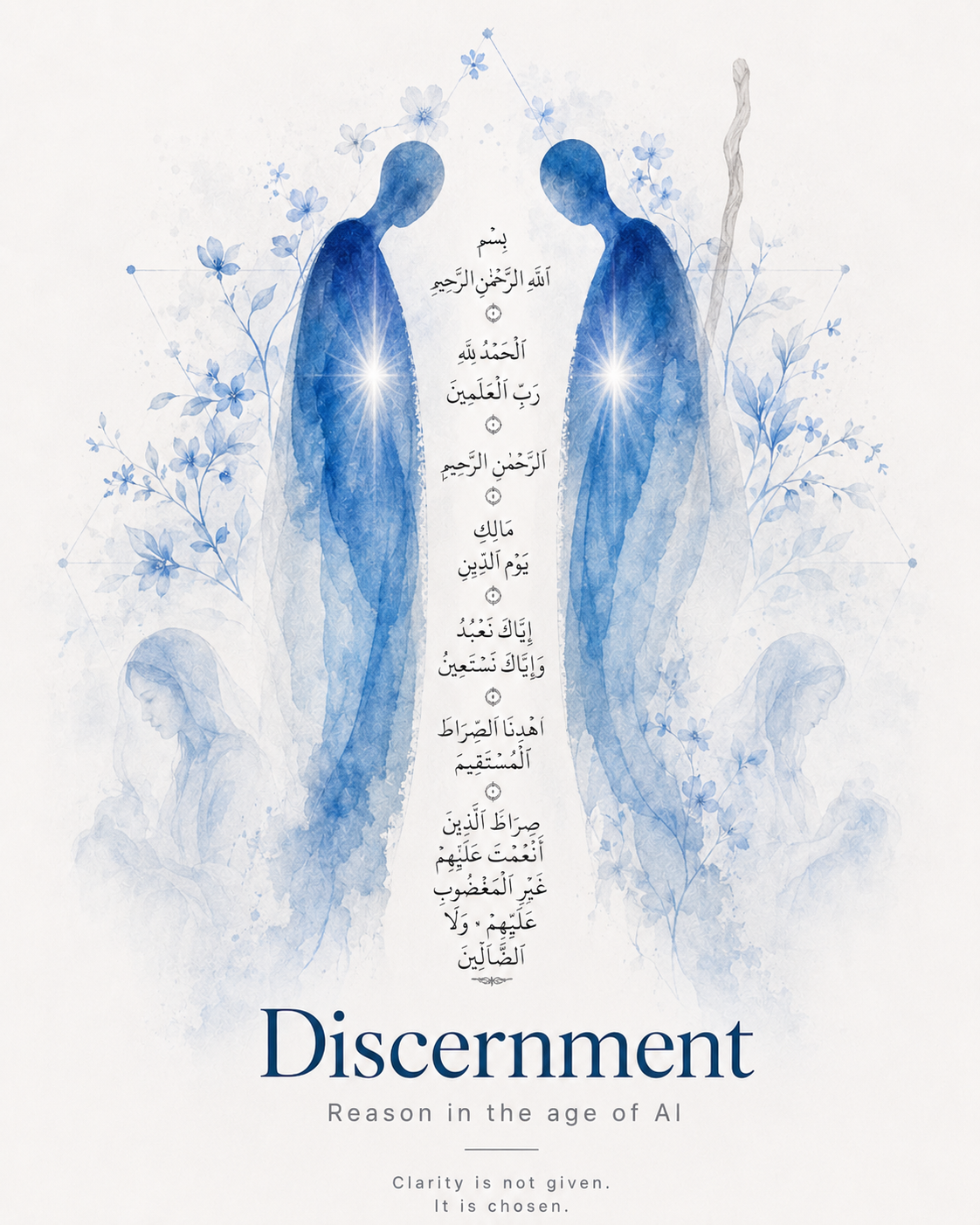
Discernment in the Age of Artificial Reason
What the Torah, the Qur’an and the Prophets Teach Us About AI, Conscience and True Judgement
There is a peculiar confidence in the voice of a machine.
It does not hesitate because it fears it may be wrong. It does not feel embarrassment when its evidence is weak, remorse when its advice causes harm, or anxiety when another person’s life may depend upon its conclusion.
It simply continues.
Sentence follows sentence. Premise follows premise. The language is orderly. The conclusion arrives dressed in the clothing of certainty.
To us, this can feel remarkably like thought.
Artificial intelligence can now search enormous bodies of knowledge, compare arguments, analyze documents, write computer programs, interpret data and construct sophisticated chains of reasoning. Increasingly capable systems can use tools, test possible solutions and even criticize their own answers before responding.
The temptation is obvious.
If the machine can reason, perhaps the machine can judge.
But revelation introduces a distinction that may become increasingly important as artificial intelligence becomes more powerful.
An answer is not the same as guidance.
Intelligence can identify possibilities.
Reason can weigh them.
Evidence can narrow them.
But guidance ultimately belongs to God.
And this is why the defining prayer of the Muslim is not:
Give us more information.
It is:
اهْدِنَا الصِّرَاطَ الْمُسْتَقِيمَ
Ihdinā al-ṣirāṭ al-mustaqīm
“Guide us to the Straight Path”
That single sentence may contain one of the most important principles for living in the age of artificial reason.
Information Is Not Guidance
A Muslim recites Al-Fātiḥah repeatedly throughout every day.
Why continually ask for guidance?
Because possessing information is not the same as knowing what to do with it.
A person can know the law and still behave unjustly.
A merchant can understand arithmetic and still cheat.
A ruler can possess excellent intelligence and still oppress.
A scholar can possess knowledge and still become arrogant.
Human history is not principally a story of people behaving badly because nobody gave them enough data.
We can know and still choose wrongly.
Revelation therefore describes a form of understanding deeper than information processing.
The Quran says :
أَفَلَمْ يَسِيرُوا۟ فِى ٱلْأَرْضِ فَتَكُونَ لَهُمْ قُلُوبٌۭ يَعْقِلُونَ بِهَآ أَوْ ءَاذَانٌۭ يَسْمَعُونَ بِهَا ۖ فَإِنَّهَا لَا تَعْمَى ٱلْأَبْصَـٰرُ وَلَـٰكِن تَعْمَى ٱلْقُلُوبُ ٱلَّتِى فِى ٱلصُّدُورِ ٤٦
Have they not travelled throughout the land so their hearts may reason, and their ears may listen? Indeed, it is not the eyes that are blind, but it is the hearts in the chests that grow blind.
Similarly, the Hebrew Bible says :
“But to this day the LORD has not given you a heart to understand, or eyes to see, or ears to hear.”
Deuteronomy 29:4
The language is striking.
Hearts by which to reason.
In the Qur’anic conception, the qalb, the heart, is not merely the location of emotion. It is connected to understanding, intention, recognition and moral perception.
A human being may therefore possess extraordinary intellectual ability while suffering from a deeper blindness.
This is where artificial intelligence encounters a boundary that computational power alone cannot cross.
AI can define mercy.
It has never shown mercy.
It can analyze repentance.
It has never repented.
It can write about injustice.
It does not fear becoming unjust.
It can describe death.
It does not confront its own mortality.
It can discuss Allah.
It does not worship Allah.
And it can speak eloquently about the heart without possessing a human qalb.
AI can process the language of guidance.
It cannot give guidance.
Guidance is from God.
O Turner of Hearts
يَا مُقَلِّبَ الْقُلُوبِ ثَبِّتْ قَلْبِي عَلَى دِينِكَ
Yā Muqallib al-qulūb, thabbit qalbī ʿalā dīnik.
“O Turner of the hearts, make my heart firm upon Your religion.”
The supplication reflects a profound spiritual truth: the heart is not static. It can turn, soften, harden, perceive, misunderstand, draw near to truth or become veiled from it. For that reason, even the Prophet ﷺ continually asked Allah for steadfastness of heart.
Jāmiʿ al-Tirmidhī, 2140
Consider the humility of this prayer.
The Messenger of Allah ﷺ, the recipient of revelation, asks Allah for steadfastness of the heart.
Knowledge, then, is not enough.
The human being needs a heart capable of receiving knowledge correctly, resisting corruption and remaining oriented towards truth.
This gives us a very different conception of intelligence.
Modern technology asks:
How capable is the system?
Revelation forces us to ask:
Towards what is the heart oriented?
The first is a question of capability.
The second is a question of guidance.
The Adapted Schrödinger Test
This distinction can be illustrated through a thought experiment.
Call it the Adapted Schrödinger Test.
Imagine an artificial intelligence produces an answer to an important question.
Perhaps it concerns medicine, law, religion, warfare, someone’s reputation or the welfare of a child.
Place the answer inside a metaphorical closed box.
It contains citations, statistics, arguments and an impressive conclusion.
But nobody has checked it.
Nobody has opened the cited sources.
Nobody has tested its assumptions.
Nobody has searched for contradictory evidence.
Nobody has asked what information might be missing.
Is the answer correct?
Perhaps.
Is it wrong?
Perhaps.
Is it mostly correct but dangerously incomplete?
Perhaps.
Until somebody opens the box and investigates, until human consciousness inspects the answer, the answer does not have any inherent value in and of itself.
The analogy is not literal quantum physics. Its purpose is to illustrate epistemic responsibility.
Generation is not verification.
But there is a second box.
Suppose we verify the answer and discover that the facts are correct.
We must still ask:
What should we do?
Facts can tell us what is.
They cannot, by themselves, determine what ought to be done.
And here we move from information to judgement, from calculation to conscience, and ultimately from knowledge to the need for guidance.
Revelation Commands Us to Open the Box
The Qur’an establishes precisely this discipline:
“O you who believe, if a wicked person comes to you with news, verify it, lest you harm a people out of ignorance and then become regretful for what you have done.”
Qur’an 49:6
Information must be examined before consequential action.
The Qur’an goes further:
“And do not pursue that of which you have no knowledge. Indeed, the hearing, the sight and the heart, about all those one will be questioned.”
Qur’an 17:36
Again, notice the heart.
And notice what follows it:
Accountability.
The machine can produce information.
The human being remains responsible for acting upon it.
The Torah likewise establishes a culture of evidential restraint:
“At the mouth of two witnesses, or at the mouth of three witnesses, shall the matter be established.”
Deuteronomy 19:15
Serious claims demand corroboration.
A confident assertion is not evidence simply because it sounds authoritative.
That principle is thousands of years old.
Artificial intelligence has made it urgent again.
AI as Adviser, Never Moral Sovereign
None of this requires hostility towards artificial intelligence.
A tool capable of searching libraries, comparing evidence, discovering patterns and testing arguments may become one of the most valuable intellectual instruments humanity has ever created.
Use it.
Let the machine search.
Let it calculate.
Let it compare.
Let it challenge assumptions.
Let it reveal possibilities we had overlooked.
But keep the order correct.
The machine may propose. The human must judge.
The machine may identify a medical pattern. The physician remains responsible for the patient.
The machine may construct a legal argument. The judge remains responsible for justice.
The machine may identify a security risk. Human authorities remain responsible for acting lawfully, proportionately and humanely.
The machine may discuss scripture. It must never be mistaken for revelation or legitimate religious authority.
AI can reproduce the language of taqwa without possessing taqwa.
It can explain rahmah without possessing mercy.
It can discuss fitrah without having been created upon human fitrah.
It can describe guidance.
Finality of revelation and the importance of turning towards the heart.
The Qur’an confirms the truth contained in earlier revelation, stands as a criterion over it, and supersedes and abrogates the laws of previous dispensations.
In an age increasingly shaped by “Artificial Intelligence,” we must therefore remember that information is not the same as guidance: we must turn to hearts made receptive to truth, and above all to the guidance of God, if we are to discern what is right, what is true, and how we ought to live.
Discernment will not come from Artificial Intelligence, and looking at it for discernment is a “false messiah” we must be cautious of. As AI percolates more and more of our lives, and problems like “mental health issues” caused by AI, “cognitive offloading” and other problems surface – the “human in the loop” is critical. However, the human itself will need to “establish prayer”, “keep a clean heart”, and be guided by their “moral conscience” to be able to effectively harness the opportunities AI presents and navigate the risks.
“Moral restraint”
إِنَّ الصَّلَاةَ تَنْهَىٰ عَنِ الْفَحْشَاءِ وَالْمُنكَرِ
“Indeed, prayer restrains from shameful and wrongful deeds.”
Qur’an 29:45
“Keep a clean heart”
يَوْمَ لَا يَنفَعُ مَالٌ وَلَا بَنُونَ إِلَّا مَنْ أَتَى اللَّهَ بِقَلْبٍ سَلِيمٍ
“The Day when neither wealth nor children will benefit, except one who comes to Allah with a sound heart.”
Qur’an 26:88–89
Related Topics
Related Posts