An Iranian voice in exile
Dismantling the Islamic Republic Requires More Than Force — It Requires a Plan
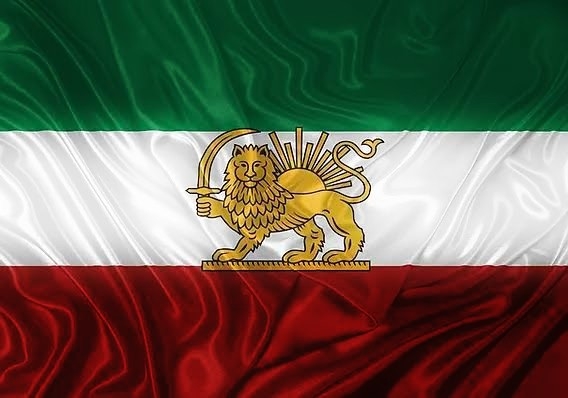
The Lion and Sun flag — a symbol adopted by many Iranians opposing the Islamic Republic — represents an alternative vision for the country's future.(AI-generated image)
The military campaign against the Islamic Republic has degraded its conventional capabilities. Over 8,000 targets struck. A navy eliminated. The ayatollah and scores of senior military, intelligence, and security commanders killed — many through precision operations attributed to Israel’s Aman intelligence directorate. Yet the regime’s structural core and its hard nucleus of power remain standing, and it now sits at a negotiating table it should never have been offered.
The Islamic Republic functions as an operation, not a state; it must be dismantled, not managed. The Principle of Simultaneity — the convergence of external and internal pressure — is a necessary condition for regime collapse. This article examines what that principle requires in practice: the political infrastructure needed to ensure that dismantlement produces stability rather than chaos — a matter of direct consequence not only for Iran, but for regional security and the global economy.
The dismantlement of the Islamic Republic is a project of extraordinary complexity, requiring precise and concentrated action across military, financial, diplomatic, intelligence, and informational domains simultaneously. This analysis examines one fundamental dimension among many: the political conditions required to prevent a post-regime power vacuum from destabilizing the region.
Why Simultaneity Is Necessary but Not Sufficient
External military pressure without coordinated internal action produces degradation, not collapse. This has been established. But the concept requires further elaboration to be operationally actionable in the current environment.
Even when external and internal forces converge, the outcome depends on the balance of power at the moment of convergence. Three elements determine whether simultaneous pressure produces regime change or civil war: the legitimacy deficit of the existing order, the existence of a coherent alternative vision, and the organizational capacity to execute a transition. In the absence of any one of these, even overwhelming force produces instability rather than transformation. Iraq after 2003 demonstrated this with devastating clarity: the regime fell, but no credible alternative existed to fill the vacuum. The result was not liberation but a decade of sectarian warfare.
The situation inside Iran underscores the urgency. Field observations indicate an intensifying security crackdown: daily executions of protesters, mass arrests, raids on private homes, and threats of property confiscation. The regime senses the danger and is deploying its full coercive capacity to control the internal space through systematic intimidation. Without external support, any internal uprising under current conditions will be met with massive and bloody suppression — as January demonstrated with over 30,000 killed.
Iran today faces the same structural risk as post-Saddam Iraq. The regime’s legitimacy has been shattered — the January massacres, the economic collapse, and the war have ensured that. But legitimacy deficit alone does not produce orderly transition. It produces a power vacuum. And a power vacuum in a country of 88 million people, with ethnic fault lines, armed factions, and 440 kilograms of unaccounted-for nuclear material, is not a theoretical concern. It is a direct threat to regional stability and the global economic order.
The Opposition Landscape: Fragmented by Design
Iran’s opposition exists in multiple forms, none of which currently possesses the combination of popular legitimacy, organizational capacity, and strategic coherence required to govern a post-regime Iran.
The landscape can be broadly categorized. Inside Iran, the population has demonstrated extraordinary courage — millions took to the streets in January 2026, knowing the cost. But the internal opposition lacks arms, coordination infrastructure, and organized leadership. The regime’s 47-year project of social engineering has systematically dismantled the institutional foundations of civil society, leaving a population that is willing but structurally unable to execute a transition independently.
Outside Iran, the diaspora opposition is fragmented along ideological, personal, and generational lines. Republican factions, leftist groups, monarchists, ethnic movements, and religious organizations each maintain separate structures, separate media platforms, and separate visions for Iran’s future. The pattern is consistent: at moments of maximum opportunity, these groups turn their energy not against the regime but against each other — particularly against the most visible alternative.
The question is whether this fragmentation is organic or engineered. The answer is both. Iranian political culture carries historical patterns of factionalism and elite rivalry that predate the Islamic Republic. But the regime has deliberately amplified and exploited these patterns through systematic intelligence penetration of opposition groups, disinformation campaigns designed to discredit emerging leaders, and the cultivation of proxy voices — particularly within leftist and “anti-imperialist” circles — whose function is to delegitimize any collaboration with Western powers and to frame resistance to the regime as betrayal of national sovereignty.
These proxy narratives — “we believe in civil movements, not war,” “resistance to global imperialism,” “no to foreign intervention” — serve a specific operational function: they create psychological barriers that prevent the opposition from coalescing around actionable strategies. They manufacture shame and taboo around the very alliances that could enable regime change. And they ensure that the political space remains fragmented enough for the regime to survive.
The Pahlavi Factor: The Only Viable Transition Vehicle
Among the existing opposition structures, the coalition led by Crown Prince Reza Pahlavi represents the most operationally viable vehicle for transition — not because monarchy is the ideal endpoint, but because it is the only option that currently satisfies the minimum requirements for a credible alternative.
First, cultural and historical resonance. The monarchical tradition is embedded in Iranian national identity across 2,500 years. The January 2026 uprising reached its peak following Pahlavi’s public call to action — his name was chanted in streets across all 31 provinces. No other opposition figure commands this level of spontaneous popular recognition.
Second, institutional preparation. The Iran Prosperity Project, developed by the National Union for Democracy in Iran under Pahlavi’s direction, provides the most detailed post-regime governance framework currently available. It proposes a 180-day emergency phase with transitional legislative, executive, and judicial institutions, followed by a national referendum on the future system of government — constitutional monarchy or republic — to be decided by the Iranian people through free elections. Pahlavi has explicitly stated that he views his role as “a bridge, rather than the destination” and that democratic elections will determine Iran’s permanent political structure.
Third, international credibility. Pahlavi was selected by a coalition of liberal and nationalist parties at the Munich Convergence Summit in February 2025 to lead a transitional government. He has engaged with Western policymakers, presented at the Munich Security Conference, and established communication channels with — by his own account — over 50,000 potential defectors within the regime’s bureaucracy and military.
This does not mean the Pahlavi option is without criticism. Some analysts have raised concerns about the concentration of transitional authority. And Trump himself has expressed skepticism, suggesting that “somebody from within, maybe, would be more appropriate.” These concerns deserve scrutiny. But in the current landscape, no alternative possesses the same combination of popular recognition, institutional readiness, and strategic positioning.
The operative question is not whether Pahlavi is perfect. It is whether he is functional. And in a crisis where the alternative to an imperfect transition is no transition at all — the answer matters.
The Civil War Scenario: Not Hypothetical
Without a credible transitional authority, the collapse of the Islamic Republic does not produce freedom. It produces fragmentation.
Ambassador Robert Ford, who served during civil wars in Algeria, Iraq, and Syria, has warned that the lesson from these cases is consistent: “with loyal security forces, a fierce but brittle regime can hang on for a long time in the absence of a unified, national opposition inside the country enjoying outside help.” And when such regimes do fall without a prepared alternative, the result is not democracy but prolonged conflict.
Brookings Institution analysts have noted that massacres can produce three outcomes: they crush the movement (Tiananmen), they transform it into civil war (Syria 2011), or they galvanize it into revolution (Iran 1978). The determining factor is not the scale of violence but the existence of organized alternatives.
Iranian analyst Ahmad Naghibzadeh stated the risk plainly: “If the international community were to opt for the fragmentation of Iran, or for the emergence of civil war and chaos, it would be deeply frightening and alarming.”
It must be noted that the Islamic Republic itself has prepared the ground for this scenario. Its deliberate cultivation of ethnic tensions, its suppression of unifying national institutions, and its systematic destruction of civil society have created precisely the conditions in which post-regime fragmentation becomes most likely. The scorched earth strategy extends beyond the military domain — it includes ensuring that whatever replaces the regime inherits a fractured society incapable of self-governance.
This is why a prepared alternative is not a luxury. It is a strategic necessity.
What Western Governments Must Do
The international community — particularly the United States and Israel — faces a choice that will determine the trajectory of the Middle East for decades. The military campaign has created an opening. The ceasefire has not closed it. But without deliberate political action, the opening will produce not transformation but disorder.
To prevent Iran from becoming the next Syria, Afghanistan, or Iraq, Western governments must act on several fronts simultaneously.
Identify and develop viable political alternatives. This means moving beyond rhetorical support for “the Iranian people” and engaging concretely with opposition structures that demonstrate organizational capacity, popular legitimacy, and a credible governance plan. The Pahlavi coalition currently meets these criteria more fully than any alternative — not as an endorsement of monarchy, but as a recognition of operational reality.
Provide protective, tactical, and intelligence support to opposition networks — both inside Iran and in the diaspora — while establishing robust counterintelligence measures to prevent regime penetration and sabotage of these networks.
Coordinate internal pressure with strategic timing. The Principle of Simultaneity requires that internal action be synchronized with external pressure. This does not happen spontaneously. It requires communication infrastructure, secure channels, and coordination mechanisms that only state-level actors can provide.
Neutralize subversive narratives. The regime’s information warfare — conducted through proxy media, diaspora networks, and ideological fellow-travelers — must be identified and countered. Groups that systematically delegitimize opposition unity, frame collaboration with democratic allies as treason, or promote paralysis under the banner of “civil resistance only” are functioning — whether knowingly or not — as force multipliers for the regime’s survival.
Maintain maximum economic pressure. Any relaxation of sanctions — including the potential easing of restrictions on Chinese oil purchases — provides the regime with the financial oxygen it needs to rebuild. As the JCPOA era demonstrated, every dollar that enters the regime’s coffers funds the IRGC, not the Iranian people.
Conclusion
Dismantling the Islamic Republic requires more than force. Force can degrade the regime’s military capacity. Force can eliminate its leaders. Force can create the conditions for change. But force alone cannot determine what comes next.
What comes next depends on whether a credible alternative exists — an alternative with sufficient legitimacy to unite a fractured society, sufficient organization to prevent chaos, and sufficient strategic clarity to execute a transition under extreme pressure.
The stakes extend far beyond Iran’s borders. An unstable, fragmented Iran — with unmonitored nuclear material, armed factions competing for control, and 88 million people in a country that borders Iraq, Afghanistan, Pakistan, Turkey, and the Persian Gulf — would destabilize the entire region. The Strait of Hormuz, through which one-fifth of the world’s oil supply passes, would remain contested. Refugee flows would dwarf those of the Syrian crisis. And the vacuum would be exploited by every actor — from ISIS remnants to rival state powers — seeking to advance their interests in the wreckage.
Today, a credible alternative is imperfect but identifiable. The window to develop, support, and position it is open — but it will not remain open indefinitely. Every week of ceasefire without political preparation is a week the regime uses to regroup, the opposition fragments further, and the risk of post-collapse chaos increases.
The Islamic Republic engineered a nation for 47 years. Reversing that engineering requires not just the removal of the regime, but the deliberate construction of what replaces it. That construction must begin now — not for Iran’s sake alone, but because the security of the Middle East and the stability of the global economy depend on it.
Related Topics
Related Posts