NAnews - Nikk.Agency Israel News
‘Do Not Forget the Sword’: Petliura, Ukraine and Israel
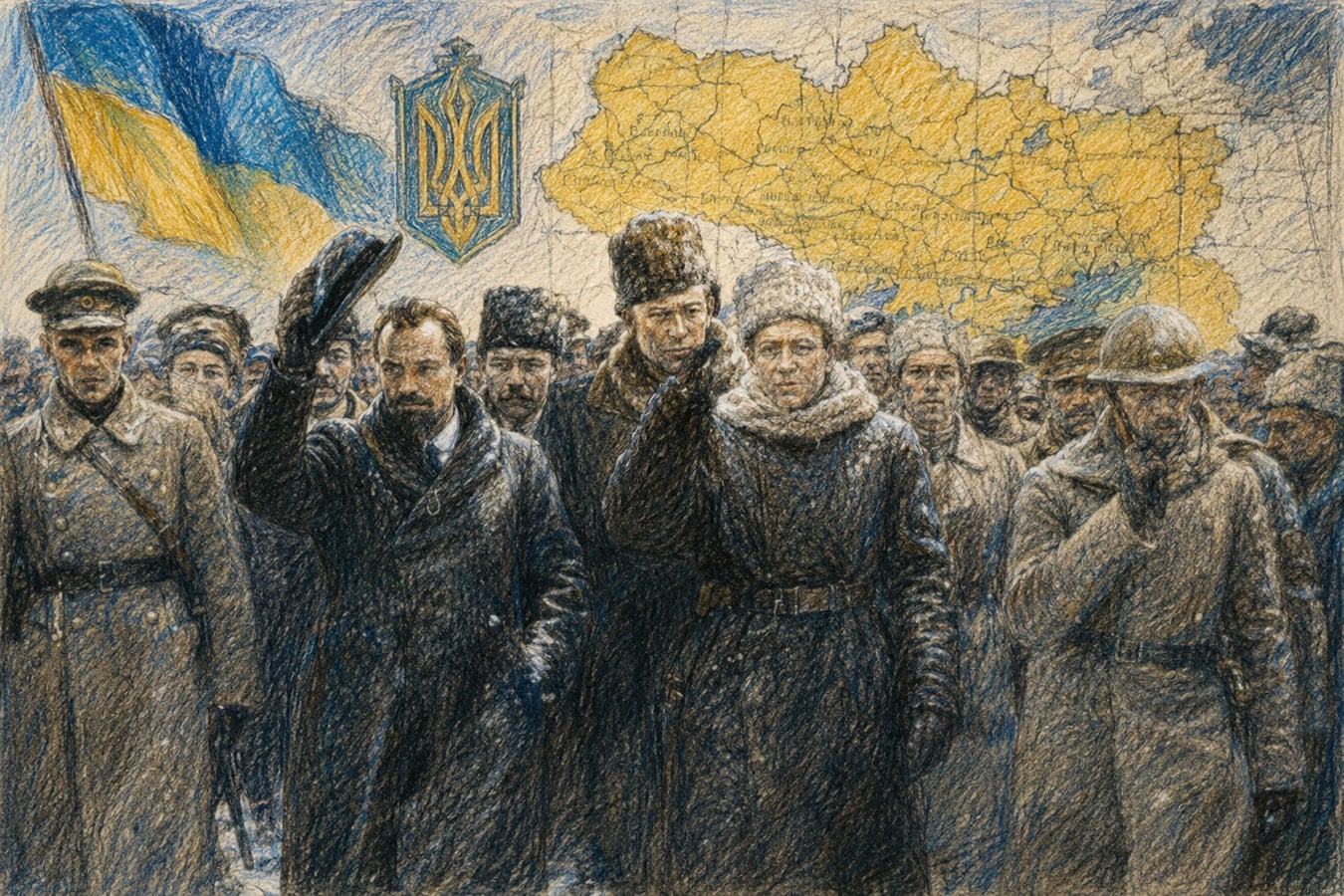
'Do Not Forget the Sword': Why Symon Petliura Matters to Ukraine — and Why Israel Should Read This History Carefully. The image was created using AI.
On May 25, 1926, Symon Petliura was assassinated in Paris by Samuil Schwartzbard.
Symon Petliura remains one of the most complex figures in Ukrainian history. For Ukraine, he symbolizes statehood, armed resistance and the struggle against Moscow. For Israel, his name opens a painful conversation about Jewish pogroms, Sholem Schwarzbard, Soviet propaganda and historical responsibility.
Symon Petliura was killed almost a century ago, yet his name has returned to Ukraine’s public conversation not as a distant historical reference, but as a living question of war, statehood and survival.
Ukraine is again fighting Moscow.
Again, it is being forced to prove that it is not a borderland, not a buffer zone, not a temporary political accident, and not a province of someone else’s empire. It is a nation with its own army, language, memory, diplomacy and right to exist.
That is why Petliura’s phrase, “Do not forget the sword,” sounds different today.
It no longer feels like an old political metaphor. It sounds like a warning.
For many Ukrainians, Petliura is associated with the Ukrainian People’s Republic, the struggle for independence after the collapse of the Russian Empire, the army, exile and the unfinished fight against Moscow. He was Chairman of the Directory of the Ukrainian People’s Republic and Chief Otaman of its forces. He belonged to a generation that tried to build a Ukrainian state when empires were falling and armies were moving across Eastern Europe like storms.
But for Israel, this history cannot be told only through the Ukrainian lens.
Here, Petliura’s name immediately opens another, much more painful layer: Jewish pogroms, Sholem Schwarzbard, Paris, the 1927 trial, Soviet propaganda, and the still unresolved question of where personal guilt ends and political responsibility begins.
That is why this story cannot be reduced to a slogan.
Petliura should not be turned into a saint.
But he also should not be left inside the flat Soviet caricature that tried to make Ukrainian independence itself look morally criminal.
The truth is harder.
And that is exactly why it matters.
Ukraine, Petliura and the meaning of the sword
The Ukrainian People’s Republic did not survive.
That is the brutal fact.
But it did something no empire could erase: it proved that Ukraine existed as a political nation. Not as folklore. Not as a regional color inside Russia. Not as a peasant dialect with songs and embroidery, but as a state project with a government, army, diplomacy, institutions and a claim to international recognition.
Petliura became one of the faces of that attempt.
He was not a flawless leader. No serious historian should pretend otherwise. Around his name there are defeats, tragedies, arguments, compromises and wounds that remain open.
Yet in one sense he was strikingly modern: he understood that independence cannot be defended by declarations alone.
Paper does not stop an army.
Diplomatic language does not shoot down missiles.
Foreign sympathy does not replace the ability to hold the front.
Ukraine learned this again after February 24, 2022. When Russian troops moved toward Kyiv, Kharkiv, Chernihiv, Sumy and southern Ukraine, everything depended not on abstract formulas but on people with weapons, command structures, logistics, drones, artillery, air defense and the will of society not to surrender.
Petliura spoke about the sword in another century.
But the meaning survived.
A state that wants to live must be able to defend itself.
Israel understands this logic
An Israeli reader does not need a long lecture to understand why force can become not a choice, but a condition of existence.
Israel was built on the understanding that a people threatened with destruction cannot place its survival entirely in the hands of others. Diplomacy matters. Alliances matter. International law matters.
But when a state has no power of its own, other people begin discussing whether it has the right to live.
Ukraine is now in precisely that position.
Putin’s Russia is not merely disputing borders. It is trying to prove that Ukraine has no right to exist separately from Moscow — not as a civilization, not as a political community, not as a memory, not as a future.
In this sense, Petliura’s “sword” is not a romantic cult of war.
It is the language of survival.
And Israel knows that language.
Why Moscow has always feared Ukrainian subjectivity
Petliura was dangerous to Moscow not only as a military leader.
He was dangerous as a symbol.
He reminded Russia that Ukrainian independence did not suddenly appear in 1991. It was not a “gift” from the collapse of the Soviet Union, and it was not a “Western project,” as Russian propaganda claims today.
There were predecessors.
There was the Central Rada. There was the Ukrainian People’s Republic. There was the Directory. There was an army. There was diplomacy. There was exile. There was memory. There were people who lost the war but did not allow the idea to disappear.
This is why Russia attacks Ukrainian history so aggressively.
It is not enough for Moscow to occupy territory. It must also prove that Ukraine was never real.
Petliura breaks that scheme.
He shows a long line of Ukrainian resistance: from the Ukrainian People’s Republic to modern Ukraine, from Petliura’s army to the Armed Forces of Ukraine, from the struggle to hold Kyiv in 1919 to the defense of Kyiv in 2022.
This is no longer just history.
It is memory as a political weapon.
The Israeli knot: Petliura, Schwarzbard and Jewish pain
And now we reach the hardest part.
If this article were written only for a Ukrainian audience, it could focus on the Ukrainian People’s Republic, the army, exile, the struggle against Bolshevism, the European choice and the long confrontation with Moscow.
For an Israeli audience, that would not be enough.
Because in Jewish memory, Petliura’s name is connected not only with Ukrainian statehood. It is connected with pogroms.
This cannot be pushed aside.
The anti-Jewish pogroms in Ukraine during the revolutionary years and civil war were a real catastrophe. People were murdered. Communities were destroyed. Families fled, hid, lost relatives, carried trauma into emigration, Europe, Palestine and later Israel.
For many Jews, this was not an abstract “complex period.” It was a family wound.
So an honest conversation must begin with recognition: the pain was real.
It was not a Soviet invention.
It was not propaganda.
It was real Jewish suffering.
But recognizing the pogroms does not mean accepting the Soviet caricature of the entire Ukrainian struggle for independence.
That is where the complexity begins.
Paris, 1926: the shots that became a trial of history
On May 25, 1926, Symon Petliura was assassinated in Paris by Sholem Schwarzbard.
For Schwarzbard, it was revenge. He believed Petliura was responsible for the massacre of Jews during the pogroms in Ukraine. The French trial that followed quickly became more than a murder case. It became a public argument about responsibility, memory and Jewish suffering.
Formally, Schwarzbard was on trial.
But in reality, Petliura was being judged.
His authority. His army. His responsibility. His ability — or inability — to stop violence.
For Ukrainians, it was the assassination of an exiled national leader.
For many Jews, it was an act of vengeance.
For Moscow, it was a political gift.
At that point, Ukrainian and Jewish memory collided head-on.
Was Petliura the organizer of pogroms?
This question must be handled with care.
The historically honest formula is this: the pogroms happened. Their scale was terrible. But Petliura’s personal role is much more complicated than the Soviet formula “Petliura the pogromist.”
There is no convincing historical picture in which Petliura appears as the organizer of a state policy aimed at murdering Jews.
Many Ukrainian and Western historians emphasize that he did not issue orders to carry out pogroms. On the contrary, documents and statements attributed to the leadership of the Ukrainian People’s Republic show condemnation of anti-Jewish violence and calls to punish those responsible.
But that does not close the matter.
A leader is responsible not only for his words. He is responsible for the army he commands, for discipline, for whether the state he leads is able to protect vulnerable people under its authority.
And here history offers no comfortable answer.
Petliura may not have been the organizer of pogroms.
But his state failed to protect Jewish communities.
These two sentences must stand together.
Only then does the conversation become honest.
The Ukrainian People’s Republic and the Jewish question
The Ukrainian People’s Republic was not conceived as an antisemitic project. This is an important fact that is often lost in black-and-white polemics.
The Ukrainian revolutionary movement included the idea of rights for national minorities. Jews were offered forms of representation. The concept of national-personal autonomy was discussed. Institutions dealing with Jewish affairs existed within the framework of the Ukrainian state-building project.
In other words, at the level of political idea, the Ukrainian People’s Republic tried to build not a closed ethnic state, but a model in which different peoples of the former empire could have rights.
And then came the tragedy.
On paper — rights.
On the ground — pogroms.
This is often how a weak state looks during imperial collapse. It proclaims principles but does not control all territory. It demands discipline, but parts of its army act according to their own logic. It speaks of protecting citizens, while local otamans, gangs, Red forces, White forces, rumor, fear and revenge move through towns and villages faster than law.
This is not an excuse.
It is an explanation of complexity.
For Israel, that distinction matters. It allows us to avoid the primitive formula “Ukrainian independence equals antisemitism,” while also refusing to erase Jewish suffering for the sake of a clean national legend.
Jabotinsky as an unexpected bridge
There is another figure in this story who matters deeply for Israeli readers: Ze’ev Jabotinsky.
He was not a marginal observer. He was one of the central thinkers of Zionism, and his legacy still shapes Israeli political tradition.
Jabotinsky looked at the Petliura question in a more complex way than many might expect. He did not reduce Petliura to the image of a conscious pogromist. He tried to distinguish personal antisemitism from the chaos of events, war, state collapse and mass violence that can emerge not from one order, but from the breakdown of an entire world.
That was not simple justification.
Jabotinsky understood Jewish vulnerability very well. In fact, the idea of Jewish self-defense was central to his worldview. He knew that when a people has no strength of its own, its security depends on the mood of others.
Here an almost painful parallel appears.
Petliura told Ukrainians: do not forget the sword.
Jabotinsky told Jews: do not rely only on someone else’s protection.
Different peoples. Different tragedies. One conclusion: without power, a nation becomes the object of other people’s politics.
How Soviet propaganda used Jewish pain against Ukraine
The most dangerous mistake would be to allow Moscow to steal both memories at once.
For decades, Soviet propaganda used the subject of pogroms to present the Ukrainian national movement as inherently criminal. This was politically useful. If Ukrainian independence could be associated only with antisemitism, then the very idea of Ukrainian statehood would appear morally suspect.
But Moscow was never an honest guardian of Jewish memory.
The Soviet system itself destroyed Jewish culture, persecuted Zionism, waged campaigns against “cosmopolitans,” suppressed the Jewish specificity of the Holocaust and used antisemitic motives when convenient.
So the question is not whether pogroms happened. They did.
The question is who later turned this tragedy into a weapon against Ukrainian statehood — and why.
For Israel, this matters profoundly. Jewish memory must not become a tool in the hands of an empire that today bombs cities, deports children, erases Ukrainian identity and justifies war in the language of “historical mission.”
Why Petliura matters now
Petliura is returning to Ukrainian public discussion not because Ukraine is looking for a comfortable hero.
Quite the opposite.
Ukraine needs not comfortable heroes, but difficult lessons.
The first lesson is the army. A state without an army becomes a request. Ukraine paid too high a price for this in the twentieth century — and is paying again in the twenty-first.
The second lesson is alliances. Petliura searched for external support, entered painful partnerships and made compromises that remain controversial. Modern Ukraine also depends on partners, but it has learned something crucial: allies help those who resist.
The third lesson is memory. If a nation does not explain its own history, its enemy will explain it instead.
And the enemy will explain it in a way that leaves that nation with no right to the future.
That is why NAnews – Nikk.Agency Israel News sees the Petliura question not as an attempt to replace Jewish pain with a Ukrainian heroic myth, but as a demand to see the whole picture: the Ukrainian struggle for statehood, the tragedy of Jewish communities, Soviet manipulation of memory and Russia’s present war against Ukraine.
Ukraine in 2026 is not the Ukraine of 1919
There is another point that Israeli readers should keep in mind.
Modern Ukraine is not the Ukraine of the civil war.
It is a democratic state in which Volodymyr Zelensky, a Jew, was elected president. It is a country where Jewish communities are part of public life, the army, volunteer networks, business, culture and diplomacy. It is a country where the memory of Babyn Yar, the Holocaust, Ukrainian-Jewish relations and Russian aggression has become part of a difficult but real public conversation.
That is why Russia’s attempt to describe modern Ukraine through old antisemitic clichés is so cynical.
Putin’s Russia destroys Ukrainian cities, kills civilians, attacks energy infrastructure, deports children, bombs homes, schools, hospitals and museums.
Then it tells the world it is fighting “fascism.”
For Israel, this should sound familiar and alarming.
When an aggressor hides behind the memory of victims, one must look not at his slogans, but at his actions.
Petliura between the Ukrainian sword and Jewish pain
Petliura remains a difficult figure.
Perhaps that is why he matters.
He cannot be turned into a spotless icon.
But he also cannot be left inside a Soviet caricature in which the entire Ukrainian struggle for independence is reduced to one accusation.
His history demands two kinds of honesty at once.
Honesty toward Jewish pain.
Honesty toward the Ukrainian fight for freedom.
For Ukraine, he matters as a man who understood the price of an army, independence and separation from Moscow. For Israel, he matters as a figure through whom one can discuss pogroms, Schwarzbard, political responsibility, Soviet propaganda and the painful memory of two peoples.
This is not an easy conversation.
But during war, easy conversations are often the least useful.
Russia is again trying to steal the past in order to justify the present. That makes historical clarity not a luxury, but part of resistance.
“Do not forget the sword” today should not be read as a call to violence. It should be read as a lesson for nations that know the price of helplessness.
Freedom needs strength.
Memory needs honesty.
And the history of Ukraine and Israel requires not convenient myths, but the courage to see tragedy and struggle at the same time.
Related Topics
Related Posts