
Teaching the Holocaust through stories of Jewish Resilience
Do the voices of the Nazis have a place in Holocaust education?
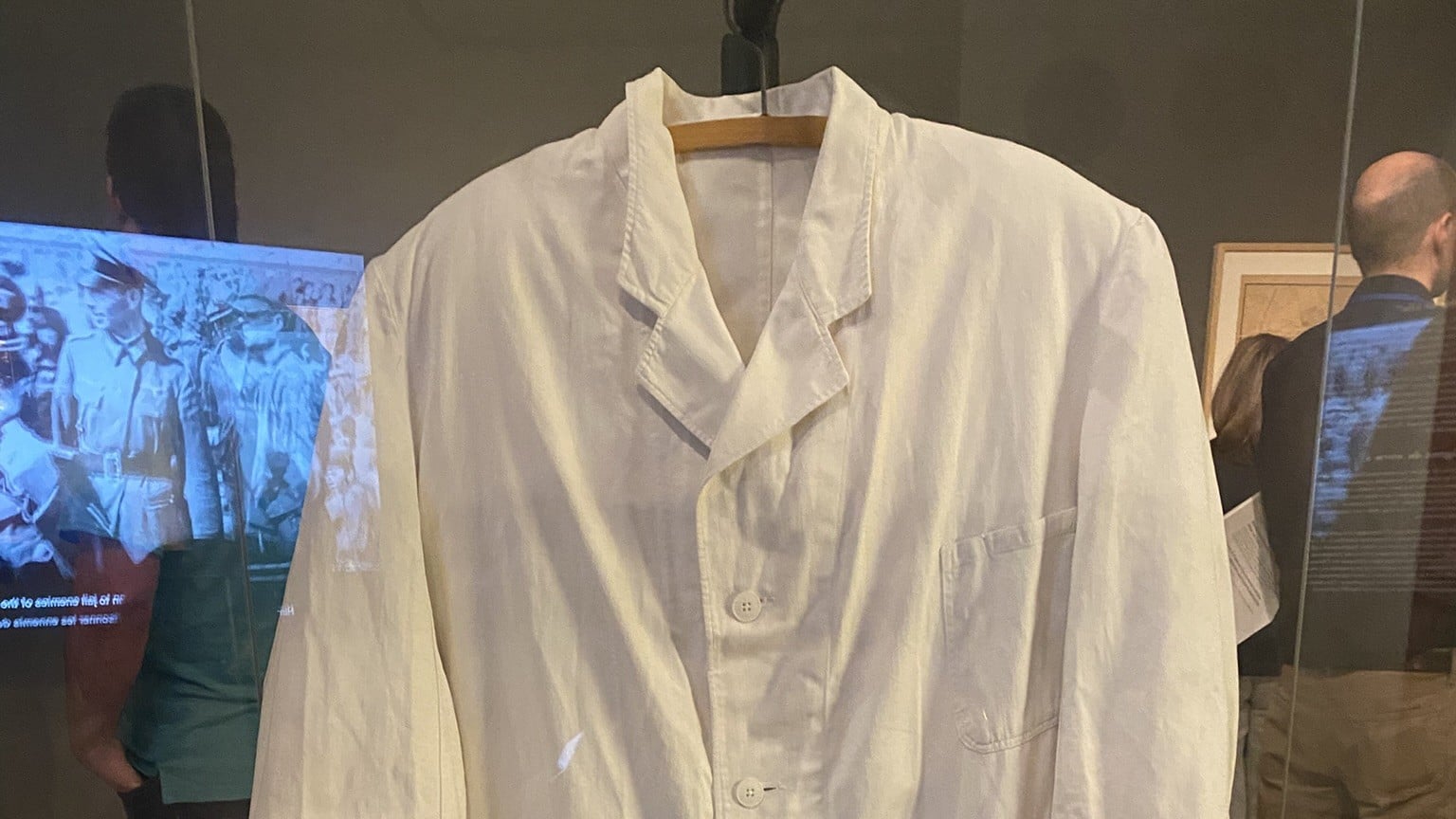
The lab coat of a doctor who murdered disabled people during the Holocaust seen at the Auschwitz exhibit (source: Lynne Feldman)
The words of the Nazis show us how ordinary people can become psychopathic killers. Can we use this evidence to teach about the perpetrators of the Holocaust without legitimizing their beliefs?
Holocaust exhibits often tell the story of the Holocaust through artifacts that highlight the individuality of the victims: a fancy red shoe found among the piles of practical shoes in Auschwitz; a Roma scarf traded to a Jewish inmate for a piece of bread; a Jewish veteran’s Iron Cross medal.
Through these items, we connect to the Jewish story of survivors and victims, of struggling to hold onto your humanity, of inner strength and overwhelming loss.
A different aspect of the story emerges when we focus on a different set of artifacts: the lab coat worn by one of the doctors who murdered disabled people; a pair of SS jackboots; a report describing how to build a killing pit.
These artifacts mirror the first story. They present the story not of those who experienced the Holocaust but of those who perpetrated it.
Focusing on the second set of artifacts reminds us that, like the victims, the perpetrators were individuals. The things that were done by the people who wore these items rise before us as we contemplate them. What terror followed the sight of this lab coat, the sound of these boots? Who were these people who could do such things?
Breaking the Ranks
For the past 30 years or so, Holocaust educators have made an effort to move beyond presenting the Jews as a massed, faceless herd of victims. We seek to “rescue the individuals out of the piles of bodies.” We give names and stories to those who died and to those who lived with the scars of their experiences.
Now, we are beginning to move beyond presenting the Nazis as a massed, faceless horde of perpetrators. We are breaking the ranks of soldiers and collaborators, giving names and voices to the individual people who did this. This trend is effectively portrayed in recent productions: Here There Are Blueberries, The Devil’s Confession, Zone of Interest, The Commandant’s Shadow.[1] The artifacts described above are part of the traveling exhibit Auschwitz: Not Long Ago, Not Far Away[2], where I exited early, overcome by the emotional weight of the story told by the Nazi artifacts.
Recognizing the individuality of the perpetrators is emotionally hard. It is much easier to think of “Nazi soldiers” or even “perpetrators.” Contemplating the person who wore those army boots or that medical lab coat is more difficult. Then we have to acknowledge that these were ordinary people, not faceless monsters, even as they engaged in monstrous acts.
Guardrails and Guidelines
I recognize the power of this approach. Simultaneously, I recognize the peril – especially in this bizarre time of Nazi appreciation. How do we portray Nazis as individuals without creating sympathy for them? How do we present the memoirs of villains without glorifying what they did? How do we display Nazi artifacts without legitimizing Nazi memorabilia?
As we approach this third rail of Holocaust education, what guardrails do we need to put into place to ensure that we are not undermining our mission? What guidelines can we outline that will help us get our message across?
Here are some guidelines that we are considering as we approach this effort.
Do not separate the person from their crimes. Do not tell stories about Nazi soldiers’ lives because stories often create sympathy. Instead, use their own words, letters, reports, and admissions of guilt without regret. They left us an archive of atrocity. We can use those records to show the world who they were. We do not want to humanize their inhuman behavior. Instead, we want to show the widespread cruelty embraced by individual soldiers and local collaborators.
Do not give voice to antisemitism, lies, or Nazi ideology. Avoid repeating falsehoods, even to deny them, because the lie is reinforced through repetition. People often remember the falsehood and not the rebuttal.
The presentation of these lies in the texts can be subtle. Here’s a quote from a police official from the Krakow District of the General Government:
Members of the Grenzpolizeikommissariat were, with few exceptions, quite happy to take part in shootings of the Jews. They had a ball! … There was great hatred against the Jews; it was revenge, and they wanted money and gold.
[emphasis mine] (from The Good Old Days)[3]
The first part of this quote gives us exactly what we are seeking – the admission of guilt without regret. The final bolded line, however, reinforces antisemitic lies and, thus, should not be used. “It was revenge” is the Nazi lie that the Jews had done something to deserve this, done something that merited revenge. “They wanted money and gold” is the antisemitic lie that all Jews are rich. We can read the first part of this quote, but we should not give voice to the lies. In fact, it is with some trepidation that I include it even here.
Be aware of your audience. There are places where antisemitic tropes and Nazi ideology are still common (See When you meet a Nazi at a gas station). Bringing Holocaust education to these places is critical to fighting antisemitism. We want to help the people in these places understand that ordinary people holding such beliefs can, and did, participate in monstrous atrocities. In these places, however, we need to be extra careful not to repeat the lies and to be explicit about the nature of the atrocities.
Talk about the ordinary people, not just the leaders. The leaders of the Reich were indeed evil, but ordinary people agreed with those evil leaders. Himmler and Heydrich may have ordered the mass murder, but ordinary soldiers and local collaborators pulled the triggers. Atrocities of the magnitude of the Holocaust are not possible without the help of many people doing the actual work and agreeing that this is the right thing to do.
Sometimes when I teach, I show a picture of a group of men loading a wagon with furniture. They stand by the wagon, smiling, as if they are in the middle of helping a friend move across town – except that the wagon is loaded with furniture stolen from Jewish homes. Their smiles loudly recount the delight of the local populations in looting the lost livelihood of their neighbors.
What do you think?
As a community, Holocaust educators are recognizing that teaching about the individuality of the perpetrators can be an important part of Holocaust education. With a set of guardrails to guide our conversation, we can add depth to our narrative and show our audiences how ordinary people became psychopathic killers.
Do you believe the voices of Nazis have a place in Holocaust education?
What guardrails or guidelines are we missing?
Please add your thoughts in the comments.
———————-
[1] HereThereAreBlueberries.com; MenemshaFilms.com/The-Devils-Confession; en.wikipedia.org/wiki/The_Zone_of_Interest_(film); en.wikipedia.org/wiki/The_Commandant’s_Shadow
[3] Klee, Ernst, Willi Dressen, and Volker Riess, eds. “The Good Old Days”: the Holocaust as seen by its perpetrators and bystanders. Konecky, 1991. P. 76
Related Topics
Related Posts