
An Aging Jewish Feminist
Do We Deserve This Land? Parshat Ekev and the Test We’re Failing
Parshat Ekev opens on a note of promise—one that I find deeply relatable. The Torah assures us that if we remain faithful, God will bless us with fertility, prosperity, and security in the land:
“And if you do obey these rules… the ETERNAL your God will maintain faithfully for you the covenant… [God] will favor you and bless you and multiply you…” (Deut. 7:12–15).
When my husband and I came to Israel 59 years ago, we felt that blessing. Our three children were born and raised children here. We each contributed in our own way, and shared in building this society.
But the blessing comes with a troubling message. Protection is paired with destruction:
“You shall destroy all the peoples… showing them no pity… no one shall stand up to you, until you have wiped them out” (Deut. 7:16–24).
Why must God’s blessing be tied to annihilation? Why does the Torah assume that our neighbors are, by default enemies?
The Hardest Battle Comes After Victory
Parshat Ekev, together with its haftarah (Isaiah 49:19–20), promises growth, return, and flourishing in the land. Yet both also force us to confront an uncomfortable truth: the greatest danger we face is not from our enemies—but from within.
The Torah promises that God will remove disease from us and inflict it upon our enemies. But reality teaches otherwise. Disease does not respect borders. Suffering in Gaza and elsewhere—whether from war, hunger, or illness—reminds us that human vulnerability is universal. History has shown, time and again, that those who imagine themselves immune are often the next to suffer. Biblical promises are powerful. Reality is not straightforward.
Land Is Not a Trophy
One of the most difficult ideas in Ekev is the command to dispossess others “showing no pity.” Some argue these are merely ideological texts, never meant to be enacted. But that claim is dangerous. Today, when we possess real power, we are capable of destruction on a scale the Bible could only imagine.
The Torah itself undercuts any sense of moral superiority on our part:
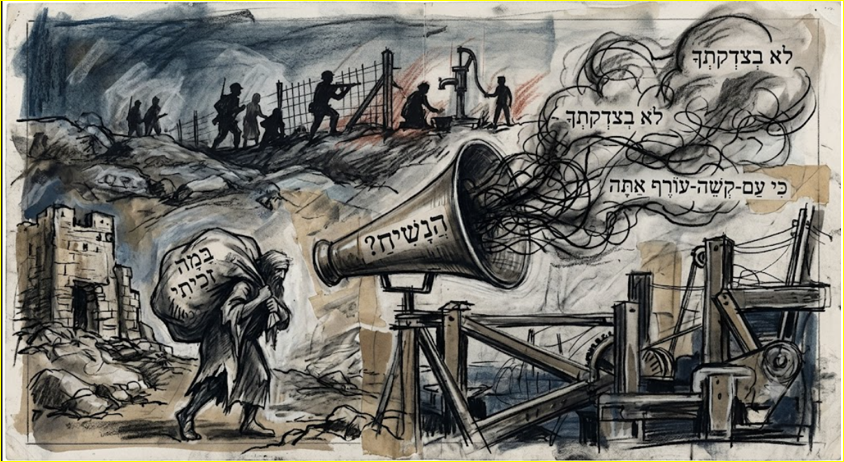
“It is not because of your virtues… that you will possess their land… for you are a stiff-necked people” (Deut. 9:5–6).
This is a radical statement. We do not deserve the land because we are righteous. Furthermore, when we act wickedly, we forfeit that claim.
This is not theoretical. When Jewish extremists commit acts of violence against Palestinians, this is not patriotism—it is terrorism. When such actions are justified in religious language, and/or defended or overlooked by the government, we corrupt our collective souls. The latest threat is that of an Intifada. If it takes place it will be of our own causing.
The story of Jacob rebuking Shimon and Levi after their massacre at Shechem echoes powerfully here:
“You have brought trouble on me, making me odious among the inhabitants of the land” (Gen. 34:30).
Their justification—“Should our sister be treated like a whore?”—is the language of wounded honor. It is dangerous and has no end in sight—except one of tragedy.
A Warning from the Past—and the Present
Moses insists that we remember our own failures: the Golden Calf, the rebellions in the wilderness, our persistent defiance. The message is clear: we are not inherently better than others.
And yet today, a zealous minority acts with certainty that God is on their side, pushing an agenda of domination, displacement, and exclusion. Under the banner of “patriotism,” they erode democratic institutions, spread conspiracy theories, and silence dissent.
This is not strength. It is the beginning of decay.
Civilizations rarely collapse from external threats alone. They fall from arrogance, moral complacency, and internal division. The real danger is not only what is happening around us—but what is happening within us.
The Test We Are Failing
The central lesson of Ekev is not about military victory. It is about moral responsibility. This land is not a reward. It is a trust. If we exploit the vulnerable, ignore the suffering of others, or justify cruelty in the name of security, we risk losing not only our moral standing—but our right to remain here.
As we read in Eicha (Lamentations), especially poignant during these seven weeks of comfort after Tisha B’Av:
“Let us search and examine our ways, and turn back to the LORD” (Lam. 3:40).
That is the real test—not whether we can defeat our enemies, but whether we can remain worthy of the land we inhabit.
A Final Thought
We are living in a decisive moment. If we do not awaken, speak out, and hold ourselves accountable, we may find ourselves repeating the darkest chapters of our history—where destruction comes not from outside, but from within.

Gemini image for ekev in style of J.M.W Turner This image captures the Turneresque style, blending dramatic atmosphere with a landscape that evokes the Biblical land while representing the family described here.
Yet since this is the three weeks of comfort, I should end on a more positive note:
In this week’s parsha there is a verse that always resonates with me:
When you have eaten your fill, give thanks to Adonai your God for the good land which God has given you (Deuteronomy 8:10).
It is also part of birkat hamazon (Grace, the blessing after eating) when we thank God for our food. Knowing all this has always made me aware of the blessings that I have received. I take nothing for granted. At age almost 83 I can be both pessimistic but also be grateful that “there for the grace of God, go I.”
Shabbat shalom!
Related Topics
Related Posts